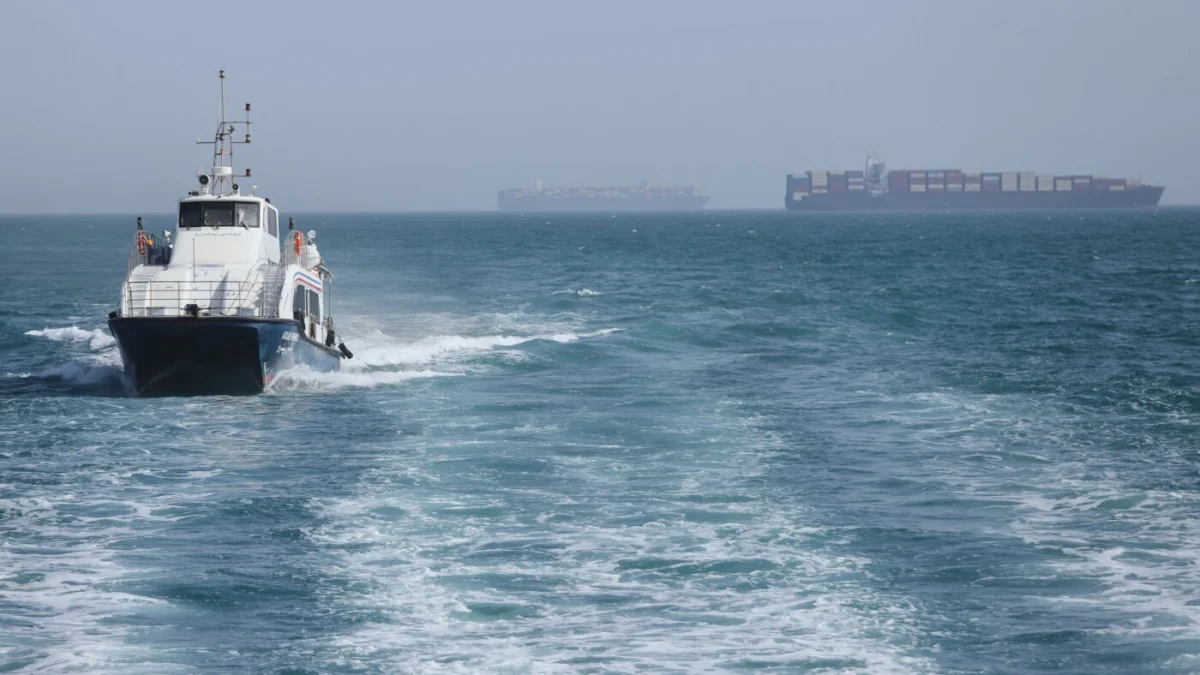
According to NPR reporting and official statements cited in the report, the United States military announced on Monday that it had successfully facilitated the transit of two merchant ships through the Strait of Hormuz, a critical global energy chokepoint. Concurrently, the United Arab Emirates reported that it was actively defending against missile and drone attacks originating from Iran, marking the first such assaults since a tentative ceasefire was established in early April. These developments suggest a potential escalation of hostilities as the U.S. endeavors to restore unimpeded passage through the vital waterway.
Sources indicate that the Iranian attacks were likely a direct response to President Donald Trump’s latest initiative aimed at reopening the Strait of Hormuz. The U.S. military confirmed that two American-flagged merchant vessels completed their passage through the strait as part of this new operation. The UAE’s Ministry of Defense stated that Iran launched four cruise missiles, with three being intercepted and one falling into the sea. Additionally, authorities in Fujairah, an eastern emirate, reported that an Iranian drone caused a fire at a significant oil facility, resulting in injuries to three Indian nationals. The British military also reported that two cargo vessels sustained damage from fires off the coast of the UAE.
Reestablishing free passage through the Strait of Hormuz is seen as crucial for alleviating global economic concerns and diminishing Iran’s leverage. However, such efforts carry the significant risk of reigniting the full-scale conflict that erupted following the initial U.S. and Israeli attacks on Iran on February 28, which prompted Iran to close the strait. The ongoing conflict has already had considerable economic repercussions, with the war’s effects rippling across the global economy.
Reports of these renewed attacks have cast doubt on the willingness of shipping companies and their insurers to undertake the risks associated with transiting the strait. Iran has previously targeted vessels in the waterway and has vowed to continue such actions. Tehran views the new U.S. initiative as a violation of the fragile ceasefire that had been in place for over three weeks, underscoring the precarious nature of the current situation.
The closure of the Strait of Hormuz, which lies between Iran and Oman, has significantly impacted global fuel prices and destabilized the world economy. The U.S.-led Joint Maritime Information Center had advised ships on Monday to navigate through Omani waters, announcing the establishment of an “enhanced security area.” Admiral Brad Cooper, commander of U.S. Central Command, informed reporters that American forces had successfully cleared a passage through the strait, removing Iranian mines. He detailed that Iran had deployed multiple cruise missiles, drones, and small boats targeting civilian vessels under U.S. protection.
Admiral Cooper further stated that U.S. military helicopters engaged and sank six of the small Iranian boats, emphasizing that all threats were neutralized. He asserted that U.S. commanders on the ground possess the necessary authority to defend their units and commercial shipping, as demonstrated by the day’s events. President Trump had previously warned on Sunday that any Iranian attempts to impede passage through the strait would be met with forceful action. He characterized the U.S. effort, dubbed “Project Freedom,” as a humanitarian mission designed to assist hundreds of seafarers stranded in the Persian Gulf since the conflict began.
Iran’s state-run IRNA news agency dismissed the U.S. initiative as a product of Trump’s “delirium.” The UAE strongly condemned what it termed “renewed treacherous Iranian aggression” and demanded an immediate cessation of the attacks. For the first time since the ceasefire commenced, four missile alerts were issued in the UAE, prompting residents to seek shelter. Commercial flights bound for Dubai and Abu Dhabi, major global travel hubs, were rerouted mid-flight. The full extent of the attack on Fujairah remained unclear, but the emirate is a key terminal for a pipeline used by the UAE to bypass shipping oil through the Strait of Hormuz. Fujairah, situated on the Gulf of Oman, hosts extensive oil storage facilities and serves as the UAE’s primary maritime access point outside the strait.
The UAE’s Ministry of Foreign Affairs issued a statement on X, describing the attacks as a “dangerous escalation and an unacceptable violation.” Meanwhile, Iran’s military command has issued warnings that any vessels transiting the strait must coordinate with Iranian forces. Major General Ali Abdollahi told state broadcaster IRIB, “We warn that any foreign military force — especially the aggressive U.S. military — that intends to approach or enter the Strait of Hormuz will be targeted.”
The South Korean government reported an explosion and fire aboard a South Korean-operated ship anchored in the strait near the UAE. No injuries were reported in this incident. It remains unconfirmed whether this vessel was among those damaged and reported ablaze by the British military’s United Kingdom Maritime Trade Operations center. President Trump mentioned on social media that Iran had “taken some shot” at a South Korean cargo ship, without providing further details.
The UAE also accused Iran of targeting a tanker associated with its primary oil company with two drones as it navigated the strait, though the timing of this attack was not specified. No injuries were reported in that incident. The disruption of this vital waterway has severely impacted European and Asian nations reliant on oil and gas from the Persian Gulf, leading to significant price increases across the region. The U.S. has warned shipping firms that they could face sanctions for paying Iran for transit rights through the strait.
Since April 13, the U.S. has maintained a naval blockade on Iranian ports, compelling at least 49 commercial ships to turn back, according to Central Command. This blockade aims to deprive Tehran of crucial oil revenue needed to support its struggling economy. U.S. officials have expressed hope that this economic pressure will compel Iran to make concessions in ongoing negotiations concerning its nuclear program and other long-standing disputes.
Negotiations have seen limited progress. Iran’s latest proposal for ending the war reportedly includes demands for the U.S. to lift sanctions, end the blockade, withdraw forces from the region, and cease all hostilities, including Israeli operations in Lebanon, according to the semiofficial Nour News and Tasnim agencies. Iranian officials stated they were reviewing the U.S. response, although Foreign Ministry spokesperson Esmail Baghaei indicated on Monday that shifting demands were complicating diplomatic efforts, without providing specific details. Iran asserts that its proposal does not encompass issues related to its nuclear program or enriched uranium, which have been central to tensions with the U.S. and Israel. Iran seeks a resolution to these other matters within 30 days to end the war rather than merely extend the ceasefire. President Trump expressed skepticism over the weekend regarding the likelihood of the proposal leading to a comprehensive agreement.