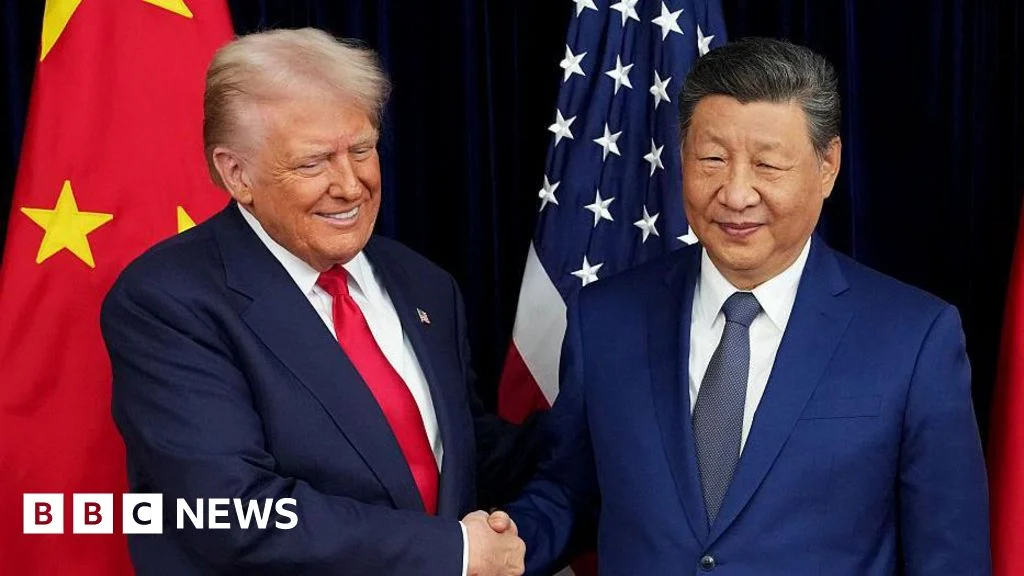
Beijing has officially confirmed that United States President Donald Trump is scheduled to visit China this week, with his itinerary including a meeting with President Xi Jinping. This visit, slated for May 13-15, marks the first time a sitting US president has traveled to China in almost a decade. The timing is particularly significant, occurring at a critical juncture for the relationship between the world's two largest economies.
Accompanying President Trump on this trip are expected to be executives from several prominent American corporations, including giants like Boeing, Citigroup, and Qualcomm. Their presence suggests a potential focus on forging new business deals with Chinese enterprises during the visit. More broadly, the summit is poised to serve as a crucial assessment of the delicate trade truce that currently exists between Washington and Beijing.
In April 2025, President Trump initiated a policy of imposing broad import taxes on a wide range of countries, regardless of their alliances or rivalries with the United States. A significant consequence of this policy was the escalation of a tit-for-tat trade war between the US and China, leading to reciprocal tariffs that ultimately exceeded 100% on many goods. These escalating tariffs were temporarily suspended following the last in-person meeting between President Trump and President Xi in South Korea in October. However, both nations have continued to issue threats regarding future trade actions, keeping the situation volatile.
The origins of this trade conflict can be traced back to President Trump's 2016 election campaign, during which he pledged to renegotiate trade agreements to be more favorable to the US and to stimulate the return of manufacturing jobs to the country. In 2018, his administration announced tariffs on approximately $250 billion worth of Chinese imports, a move widely regarded by analysts as the catalyst for the trade war. In the same year, President Trump also implemented tariffs on other major trading partners, such as Mexico, Canada, and European nations, asserting that these countries were exploiting the United States.
According to Ning Leng, a policy researcher at Georgetown University, these sweeping measures came as a considerable surprise, particularly to China. Leng noted that it was the first time China had seriously engaged with President Trump's trade policies, and they likely did not anticipate him following through with such extensive tariffs. At that particular time, China's economy was considerably more dependent on trade with the United States. The US served as a primary importer of manufactured goods from China, placing Chinese industries and their workforces at risk should American buyers reduce their purchases due to the imposed tariffs.
These trade tensions exacerbated pre-existing challenges that had been impacting China's economy for years, including subdued domestic consumer spending, elevated unemployment rates, and a protracted property market crisis. Exports to the US had provided a vital lifeline for maintaining Chinese employment, but President Trump's trade actions placed this crucial outlet in jeopardy. Leng further commented that it is inherently more difficult for a nation to withstand a trade war with a country with which it maintains a significant trade surplus.
Upon assuming office in 2021, President Joe Biden maintained a firm stance on trade relations with Beijing. His administration opted not to remove the tariffs imposed by the Trump administration on China, sharing a common objective of limiting China's growth, particularly in strategic sectors like technology. President Biden also implemented restrictions on various Chinese technology firms, notably including the telecommunications giant Huawei, which faced significant limitations in the US market citing national security concerns. Furthermore, the administration placed TikTok under intense scrutiny, ultimately leading to its US operations being separated from its Chinese parent company.
Chinese electric vehicles (EVs) also encountered substantial barriers to entering the US market, effectively being blocked by the imposition of heavy tariffs under the Biden administration. Tang Heiwai, an economist at the University of Hong Kong, suggested that while President Trump is often perceived as being tough on China, there is a case to be made that President Biden's approach has been even more protectionist in certain aspects.
President Trump intensified his tariff policies upon returning to office in 2025. He introduced a 20% tariff on goods from China, citing the country's alleged role in facilitating the influx of the drug fentanyl into the United States. On a day he termed "Liberation Day," President Trump enacted a 34% levy on Chinese imports, resulting in some of the highest tariff rates applied to any country. These measures sent shockwaves through Chinese businesses, leading to stockpiles of goods accumulating in warehouses, while American companies struggled to secure alternative sources of supply.
Beijing responded swiftly with retaliatory measures, including the imposition of duties on key US agricultural products, which directly impacted American farmers, a significant demographic within President Trump's voter base. However, President Trump's strategy appeared to overlook China's near-monopoly on the global supply of rare earth elements, which are indispensable for the production of a vast array of products, from smartphones to advanced military aircraft. President Trump had employed tariffs as a tool to compel countries into making trade deals favorable to the US, but he could not afford to alienate key industries reliant on China's raw material exports. This situation necessitated a shift towards negotiation.
A meeting between President Trump and President Xi in October resulted in Beijing agreeing to suspend its export controls on rare earths, which was viewed as a significant concession for President Trump. He also claimed to have secured an agreement for China to commence immediate purchases of US agricultural and other farm products, sectors that form the backbone of the American economy. In exchange for these concessions, Washington agreed to reduce some of the tariffs it had imposed on China concerning the flow of ingredients used in the production of the synthetic opioid fentanyl. Planned increases to reciprocal tariffs were also put on hold. In the subsequent weeks after this meeting, restrictions on the sale of advanced semiconductors to China were eased, although this did not extend to the most cutting-edge chip technologies.
While a temporary truce on tariffs was established last year, a permanent resolution to the broader trade dispute has remained elusive. China's substantial investments in its manufacturing sector mean its businesses are compelled to seek export markets due to persistently weak domestic demand, according to Tang Heiwai. "It will need the US. There's no single country as big as them as a consumer market," Tang stated, highlighting the critical role of the US market for Chinese exports.
However, China is entering the current meeting from a position of considerable strength. Its export figures have reached record highs, a testament to its success in cultivating new trading partnerships globally as its economic ties with the US have become more strained. Furthermore, Beijing has continued to invest heavily in advanced technologies such as robotics and is actively pursuing efforts to develop its own sophisticated chips, thereby reducing its reliance on Western technology firms like Nvidia.
On the US side, the Trump administration is expected to press Beijing for increased purchases of goods from key American industries, including agricultural products like soybeans and components for aircraft manufacturing. This visit, however, occurs amidst a setback for President Trump's trade policies, as the US Supreme Court recently invalidated his "Liberation Day" tariffs. In response, he has resorted to a separate legal provision to implement a temporary 10% levy on all countries while initiating investigations into China and other nations for alleged unfair trade practices. Furthermore, a US trade court ruled just last week that the most recent global tariffs were not adequately justified, potentially opening the door for future legal challenges.
The ongoing conflict in Iran is undeniably expected to be a significant topic of discussion during the Trump-Xi meeting. China, possessing vast oil reserves and diversified energy sources, has thus far appeared to navigate the economic fallout of the conflict more effectively than many of its regional neighbors. As a major oil producer, and with most of its imported crude oil sourced from Russia, China has been somewhat insulated from the direct impact of the conflict. This has helped cushion the economic effects, despite Beijing being Iran's largest oil customer. Nevertheless, there are indications that the prolonged conflict is beginning to strain the Chinese economy, prompting senior officials to pledge robust measures to safeguard China's energy security and supply chains, according to policy analyst Lyle Morris. Consequently, while both Beijing and Washington may have incentives to seek an end to the conflict, their fundamental perspectives on Iran differ significantly, and the global community will be closely observing how, or if, they manage to bridge these divides.
China has demonstrated resilience in weathering President Trump's tariffs, but the ongoing conflict in Iran is now presenting new economic challenges. The situation in Iran is unsettling for China and its broader economic ambitions, raising questions about the strategic game plan for navigating these complex geopolitical and economic pressures.


