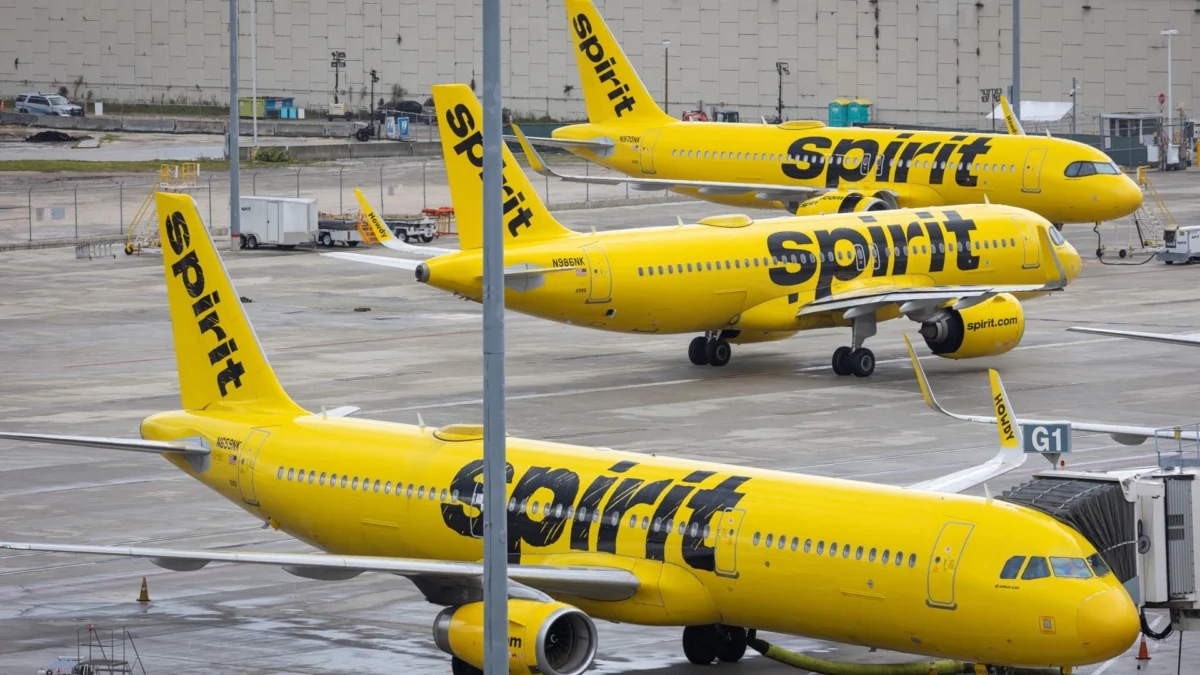
Spirit Airlines has officially ceased all flight operations, marking the end of an era for the prominent U.S. discount carrier. The shutdown occurred before dawn on Saturday, following the failure to secure a last-minute bailout agreement with bondholders and the Trump administration. This development brings a close to the airline's prolonged struggle, which included its second bankruptcy filing in less than a year.
The iconic budget airline, instantly recognizable by its bright yellow planes, had become a symbol of affordable air travel in the United States. While often the subject of jokes for its extensive list of fees for ancillary services, Spirit Airlines pioneered a no-frills, low-fare model that made flying accessible to millions of Americans. The message displayed upon opening the Spirit Airlines app confirmed the grim reality: "We regret to inform you that all Spirit Airlines flights have been canceled, effective immediately."
Spirit's demise is attributed to a confluence of factors that have plagued the South Florida-based carrier for years. These include a failed merger attempt, evolving consumer preferences, intense competition within the airline industry, and escalating operational costs. Most recently, a significant surge in jet fuel prices, exacerbated by geopolitical tensions in the Middle East, proved to be the final blow.
The immediate consequence of the shutdown is the loss of jobs for approximately 17,000 direct and indirect employees. The airline's financial situation had become increasingly precarious, with its legal counsel, Marshall Huebner, informing a bankruptcy court in New York on April 23 that the company's cash reserves were rapidly dwindling. Spirit has stated that it will automatically issue refunds for flights purchased with credit or debit cards.
For decades, Spirit Airlines served as a catalyst for competitive pricing, keeping other carriers on their toes with its aggressively low fares. The airline had maintained profitability for a considerable period, but a combination of rapid expansion, rising expenses, and post-pandemic market dynamics eventually eroded its financial stability. Industry experts anticipate that the absence of Spirit Airlines could lead to increased airfares in certain markets, although the carrier had already significantly reduced its flight schedule in recent months.
Spirit's final flight, NK1833 from Detroit to Dallas Fort Worth International Airport, a journey of two hours and 39 minutes, touched down shortly after midnight local time, according to data from the company and Flightradar24. Over the preceding day, Spirit Airlines transported more than 50,000 passengers.
"For more than 30 years, Spirit Airlines has played a pioneering role in making travel more accessible and bringing people together while driving affordability across the industry," stated Dave Davis, Spirit's chief executive, in the company's official shutdown announcement. Davis extended his gratitude to the Trump administration, particularly Commerce Secretary Howard Lutnick, for their efforts to support the airline's survival.
Earlier discussions indicated that the airline was bracing for closure after failing to secure the necessary financial lifeline. Sources close to the matter, who requested anonymity as they were not authorized to discuss the ongoing negotiations, revealed that the airline had initially anticipated emerging from bankruptcy protection by midyear. However, the sharp increase in fuel prices presented an insurmountable obstacle, compounding the airline's existing challenges.
Jet fuel costs have seen a dramatic escalation, with prices doubling in some regions since late February, following military actions involving the U.S., Israel, and Iran. "The sudden and sustained rise in fuel prices in recent weeks ultimately has left us with no alternative but to pursue an orderly wind-down of the Company," Davis explained. He further elaborated that sustaining operations would have required hundreds of millions of dollars in additional liquidity, which Spirit was unable to secure. "This is tremendously disappointing and not the outcome any of us wanted," he added.
Following the Trump administration's engagement in bailout talks for Spirit, other low-fare carriers, including Frontier Airlines and Avelo, had also sought approximately $2.5 billion in federal assistance to mitigate the impact of higher fuel costs. Spirit had also expressed its commitment to working with its vendors throughout the wind-down process, promising direct communication regarding next steps and assuring that any outstanding claims would be handled through the bankruptcy proceedings.
Earlier in the month, the Trump administration had proposed a $500 million loan package, which could have resulted in the government acquiring up to a 90% stake in the airline. However, negotiations with bondholders regarding this government-backed bailout ultimately failed to reach a conclusive agreement this week. Some political opposition to the bailout emerged, with certain Republican figures and Transportation Secretary Sean Duffy expressing reservations. Duffy, in an interview with Reuters, voiced concerns about the potential of "put[ting] good money after bad," given Spirit's history of financial difficulties and its inability to achieve consistent profitability.
President Donald Trump had indicated on Friday that his administration had presented a "final" bailout proposal. Despite these efforts, disagreements over the terms between bondholders and the government led to the collapse of the deal. Trump commented to reporters that the administration was attempting to negotiate a tough deal, acknowledging that it was a situation where the outcome was uncertain. He suggested that other lenders might be obstructing the agreement, potentially due to concerns about their priority in the repayment hierarchy. "We come first," Trump stated, emphasizing the administration's position.
In response to the shutdown, other airlines have stepped in to assist Spirit's stranded passengers and crew members. Southwest Airlines announced it would offer discounted fares for travelers on routes overlapping with Spirit's network. These fares were set at $200 for flights up to 500 miles, $300 for flights between 500 and 1,000 miles, and $400 for flights exceeding 1,000 miles. United Airlines also committed to capping fares for Spirit customers at $299, with most fares priced at $199, and provided specific instructions for stranded crew members. American Airlines, JetBlue Airways, and Frontier Airlines also prepared to offer similar rescue fares.
As of February, Spirit Airlines carried approximately 1.7 million U.S. domestic passengers, representing a 3.9% market share, according to aviation data firm Cirium. This share had decreased from 5.1% the previous year, reflecting the airline's cost-cutting measures, which included the reduction of flight services.


