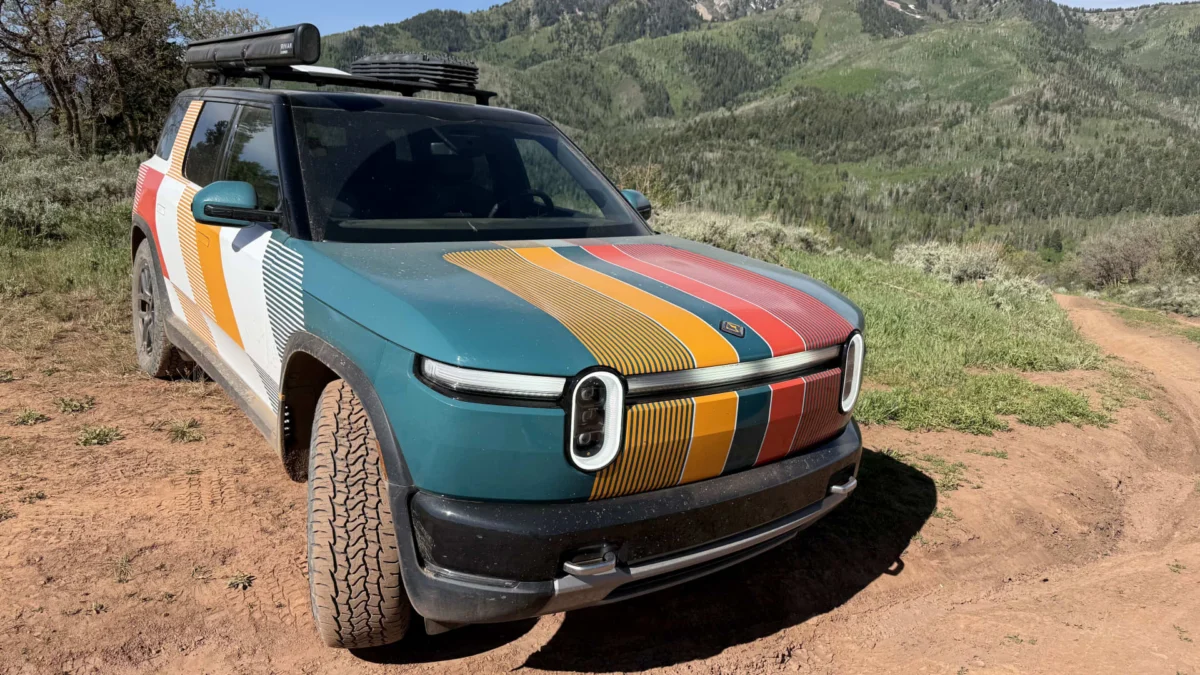
Rivian is officially launching its R2 electric vehicle, with customer deliveries beginning Tuesday, and it has moved forward its entry-level model to next summer from late 2027. The R2 SUV is designed to transform Rivian from a niche automaker specializing in luxury EVs into a mainstream brand that can compete not only with Tesla but also with established players like Jeep and Subaru. Rivian CEO RJ Scaringe said the vehicle is intended to be a high-volume product, and he emphasized that the broader opportunity extends well beyond Tesla’s customer base, describing the non-Tesla market as “many, many times larger.”
At the R2 launch event in Park City, Utah on June 2, 2026, Scaringe walked through the vehicle’s suspension and software systems and highlighted how the R2 will underpin Rivian’s shift toward higher-volume production. He noted that a roughly $45,000 entry-level model is being accelerated to next summer, a move intended to broaden the company’s appeal beyond its current California- and EV-friendly markets. While acknowledging the excitement around the base trim, Scaringe also pointed out that many customers ultimately opt for higher-margin configurations, emphasizing that the economics of the business depend on volume-driven profitability.
Rivian’s profit trajectory hinges on achieving scale, with the company having warned that the current plan to build 160,000 units at its Normal, Illinois plant may not be enough to reach per-unit profitability. Scaringe said Georgia’s new plant is central to altering that scale, arguing that the Georgia facility would generate the necessary volume and gross margin to cover the full cost of production. He also stated that as production volumes rise, Rivian would begin reducing its burn rate. The Georgia ramp is planned to begin with the R2 and expand to include other models as the site reaches full operation later in the decade.
In the near term, Rivian’s production mix is expected to include the R1T pickup, R1 and R2 SUVs, the R3 crossover, robotaxis, and delivery vans once the Georgia plant is fully up and running. The company has indicated it will offer additional vehicles built on the R2 platform, expanding its lineup beyond the current model. Scaringe stressed that the R2 program is designed to be cash-flow positive at the vehicle level, with base prices starting around $45,000 and ranges up to about $58,000. He cited that every R2 model will be cash-flow positive for Rivian, calling it a requirement for the business model. He also noted that while the base trim garners attention, the higher-margin variants drive the economics of the operation.
Despite the R2’s arrival, Rivian remains under market scrutiny. Wall Street analysts have described the R2 as a make-or-break moment for Rivian, likening it to Tesla’s shift from high-priced, first-generation EVs to the mainstream Model 3 and Model Y. Shares traded lower intraday as the timing shift for the entry-level model and early reviews of the R2 came to light.
Rivian posted a loss of about $3.6 billion last year while delivering 42,247 vehicles, and the company had previously pledged profitability on an adjusted basis by 2027, a target it withdrew earlier this year without a new timeline. The company’s automotive segment also posted a negative per-vehicle margin in the first quarter. Scaringe reaffirmed to CNBC that profitability is still the aim with the Georgia ramp, which he expects to reach its full capacity by the end of the decade.
A key part of the R2’s economics is Georgia’s scale. Scaringe said, “Georgia brings the volume to generate the gross margin for the vehicle sales that covers everything,” and he added that the project would help Rivian “start to really reduce our burn rate.” He explained that once the Georgia plant is fully operational, Rivian’s production would include the R1T, R1 and R2 SUVs, R3, robotaxis, and delivery vans, with additional models based on the R2 platform contemplated.
Rivian has also said it has cut the R2’s build-material costs in half and reduced production complexity, achieving other major efficiency gains as the vehicle’s development progressed. Scaringe stated that every R2 model — with starting prices ranging from roughly $45,000 to $58,000 — would be cash-flow positive for the company, underscoring the model’s centrality to Rivian’s broader strategy. He added that the base trim’s notoriety is offset by the fact that higher-trim configurations drive the economics while the base trim is rarely the final choice for most buyers.
Looking ahead, Scaringe projected that once full production is online, the R2 would push the company toward a pricing sweet spot in the low $50,000s. Cox Automotive data suggested that this price point would place Rivian just above the U.S. average selling price for EVs but below the broader EV average selling price, with demand leaning into the compact and midsize SUV segments. The R2’s size and price position it in a highly competitive portion of the market, where the Tesla Model Y has dominated the category.
Rivian’s software ambitions remain a pillar of the strategy. The company has a multibillion-dollar deal with Volkswagen that includes Rivian’s software and electrical architecture for VW’s future EVs, underscoring the importance of software and in-vehicle technology alongside hardware. Volkswagen has become Rivian’s largest shareholder, followed by Amazon, which remains its biggest customer for delivery vehicles. The R2 will launch with an advanced driver-assistance system that will be largely self-driving under certain conditions, monitored by a driver, and over-the-air updates to software and services will continue to be central to Rivian’s value proposition as it aims to become a broader technology-driven automaker, not just a vehicle maker.
As Georgia comes online, Rivian anticipates a broader production mix, including the R1T, the R1 and R2 SUVs, the R3, robotaxis, and delivery vans, with additional R2-based models in development. The company’s emphasis on volume, margin, and software continues to shape investor expectations as Rivian seeks to broaden its market reach and improve its financial performance.


