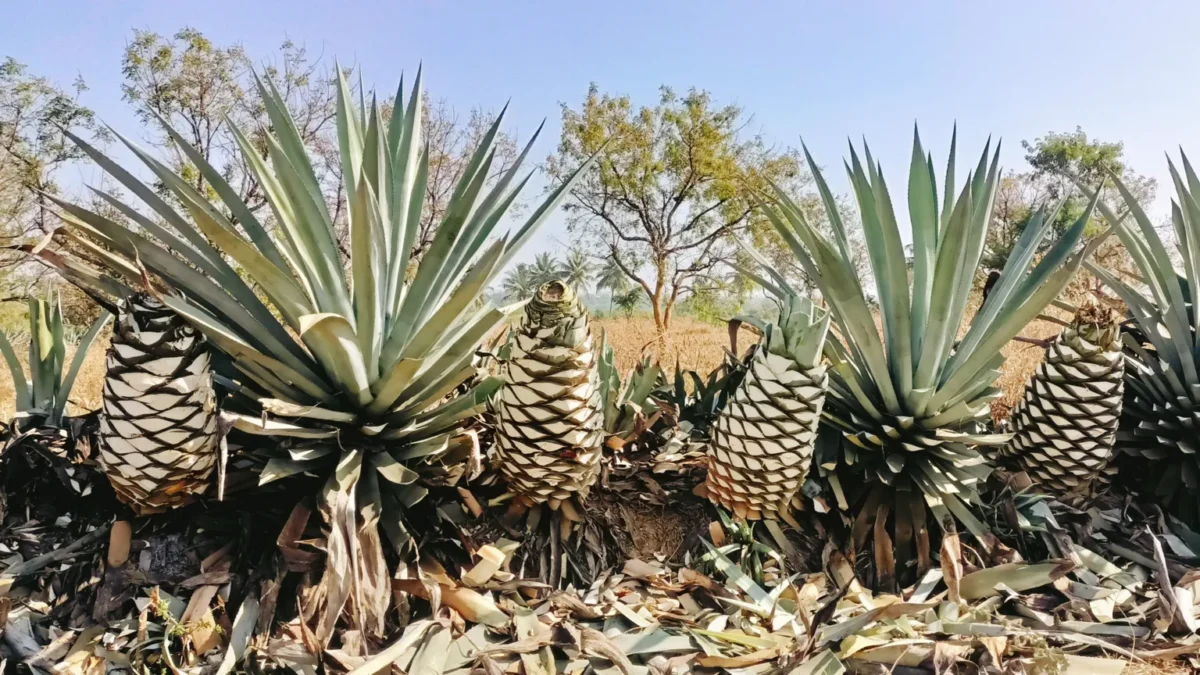
In the arid stretches of India’s Deccan Plateau, a quiet agricultural transformation is taking shape. What began in 2010 as a chance encounter with traders offering a cactus crop has evolved into a potential cornerstone for a domestic agave industry. For Masapalli Venkatesh, a 10-acre farmer from Kandukur, the humble agave plant—once dismissed as a weed—has become something more valuable: blue gold with the promise of sustaining a new products sector.
Venkatesh operates across about 100km (60 miles) of the plateau, coordinating a network of villagers and farmers to harvest agave that grows wild across marginal lands. The process hinges on precise timing. The piña, the heart of the plant that holds the sugars needed for distillation, must be harvested at the exact pre-bloom window. If the plant blooms, its stored sugars are quickly redirected upward, leaving little for alcohol production. Harvest teams must identify that narrow window and move the piñas to a pressure cooker within 24 hours to extract sugars before fermentation spoils the delicate flavor profile premium spirits demand.
Transport adds another layer of complexity. The supply network is scattered across large states such as Karnataka, Maharashtra, Rajasthan and Andhra Pradesh, so producers rely on a web of local aggregators rather than centralized cooperatives to scout, negotiate and harvest semi-wild patches. This logistical dance is shaping a nascent market for agave spirits in India, where industry players estimate a robust 31% annual growth in demand.
Industry voices say the surge in interest is more than novelty. “It’s only been a few years now that India’s finally caught the tequila bug,” notes Vikram Achanta, co-founder of 30 Best Bars India. While Aqave drinks are unlikely to replace whisky—the country’s longstanding favorite—experts anticipate that homegrown agave products could carve out a distinct market segment. The early stages are focused on experimentation with wild agave from the Deccan Plateau, with a longer view toward crafting an Indian agave identity.
Among the pioneers is Maya Pistola Agavepura, led by Rakshay Dhariwal. He recalls that the Indian agave story began with kitchen experiments: in 2011, Agave India launched India’s first homegrown agave spirit. After more than a decade of research and development, the venture established India’s first craft agave distillery, a testament to patient, incremental progress rather than overnight disruption.
The industry’s growth is tempered by concerns about supply. Agricultural experts say the domestic processing plant for agave hearts is still singular, and the wild stock remains capable of self-propagation. Braganza, an agricultural analyst, explains that a single Indian wild plant can seed a larger ecological network through root runners that form new plants over time. This natural propagation supports a potential expansion of supply without immediate depletion—but it also points to careful cultivation and selective breeding, a process large-scale producers in Mexico have refined over decades.
Some players argue that India’s agave system remains informal and unstandardized, unlike the expansive, technologically equipped farms in Mexico that employ drones and AI to monitor crop health and predict optimal harvest windows. Still, industry observers believe that with long-term vision and patience, the Deccan Plateau could host millions of acres suitable for agave cultivation—enough to rival established producers if the market and regulatory environment align with domestic demand.
The broader story is one of a possible reimagining of Indian alcohol culture. If the sector can transition from curiosity to credibility, agave could join a small group of localized craft spirits that reflect regional terroir and mechanical expertise. The journey from a weed in the field to a potential driver of a new drinks economy captures a broader shift in Indian agriculture and consumer tastes, one that may redraw the map of Indian alcohol production over the coming years.
As producers refine harvest timing, improve supply chains, and scale up small-batch distillation, investors and policymakers will watch closely whether this blue plant can sustain both rural livelihoods and a growing market for agave-based beverages in India. The coming years will reveal whether the blue gold story becomes a durable chapter in India’s evolving economy or remains an intriguing early-stage experiment.


