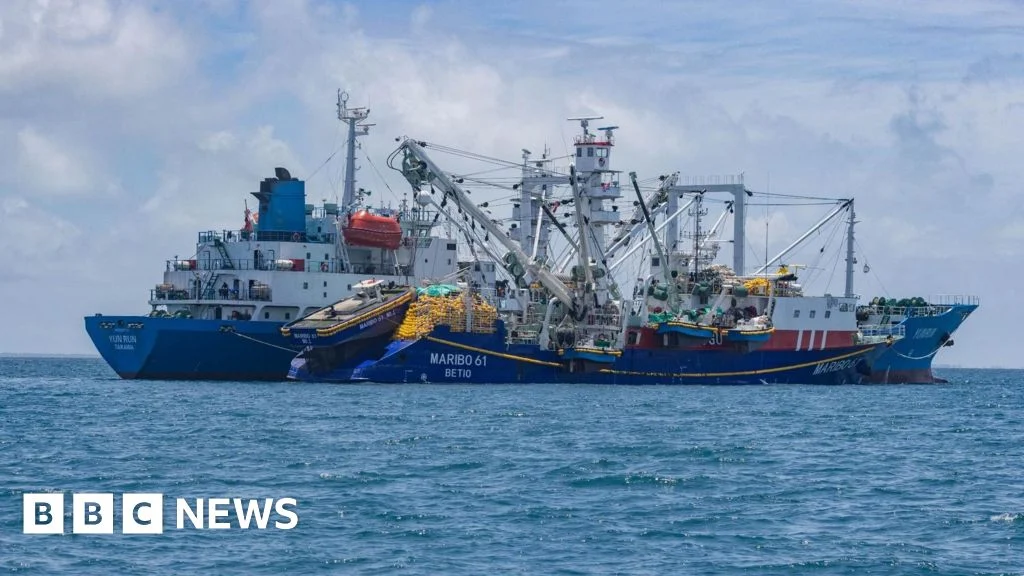
The vast Pacific Ocean, a critical source of global tuna supply, is facing unprecedented challenges due to climate change, directly threatening the economic stability of island nations like Kiribati. This low-lying archipelago, comprised of 33 scattered islands, derives over 70% of its government revenue from selling tuna fishing licenses to international fleets, a proportion higher than any other nation globally. Kiribati's landmass, collectively equivalent to the size of New York City, belies its expansive Exclusive Economic Zone (EEZ) of over 3.4 million square kilometers. This vast maritime territory, larger than India, is rich in marine life, including valuable tuna species.
However, the very ocean that sustains Kiribati's culture, livelihoods, and economy also presents its most significant threat. Rising ocean temperatures, a direct consequence of climate change, are imperiling tuna populations. Scientists express concern that tuna may permanently migrate from Kiribati's EEZ to cooler waters further east, diminishing the demand for fishing licenses from foreign fleets. Such a scenario would severely impact Kiribati's economy, which relies heavily on this income stream. The global tuna market is a multi-billion dollar industry, with foreign fleets requiring licenses to fish in Kiribati's waters. These licenses come with fees and strict regulations on catch limits and reporting.
In 2024, Kiribati generated approximately $137 million (£102 million) from the sale of these fishing licenses, according to government figures. Riibeta Abeta, permanent secretary for the Ministry of Fisheries, described this income as a "critical financial lifeline." Between 2018 and 2022, fishing licenses accounted for nearly three-quarters of the government's revenue, representing roughly two-fifths of Kiribati's entire Gross Domestic Product (GDP), as noted by the International Monetary Fund. Simon Diffey, a fisheries specialist with over three decades of experience in the region, highlighted the significance of the Western Central Pacific Ocean, stating that more than half of the world's tuna originates from this area, with Kiribati being a major contributor.
Diffey further explained that while Kiribati and Papua New Guinea are the primary players in the regional tuna market, Papua New Guinea possesses the land and resources to diversify its economy. Kiribati, in contrast, has limited land resources, with its highest natural point above sea level being only two meters. "No water, no land, no resources other than fish," Diffey stated, underscoring the nation's dependence on its marine wealth. Tuna are highly sensitive to water temperature fluctuations, reacting to changes as small as a tenth of a degree Celsius. As surface water temperatures in the Pacific rise, tuna are compelled to seek cooler environments, a migration that studies indicate will predominantly be eastward, away from many island nations, including Kiribati.
The potential for international fishing fleets to no longer require Kiribati's licenses introduces "significant volatility to the country's revenue," according to Abeta. A communique from the Pacific Community, a regional development organization, issued in November, identified Kiribati as one of the nations most vulnerable to tuna stock migration. Preliminary modeling by Kiribati's Ministry of Fisheries suggests that if global greenhouse gas emissions remain high, the country could lose over $10 million annually in fishing access fees by 2050. Conversely, under a best-case scenario with significantly lower emissions, the Ministry predicts no decrease in tuna biomass within Kiribati's EEZ.
Despite projections for international fishing revenue, local fishermen in Kiribati are expected to experience a decline in their catches under both high and low emission scenarios, according to the Pacific Community. The Line Islands are anticipated to be the most severely affected, potentially losing an estimated two-thirds of their catch even in a low-emission scenario. Simultaneously, Kiribati's population of approximately 130,000 is projected to grow, with rapid urbanization, particularly in the capital, Tarawa, intensifying pressure on the nation's already scarce land and resources. This demographic shift, coupled with declining fish stocks, exacerbates food security challenges.
As local fish supplies dwindle, households are increasingly dependent on imported foods. The UN's Food and Agriculture Organization warns that this reliance on imports raises costs and diminishes nutritional quality, especially for communities on outer islands where fish has traditionally been the primary protein source. The average person in Kiribati consumes around 100kg of fish annually, a stark contrast to the approximately 9kg consumed in the US and 22kg in Japan, as reported by Simon Diffey. This high per capita consumption highlights the critical role of fish in the Kiribati diet and economy.
In response to these mounting challenges, new support initiatives are being implemented. The United Nations' Green Climate Fund (GCF) launched a $156.8 million (£116 million) project last year aimed at helping Pacific Island communities and economies adapt to climate change. This initiative, covering 14 countries and territories, seeks to strengthen food security through improved information and early warning systems. Hemant Mandal, GCF director for Asia and the Pacific, stated that the project is "helping Pacific Island countries get ahead of climate change by strengthening their food security based on better information." The goal is to enable nations like Kiribati to better anticipate tuna stock redistribution and its economic ramifications, while also ensuring food security and government revenue despite declining reef fisheries.
These adaptive measures are projected to provide approximately four million nutritious fish meals annually to communities in Kiribati, according to the Ministry of Fisheries. The Kiribati government is also actively pursuing strategies to bolster its tuna industry by expanding its own processing and canning facilities, rather than solely relying on selling licenses to foreign vessels. Abeta indicated that the administration is exploring ocean farming of species such as milkfish, snapper, and sea cucumbers to boost both exports and domestic food security. Furthermore, Kiribati is endeavoring to diversify its revenue streams beyond the marine sector, exploring opportunities in tourism, renewable energy, and managing its offshore sovereign wealth fund.
"Kiribati retains grounds for optimism and strategic opportunity," Abeta remarked, reflecting a cautious hope for the future. Nevertheless, the nation and its territorial waters confront an existential threat from the escalating impacts of climate change. The delicate balance of its economy, intrinsically linked to the health of its tuna stocks and the predictability of its marine environment, is under severe strain. The long-term viability of Kiribati's economic backbone hinges on global efforts to mitigate climate change and the success of its own adaptive strategies in the face of profound environmental shifts.


