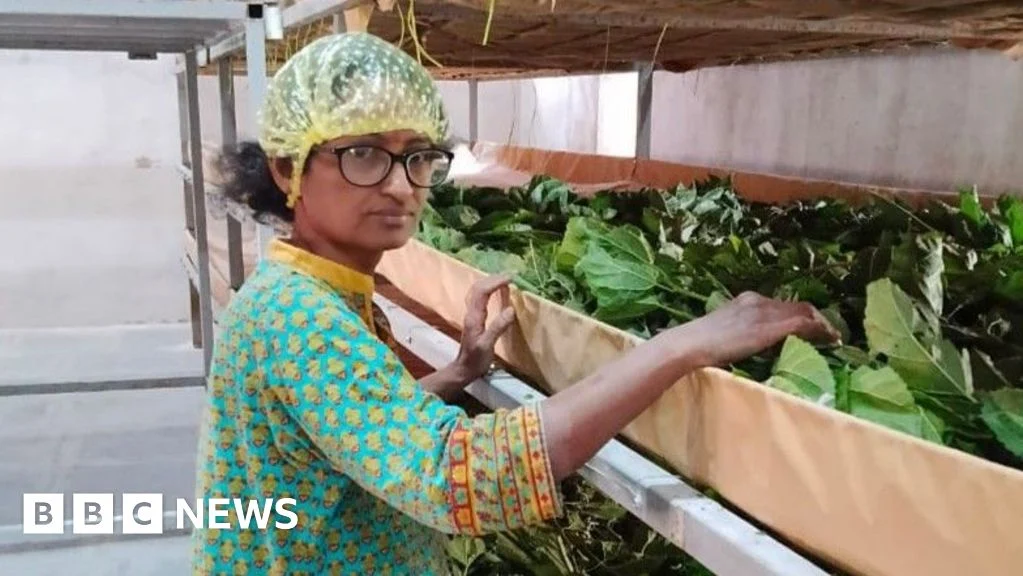
Six years ago, Dr. Jolapuram Umamaheswari transitioned from a career as a scientist in Singapore to pursue entrepreneurship in India. Seeking to be her own boss, she identified silk farming, or sericulture, as a promising venture. This practice involves cultivating silkworms by feeding them mulberry leaves, harvesting their cocoons, and then extracting the silk fibers. Dr. Umamaheswari viewed sericulture as an application of scientific principles, stating, "Silk farming sits at a rare intersection of biology, precision, and business. It didn't feel like I was leaving science, it felt like I was applying it differently."
Her initial foray into silkworm cultivation on her farm in the eastern state of Andhra Pradesh presented significant challenges. "The early days were not easy. There were disease outbreaks, inconsistent yields, and the steep learning curve that comes with managing living systems," she recalled. However, her scientific background proved instrumental in overcoming these hurdles. Through incremental improvements in hygiene, feeding protocols, and environmental management, she observed enhanced silkworm survival rates and a higher quality of cocoons.
Currently, Dr. Umamaheswari successfully manages ten silk crops annually, with each silkworm batch requiring a growth cycle of 25 to 30 days. This consistent production yields an income of approximately $1,000 (£760) per month. She highlighted the financial predictability of sericulture, noting, "The result is like a steady, almost salary-like income. That's what makes sericulture unique, If managed well, it gives you regular returns, not just seasonal income."
Krishna Tomala, founder of Asho Farms, described the current state of modern sericulture as a period of substantial digital and biotechnological advancement. Asho Farms has integrated cutting-edge technology across its operations, from the production of silkworm eggs to the supply of larvae and the rearing of cocoons. Tomala emphasized the critical environmental factors for silkworm development, explaining, "A silkworm grows nearly a thousand times in just 25 days. But its success depends completely on temperature, humidity and good-quality leaves."
Silkworms are highly susceptible to environmental fluctuations. While temperature and humidity were historically monitored manually, contemporary sericulture employs sensors and automated systems that regulate fans, heaters, and humidifiers. Asho Farms utilizes artificial intelligence for crop monitoring. Tomala elaborated, "I use computer vision and machine learning. Cameras can detect early signs of diseases in silkworm larvae with over 99% accuracy, which helps remove the infected worm immediately before the entire lot is infected."
India ranks as the world's second-largest silk producer, trailing only China, which dominates the global market. However, India distinguishes itself with an extensive array of silk products and unique varieties. Manthira Moorthy, a director at the Central Silk Board, stated, "India is the only country in the world where all four commercial varieties of silk – Mulberry, Tasar, Eri, and Muga – are available. Muga silk, in particular, is unique to India, primarily found in Assam and Meghalaya."
The future of India's silk industry is being shaped by advancements in genetic research. Genome editing is being employed to develop more resilient silkworm strains. Moorthy mentioned, "We have entered a new era of research focusing on genome editing. In collaboration with international partners like Japan, we have developed disease-resistant silkworm varieties." The Central Silk Board is also exploring innovative uses for silk production by-products. For instance, the approximately 2kg of dried silkworm pupae generated for every kilogram of raw silk produced are rich in protein and are being utilized as feed for poultry and fish.
Satheesh Kannur, whose company specializes in reeling—the process of transforming cocoons into raw silk yarn—explained that modern machinery has mechanized this stage, efficiently extracting silk fibers and combining them into strong threads. A single machine can produce between 50kg and 60kg of raw silk daily. Kannur observed, "Technology is transforming silk reeling from a slow, manual craft into a fast, precision-driven industry, while solar power is quietly making it more sustainable."
Despite technological progress, Kannur expressed concerns about the industry's future, particularly regarding the supply of cocoons from farmers. He noted, "Without cocoons, there is no silk. The entire industry depends on farmers. Many second-generation farmers are not willing to continue silk framing and the landholdings are spread in small sections. For this industry to grow we need huge lands."
The Silk Board, however, remains optimistic, attributing rising cocoon production to modern techniques despite a potential decline in farmer numbers. A statement from the Board indicated, "With advancements in rearing techniques, disease control, and scientific support to farmers, yield per acre has gone up significantly."
Meanwhile, Dr. Umamaheswari is diversifying her farm operations in Andhra Pradesh by adding a cow shed. This expansion is expected to generate additional income from milk sales and provide manure to fertilize her mulberry plants. She reiterated the value of incremental improvements, stating, "Even small improvements in technique can significantly increase yield and quality, making it a rewarding field for someone who likes to apply knowledge practically."


