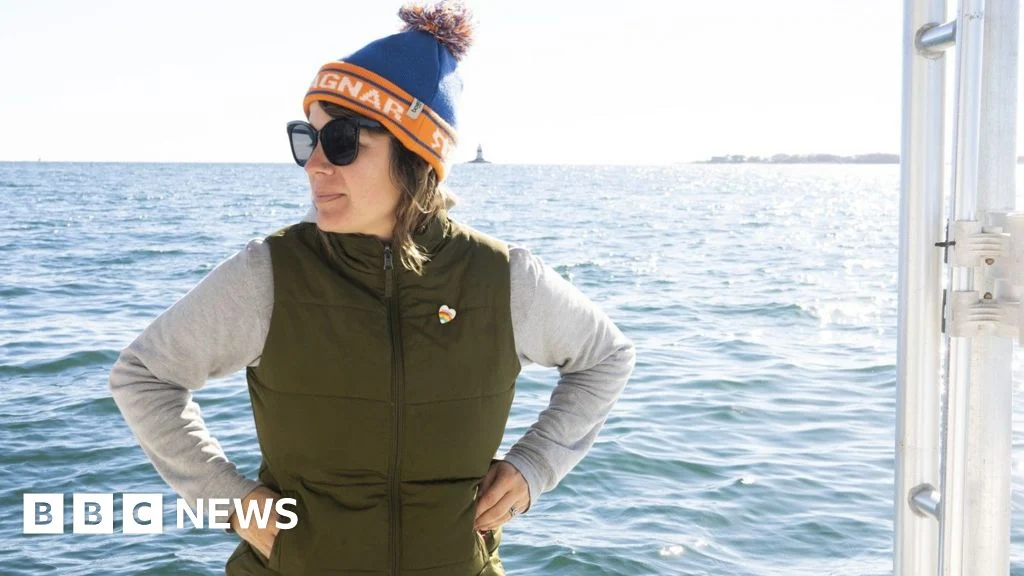
Suzie Flores, armed with an English degree and a former career in academic publishing in Manhattan, has traded her city commute for the rugged coast of Connecticut. She now runs the Stonington Kelp Company from a marina she and her husband purchased, aiming to cultivate and popularize sugar kelp, a type of seaweed, along the Atlantic. Her journey began a decade ago, a period of introspection following the birth of her third child and a growing dissatisfaction with her corporate life. Questioning her legacy, Flores, alongside her husband Jay, a former combat photographer who retrained as an engineer after his military service, relocated to the coast. They acquired a dilapidated marina, and Flores enrolled in environmental science courses. Her path soon intersected with Dr. Charlie Yarish, a University of Connecticut biologist recognized for his pioneering work in seaweed farming in the United States. Dr. Yarish's prompt reply and guidance towards GreenWave, a non-profit organization assisting new farmers with the complex permitting process, solidified her resolve. Flores described the period as feeling "1000%" aligned, despite the logistical challenges of coordinating phone calls with a newborn strapped to her chest.
Upon harvesting her inaugural crop, Flores encountered a significant market deficit: thousands of pounds of sugar kelp with no immediate buyers. This unforeseen hurdle, which she admitted might have deterred them had they known its extent, prompted her to proactively create demand. She began a determined outreach to farm-to-table restaurants, engaging chefs with the subtle, briny flavor profile of East Coast sugar kelp, distinguishing it from the chewier Pacific varieties often associated with Japanese kombu. This direct engagement proved successful, establishing a consistent demand that now results in her entire harvest selling out each season. High-end culinary establishments have become key clients, appreciating both the kelp's culinary versatility and its connection to local provenance.
David Standridge, the chef at The Shipwright's Daughter in Mystic, Connecticut, and a finalist for the James Beard Award for Outstanding Chef of the Year, is among Flores's satisfied customers. He highlights the seasonal appeal of sugar kelp, noting it as the first fresh "vegetable" available in New England each year, appearing weeks before terrestrial crops emerge. This allows him to offer a vibrant, local green option during the leanest part of the year. Standridge describes the kelp as having a "crunchy and light and salty and briny" texture that pairs well with a wide array of dishes due to its mild flavor. However, he finds the most compelling aspect to be its inherent connection to its growing environment, a quality akin to "terroir" in wine or "merroir" in oysters. He explains that even in dishes where the kelp's flavor might not be overtly detectable, it imparts a distinct "more like the ocean" essence.
Flores's experience, while successful, underscores a larger challenge facing the US seaweed industry. The nation relies heavily on imports, sourcing over 90% of its seaweed, primarily from Asian countries with long-established cultivation traditions. North American production remains a small fraction of the global output. While the number of domestic seaweed farms has steadily increased, the supporting infrastructure for processing, distribution, and market development has not kept pace. The industry's growth is thus constrained not just by cultivation but by the capacity to bring the product to consumers at scale and build sufficient demand to ensure farmer viability.
Beyond market challenges, seaweed farming on the East Coast involves significant on-water risks. The recent winter presented extreme conditions, including storms with winds reaching 70 mph and severe freezes that encased surface equipment in ice. Despite these surface challenges, strong underwater currents persisted, leading to the breakage of cultivation lines. Flores estimates a loss of 40–50% of her crop due to these conditions, adding to the approximately 30% loss that farmers are now advised to anticipate annually. The reduced yield from these losses, paradoxically, contributed to her farm selling out its available product. For the upcoming season, Flores plans to incorporate strategies to mitigate the impact of such severe winter weather.
The environmental benefits of sugar kelp cultivation are a significant motivator for Flores. As the seaweed grows, it actively absorbs excess nitrogen from the water, thereby improving water quality and creating vital habitat for marine organisms. She has observed blue mussels colonizing her farm lines and schools of fish congregating beneath them, attracting seabirds. This ecological contribution is central to her vision for the business. Furthermore, Flores sees her work as contributing to the revitalization of coastal communities like Stonington, which has seen its traditional fishing industry, particularly lobstering, significantly decline. The aging fishing fleet and the collapse of the lobster fishery highlight the need for new, sustainable economic opportunities.
Flores envisions a decentralized network of small, family-operated kelp farms rather than a single large corporate entity. This model aligns with the gradual expansion of oyster aquaculture observed along the New England coast. Kelp farming offers an attractive supplementary income for existing fishermen, who already possess the necessary boats and equipment, and can be conducted during the off-season. The upfront investment required for kelp farming is relatively low, making it an accessible venture. While her own business has experienced steady, rather than explosive, growth, Flores remains optimistic, viewing it as consistent progress in the right direction.
In addition to managing her farm, Flores actively engages in educational outreach. She serves as a guest speaker at Yale University and conducts seaweed-focused units in local school culinary programs. She notes that younger students are often initially hesitant but typically develop an affinity for seaweed once it is incorporated into familiar dishes, such as macaroni and cheese. Her own children have grown up with the farm as a backdrop to their lives, taking boat trips to school for granted. Flores's primary aspiration for them is not necessarily to follow in her footsteps in the business, but to have the freedom to pursue work that they find personally meaningful. She emphasizes the importance of self-awareness in choosing a career path that brings joy, a lesson she learned firsthand after leaving her Manhattan office.
Flores draws a parallel between kelp and the iconic lobster roll, suggesting seaweed could become a future staple. However, she quickly revises this, acknowledging the significant decline of the lobster population, partly attributed to human activities. This reflection underscores her commitment to fostering a more sustainable future through kelp cultivation. She believes that seaweed can play a crucial role in rebuilding a more resilient ocean ecosystem and supporting the economic vitality of coastal communities. Her efforts extend beyond her own farm, aiming to cultivate a broader appreciation and market for this versatile, environmentally beneficial marine resource, ensuring the health of both the ocean and the towns that depend on it.
The cultivation of sugar kelp offers a compelling environmental proposition. As the seaweed grows, it acts as a natural filter, absorbing excess nitrogen and other pollutants from the water. This process not only improves water quality but also helps to mitigate the effects of eutrophication, which can lead to harmful algal blooms and dead zones. The submerged kelp lines also provide essential habitat and shelter for a variety of marine life, including small fish and invertebrates. This creates a more biodiverse underwater environment, supporting the broader marine food web. The presence of these ecosystems can, in turn, attract more desirable species, potentially benefiting recreational and commercial fishing in the long term.
From an economic perspective, kelp farming presents a diversification opportunity for coastal communities historically reliant on single, often volatile, fisheries. The ability to integrate kelp cultivation with existing fishing operations, utilizing existing infrastructure and expertise, reduces barriers to entry and spreads economic risk. This is particularly important in regions where traditional fisheries are facing challenges due to climate change, overfishing, or shifting market demands. By providing an alternative or supplementary income stream, kelp farming can help stabilize local economies and retain skilled workers in the maritime sector. The development of a robust domestic seaweed supply chain, encompassing cultivation, processing, and distribution, is crucial for realizing these economic benefits at scale.
Flores's dedication extends to advocating for the broader acceptance and integration of seaweed into the American diet. This involves not only educating consumers and chefs about its culinary merits but also addressing potential misconceptions and barriers to adoption. The development of convenient, accessible seaweed products for everyday consumption, alongside its use in fine dining, will be key to expanding the market. Furthermore, ongoing research and development into the diverse applications of seaweed, from food and feed to biofuels and bioplastics, could unlock significant new markets and further bolster the economic viability of seaweed farming. This multi-faceted approach is essential for transforming seaweed from a niche product into a mainstream component of a sustainable food system.


