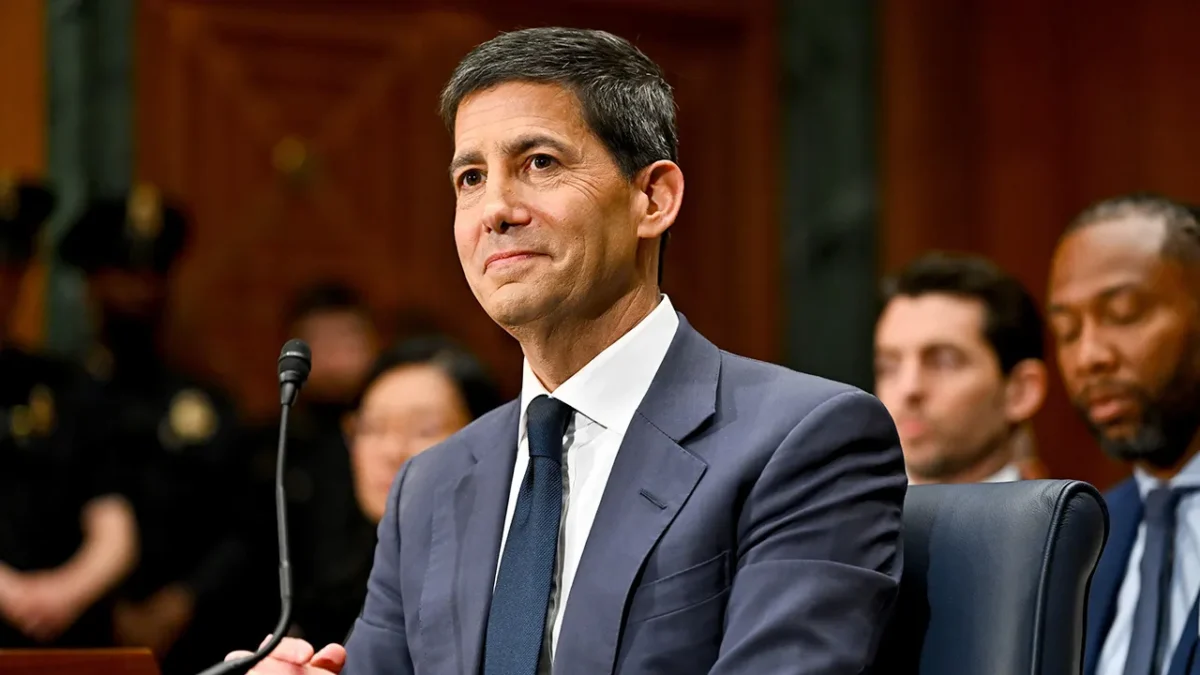
Federal Reserve Chair Kevin Warsh told members of the House Financial Services Committee that policymakers at the central bank maintain a firm stance: there is “no tolerance for persistently elevated inflation.” In his prepared remarks, Warsh said concerns about inflation helped justify keeping the benchmark federal funds rate at a steady range of 3.50% to 3.75% at the Fed’s June meeting. He stressed that the Fed’s number one objective is to get monetary policy right “– or as near to it as we possibly can. That is our clear and constant aim, the star we steer by.” He added, “And if we get policy right – and we will – the inflation surge of the last five years will be a thing of the past.” Warsh also noted that while monthly price fluctuations are inevitable in an unsettled world, underlying inflation over longer horizons is largely shaped by monetary policy. He underscored that “The members of our Committee have no tolerance for persistently elevated inflation,” and he linked that stance to a broader commitment to restoring price stability.
The hearing also touched on the Fed’s independence. Warsh was asked how he would react if President Donald Trump targeted him or other policymakers to influence rate policy. He replied that the Fed is an independent central bank, a point he said the Supreme Court had recently affirmed. “The Supreme Court said that the Federal Reserve and the conduct of monetary policy is independent. To the extent there were questions about it, the Court answered those questions,” Warsh said, adding he would continue to do his job if the president tried to fire him. He later said, “I want there to be no politics here. To the extent there’s politics there, we’re going to get rid of them.”
On the dual mandate, Warsh argued that the Fed will remain attentive to both employment and price stability, though he acknowledged that the inflation objective is farther from its goal at present. “In my view, the two parts of the mandate are not in conflict. This is not an either-or proposition. The more we can do to deliver low and stable prices, the more employers are going to want to hire more workers,” he said. He added, “You gave us a remit, we take both parts of it seriously.” Looking ahead, Warsh noted that the labor markets appear balanced, though “we’ve got some work to do on the inflation front.”
The hearing also touched on AI’s economic implications. Warsh described AI as potentially the most significant change in the economy in his adult lifetime, offering opportunities and challenges. He warned that central banks must monitor risks as technology spreads, while also acknowledging the United States’ leadership in AI development—thanks to human and financial capital concentrated here. He cautioned that risks exist if AI technologies fall into adversaries’ hands and that doing so could test the Fed and financial institutions’ infrastructure as bad actors seek to exploit the tools.
Warsh’s testimony comes as the Fed’s policy stance remains under scrutiny from lawmakers who are weighing the path for future rate moves and the central bank’s independence in a politically charged environment. The market will be watching closely for signals on whether inflation pressures ease and how the Fed plans to balance its dual mandate while the economy adjusts to evolving technological innovations.


