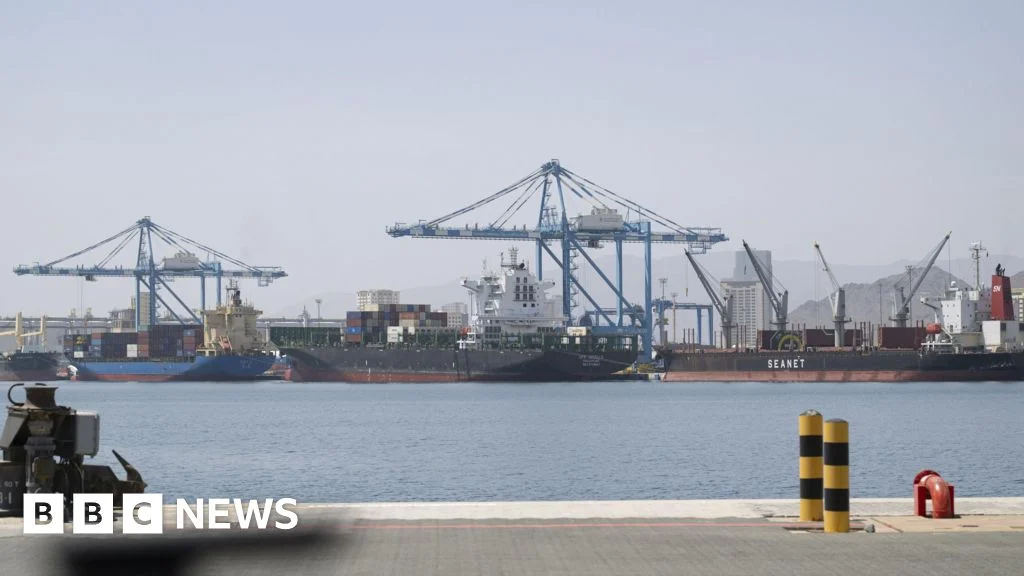
According to BBC reporting and official statements cited in the report, the United States military has engaged and struck seven Iranian “fast boats” in the Strait of Hormuz, according to President Donald Trump. This action comes as Washington aims to facilitate the passage of stranded vessels through the strategically vital waterway, which has been largely impassable. The developments on Monday also included reports from the United Arab Emirates and South Korea detailing strikes on ships operating within the critical channel. The UAE further reported that an Iranian attack led to a significant fire at its oil port of Fujairah.
Shipping company Maersk confirmed that one of its vessels, flying the US flag, successfully navigated out of the Strait of Hormuz under the protection of the US military. This operation was part of what President Trump has termed “Project Freedom.” However, Iranian Foreign Minister Abbas Araghchi offered a contrasting perspective, stating that the events in the strait underscore the absence of a military resolution to political crises. He characterized “Project Freedom” as “Project Deadlock,” suggesting it would not achieve its intended outcome.
Maersk elaborated on its vessel’s transit, assuring that the operation was “completed without incident, and all crew members are safe and unharmed.” The Strait of Hormuz has experienced significant disruptions and blockades since the US and Israel initiated air strikes against Iran in February. In response, Tehran implemented measures to obstruct this crucial shipping lane, through which approximately 20% of the global supply of oil and liquefied natural gas typically flows.
An initial ceasefire was announced in early April between the US and Iran. This agreement saw Iran cease its drone and missile attacks targeting Gulf nations, including the UAE. Despite this truce, the passage of vessels through the Strait of Hormuz has remained severely limited. The United States also imposed its own blockade on Iranian ports, further complicating maritime traffic.
President Trump asserted the US action, stating, “We’ve shot down seven small boats or, as they like to call them, ‘fast’ boats. It’s all they have left.” The US military confirmed that helicopters were deployed to carry out the strikes on the boats. However, Iranian state media later presented a different account. Citing a military source, the Tasnim news agency reported that two small cargo vessels were struck instead, resulting in the deaths of five civilians.
Earlier on Monday, the US military had announced that its navy destroyers and US-flagged merchant ships had successfully sailed through the Strait of Hormuz. Iran vehemently denied these claims, labeling them “entirely false.” Iran’s military asserted that it had fired warning shots at a US warship, a statement that the US military subsequently refuted.
Later in the day, shipping firm Maersk provided an update on its US-flagged vessel, the Alliance Fairfax. This ship had been stranded in the Gulf since the US and Israeli military actions against Iran at the end of February. Maersk stated that the US had contacted the company and offered the vessel the opportunity to exit the Gulf under US military escort. The firm confirmed that the vessel subsequently departed the Persian Gulf accompanied by US military assets.
Concurrently, the UAE’s Ministry of Foreign Affairs reported that a tanker associated with Adnoc, the UAE’s state-owned oil company, was struck within the Strait of Hormuz. South Korea also reported an explosion aboard one of its vessels that was anchored just offshore the UAE. UAE authorities further indicated that their air defense systems had engaged a significant number of aerial threats, including 12 ballistic missiles, three cruise missiles, and four drones.
Local officials confirmed that one of the strikes resulted in a large fire and three injuries at the crucial oil port of Fujairah. India’s Ministry of External Affairs stated that the three individuals injured in the Fujairah attack were Indian nationals and described the attack as “unacceptable.” Abu Dhabi condemned the attacks as a “dangerous escalation” and asserted its right to respond.
Iranian state television quoted an unnamed military official who stated that Iran had “no plans to target the UAE.” International leaders have widely condemned the attacks on UAE infrastructure. French President Emmanuel Macron denounced the strikes as “unjustified and unacceptable.” British Prime Minister Sir Keir Starmer affirmed the UK’s continued support for the defense of its partners in the Gulf. German Chancellor Friedrich Merz called for an end to the blockade of the strait, urging Tehran to return to negotiations and cease holding the region and the world hostage.
Saudi Arabia’s Ministry of Foreign Affairs issued a statement via X, calling on Iran to “respect the principles of good neighborliness.” In response to the news of the attack on Fujairah, the benchmark Brent crude oil price surged past $115 a barrel, marking an increase of over 5% for the day. Fujairah is strategically located on the UAE’s eastern coast, bordering the Gulf of Oman and situated beyond the Strait of Hormuz. A critical pipeline originating from Abu Dhabi’s oilfields terminates in Fujairah, enabling the loading of crude oil onto tankers for shipment to global markets, even when the strait is effectively blockaded.
Neighboring Qatar condemned the attack on the Adnoc-affiliated tanker and demanded the “unconditional reopening” of the strait. In Oman, state media reported that two individuals sustained injuries when a residential building in Bukha, a coastal area along the Strait of Hormuz, was targeted. These incidents follow President Trump’s announcement on Sunday regarding “Project Freedom,” which aims to assist stranded vessels in exiting the shipping lane. An estimated 20,000 seafarers aboard approximately 2,000 ships have been trapped since the conflict between the US and Iran began in February.
President Trump indicated that numerous countries worldwide had requested US assistance in freeing their ships, which he described as “locked up in the Strait of Hormuz” and “merely neutral and innocent bystanders.” Concerns have been mounting regarding the depletion of supplies and the detrimental effects on the physical and mental well-being of the trapped sailors. President Trump did not specify the exact methods for freeing these vessels but warned of the use of force if the “humanitarian process is interfered with.”


