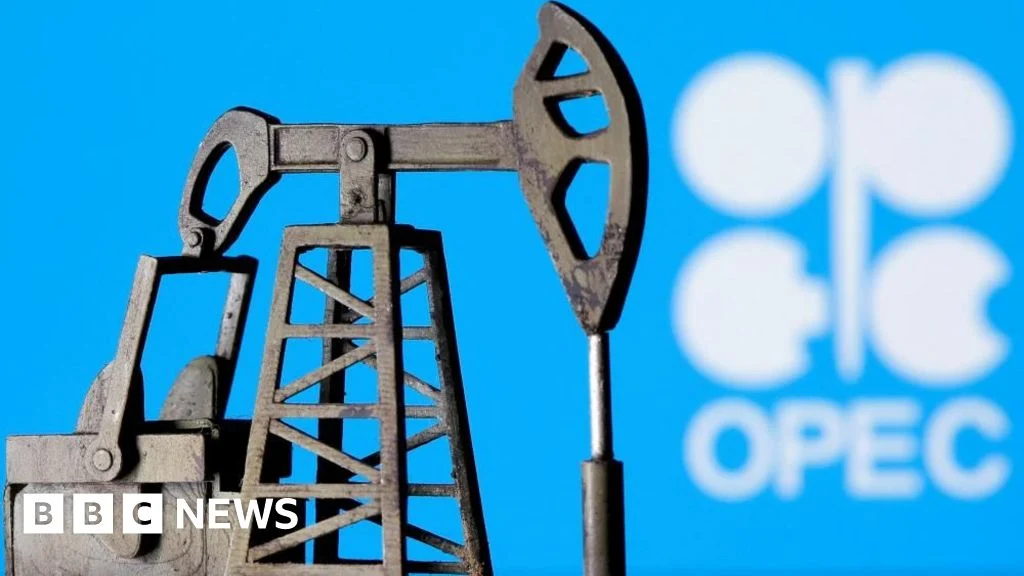
The United Arab Emirates (UAE) has signaled its intention to leave the Organization of the Petroleum Exporting Countries (OPEC), a move that analysts suggest could significantly diminish the cartel's sway over global oil prices. This decision arrives amidst a period of considerable turbulence in the oil market, exacerbated by geopolitical events that have led to substantial disruptions in oil supply. The UAE's potential solo trajectory puts new attention on OPEC's future effectiveness in managing oil production and influencing market dynamics.
OPEC, established in 1960 by Iran, Iraq, Kuwait, Saudi Arabia, and Venezuela, was founded with the primary objective of safeguarding the economic interests of major oil-exporting nations. Its core strategy involves coordinating production levels among member states to ensure stable revenue streams. Over the decades, the organization's membership has evolved, incorporating nations such as Algeria, Equatorial Guinea, Gabon, Libya, Nigeria, and the Republic of the Congo. A significant expansion occurred in 2016 when OPEC formed an alliance with ten other oil-producing countries, including Russia, to create the broader OPEC+ group, aimed at addressing market stability during periods of low oil prices.
The fundamental mechanism through which OPEC exerts influence on oil prices is by collectively agreeing on production quotas for its member states. When members decide to increase supply, the intention is to lower prices by ensuring an abundant availability of oil. Conversely, when production is curtailed, the objective is to support higher price levels, particularly when demand is weaker. Historical precedents illustrate OPEC's impact: during the 1973 Yom Kippur War, Arab oil producers imposed an embargo on nations supporting Israel, coupled with coordinated production cuts. This led to a more than doubling of oil prices, widespread fuel rationing, and significant economic repercussions, further compounded by the 1979 Iranian Revolution, which triggered a second oil shock. More recently, in response to the sharp decline in crude oil prices during the COVID-19 pandemic, OPEC+ implemented substantial production cuts to bolster prices. However, the group's reaction to the surge in oil prices following Russia's full-scale invasion of Ukraine in early 2022 was more measured, initially pledging a slight increase in production before enacting further cuts later that year.
Despite OPEC's historical role, its ability to consistently dictate oil prices has faced challenges. Critics, including former US President Donald Trump, have argued that the organization has manipulated supply to maintain artificially high prices. Maurizio Carulli, a global energy analyst at Quilter Cheviot, notes that OPEC's influence has "varied" over the past few decades. A persistent issue has been the difficulty in ensuring member compliance with agreed-upon production targets. Individual nations have often exceeded their quotas to capture a larger market share or fallen short due to operational challenges, a phenomenon Carulli describes as "widespread," citing instances where countries like Kazakhstan and the UAE have increased production beyond agreed levels.
The UAE stands as a significant player within the global oil export landscape. According to the latest OPEC data, it was the third-largest oil exporter in 2025, trailing only Saudi Arabia and Iraq. This ranking, however, does not fully capture the impact of recent geopolitical events that have dramatically affected oil exports and driven crude prices higher. The Strait of Hormuz, a critical chokepoint through which approximately one-fifth of the world's oil and liquefied natural gas typically flows, has been effectively closed for an extended period. Despite this disruption, Carulli suggests that the UAE's departure from OPEC will have a negligible short-term effect on its exports, and the OPEC+ decision to increase production is largely symbolic given the current transit constraints.
In terms of production volume, the UAE ranks as OPEC's fourth-largest oil producer. OPEC data indicates that the UAE produced an average of 3.1 million barrels of oil per day in 2025. For comparison, Saudi Arabia, widely considered OPEC's de facto leader, produced over nine million barrels per day during the same period. Following its exit from OPEC, projections suggest that the UAE could potentially increase its daily oil production by approximately one million barrels. This ambition is underscored by the state-owned oil company Adnoc's announcement, made shortly after the UAE declared its intention to leave OPEC, of accelerating its growth plans through projects valued at $55 billion slated for execution between 2026 and 2028.
OPEC's overall significance in the world oil markets has diminished compared to its peak influence in the 1970s, primarily because its share of internationally traded oil has decreased. Furthermore, the relative importance of oil to the global economy has also declined. As of 2025, OPEC countries accounted for 36.7% of global crude oil production, a notable decrease from over half (52.5%) in 1973, according to OPEC's own figures. Non-OPEC nations, including the United States, Canada, and Brazil, have absorbed some of this reduced market share, as noted by Maurizio Carulli. The United States has been the world's leading oil producer since 2018, extracting 13.6 million barrels per day last year. Russia, a key member of the OPEC+ alliance, also remains a major producer, ranking as the second-largest crude producer in 2025 with 9.1 million barrels per day.
Carulli further observes that influence over oil prices has recently "shifted" towards the United States. This shift is partly attributed to the inability of Gulf members of OPEC to export their produced oil while the Strait of Hormuz remains closed. Charles-Henry Monchau, Chief Investment Officer at the Swiss private bank Syz Group, views the UAE's departure as marking "the end of OPEC as we knew it." He acknowledges that the cartel has weathered significant global events, such as the Iran-Iraq War and the economic collapse of Venezuela. However, he posits that the loss of a major producer that has been part of the organization since its foundational era represents an unprecedented challenge. Monchau anticipates that while OPEC will continue to exist, its capacity to set global oil prices will be "materially less."
The UAE's decision to leave OPEC represents a significant development in the global energy landscape. While the immediate impact on oil exports may be limited by current transit restrictions, the long-term implications for OPEC's influence and its ability to manage global oil supply and prices are substantial. The organization's effectiveness has always been contingent on the cooperation and commitment of its key members, and the departure of a major producer like the UAE introduces a new dynamic that could reshape market power. The rise of non-OPEC producers, particularly the United States, has already altered the balance, and the UAE's independent strategy could further fragment the market and reduce the cartel's cohesive power. The coming months and years will reveal the extent to which OPEC can adapt to this new reality and maintain its relevance in an evolving energy world.


