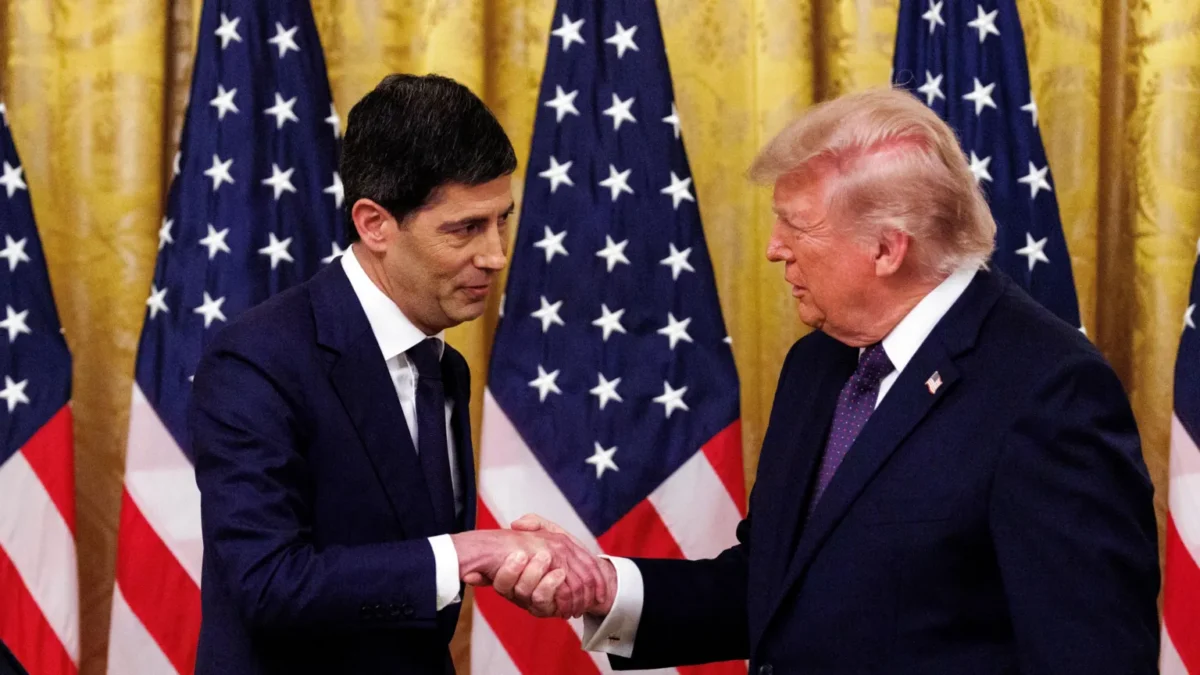
White House Swearing-In Ceremony
President Donald Trump presided over the swearing-in ceremony for incoming Federal Reserve Chairman Kevin Warsh at the White House on Friday. This event marked a significant moment, being the first time the White House has hosted such a ceremony for a Fed chair since Alan Greenspan in 1987, highlighting President Trump’s considerable investment in Warsh’s appointment. During the ceremony, President Trump publicly urged Warsh to uphold complete independence in his role, stating, “I really mean this, I want Kevin to be totally independent. Don’t look at me, don’t look at anybody, just do your own thing and do a great job, okay.” The US president, who repeatedly and publicly clashed with Warsh’s predecessor Jerome Powell, said he wants his latest pick to ignore outside opinions. The president’s decision to host the ceremony at the White House, the first time the building has been used to swear in a Fed chair since Alan Greenspan in 1987, shows the president’s investment in Warsh’s appointment.
Economic Policy and Fed Independence
The president’s emphasis on independence for the Federal Reserve chair is particularly noteworthy, given his past frequent calls for the central bank to lower interest rates to stimulate economic growth. In the lead-up to Warsh’s confirmation, Trump had consistently advocated for an immediate reduction in U.S. borrowing costs, stating that support for such a move would be a requirement for any candidate seeking a leadership position at the Fed. However, the central bank has defied Trump and delayed expected rate cuts as it weighs the impact of the U.S.-Israel war in Iran on inflation dynamics.
The Federal Reserve’s benchmark interest rate was held within the range of 3.5% to 3.75% in April. Current economic projections suggest the rate will likely remain at this level for the remainder of 2026, with some analysts even forecasting a potential increase. Higher interest rates generally make borrowing more expensive for consumers, which helps to curb inflation by slowing down overall spending and economic activity.
Warsh’s Mandate and Challenges
Critics of Warsh’s appointment, including senior Democrat Senator Elizabeth Warren, had warned he would be little more than a “sock puppet” for President Trump. Despite these criticisms, Warsh has vowed to lead a “reform-oriented” Federal Reserve. He conveyed to President Trump his belief that his tenure could usher in an era of “unmatched prosperity” that would elevate living standards for Americans across various socioeconomic backgrounds. Warsh, a former Wall Street banker, faces the complex task of navigating a divided economic landscape while simultaneously assuring skeptical politicians and the public of the Federal Reserve’s autonomy from White House influence. President Trump also called for Warsh to let the economy “boom” during his tenure, and stated that the central bank had “lost its way” under Powell’s leadership. He further elaborated that the bank had become distracted by issues unrelated to its core purposes of stable prices, low inflation, and full employment, straying into areas such as climate change and diversity, equity, and inclusion (DEI) initiatives.
Warsh’s confirmation hearing and subsequent appointment have been subjects of significant attention, with discussions ranging from his past associations to his policy stances. The Senate’s confirmation of Warsh as the new Fed chair signifies a key development in the ongoing narrative surrounding U.S. monetary policy and its relationship with the executive branch. The central bank’s independence is a cornerstone of its credibility, and Warsh’s ability to uphold this principle while addressing economic challenges will be closely watched by markets and policymakers alike.


