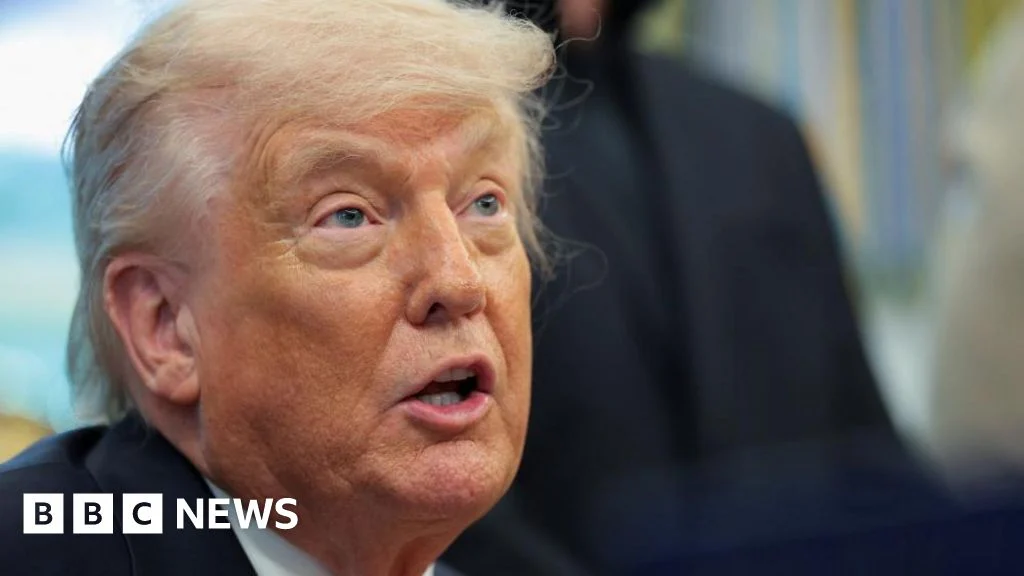
President Donald Trump has issued an ultimatum to the European Union, demanding the bloc eliminate its tariffs on U.S. goods by July 4. Failure to comply, he stated, will result in significantly "much higher" tariffs imposed by the United States on EU imports. This deadline was communicated following a phone call with European Commission President Ursula von der Leyen.
Trump indicated that he agreed to grant the EU until "our Country's 250th Birthday" to meet this demand. He warned that if the condition is not met, tariffs would "immediately jump to much higher levels." This threat comes as negotiations over an existing trade agreement continue to face hurdles.
Ursula von der Leyen, speaking after the call, acknowledged the deadline but stated that the EU is making "good progress towards tariff reduction." She expressed commitment to the implementation of the trade deal, a sentiment echoed by other EU officials involved in the talks.
Adding a layer of complexity to the situation, a U.S. trade court ruled on Thursday that Trump's recent 10% global tariffs were not justified under existing U.S. trade law. This ruling could potentially open the door for future legal challenges against the administration's tariff policies.
A trade deal between the U.S. and the EU was initially reached last July. However, the process of enacting it encountered a setback on Wednesday when talks between EU lawmakers and national governments concluded without a final agreement. This stalled progress has fueled Trump's recent threats.
Under the terms of the agreement, U.S. tariffs on exports originating from the EU were set to face a 15% tariff. This was a point of contention, as Trump had previously threatened tariffs as high as 30% on a range of European goods.
The European Parliament granted conditional approval to the trade deal in March. Lawmakers backed legislation to implement the agreement but included several safeguards. These safeguards were designed to ensure that the U.S. would uphold its end of the bargain, particularly concerning tariffs on steel and aluminum.
Specifically, European Parliamentarians stipulated that they would only accept zero tariffs on U.S. goods if European products made with steel and aluminum were exempted from Trump's existing 50% global tariff on those specific metal products. This condition highlights the sensitivity around key industrial sectors.
Despite the European Parliament's conditional backing, the trade deal requires the endorsement of all 27 member states within the EU. This multi-layered approval process has contributed to the delays in its full implementation.
Bernd Lange, the European Parliament's chief negotiator, commented earlier on Thursday, prior to Trump's public statement, that negotiations were progressing well between lawmakers and governments. However, he also noted that "there is still some way to go" before a final consensus is reached.
Negotiators are scheduled to reconvene for another round of discussions on May 19 in Strasbourg. Lange reiterated the commitment to advancing and defending the Parliament's mandate, aiming to provide additional guarantees that would benefit both EU and U.S. citizens and companies.
Last week, Trump publicly accused the EU of "not complying with our fully agreed to trade deal" via a post on Truth Social. He also reiterated his intention to increase tariffs on trucks and cars to 25% if the bloc did not adhere to the agreement.
The initial agreement on tariffs and trade was reportedly finalized after Trump concluded a round of golf at his resort in Turnberry, Scotland. The ongoing negotiations and Trump's aggressive stance underscore the complex and often contentious nature of international trade relations.
The U.S. Court of International Trade's ruling on Thursday found that Trump's 10% global tariffs, introduced in February, were not justified under Section 122 of the 1974 Trade Act, which he invoked to address alleged "balance of payments deficits." While this ruling does not immediately block the tariffs for all importers, it applies to specific cases and could pave the way for broader legal challenges against the administration's tariff measures.


