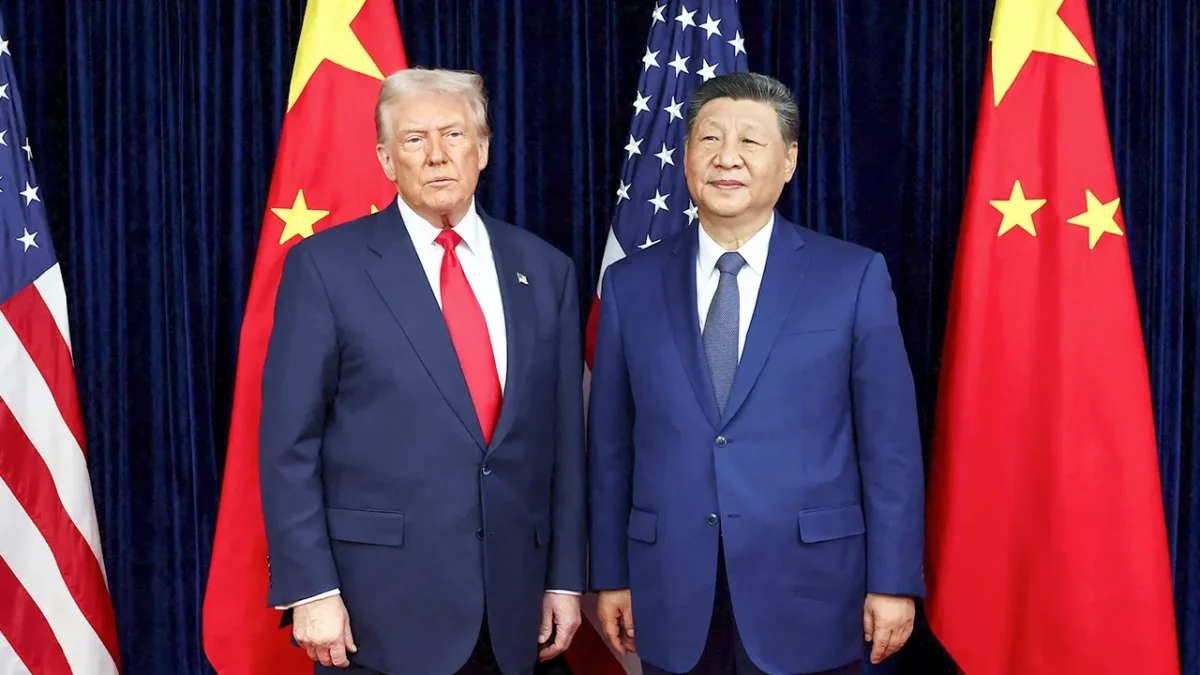
President Donald Trump is slated to travel to China this week for a significant summit with Chinese President Xi Jinping. The meeting, scheduled for May 14-15 in Beijing, occurs against a backdrop of ongoing trade disputes and intensifying competition in emerging technologies between the world's two largest economies. This high-stakes gathering is expected to address critical issues including potential new commitments from China to purchase American farm goods and jetliners, with the sale of advanced artificial intelligence (AI) chips emerging as a key point of contention.
Derek Scissors, a senior fellow at the American Enterprise Institute specializing in U.S. economic ties with China, indicated that President Trump is looking to secure announcements of substantial Chinese purchases of U.S. products. "The president wants to announce a bunch of purchases following the talks," Scissors told FOX Business, adding that China possesses the flexibility to make public commitments to such deals. He elaborated that Xi Jinping could readily declare that China will buy a specific quantity of U.S. goods, such as Boeing aircraft or soybeans. "It doesn't mean they actually do it – they didn't do it in the phase one deal – but he can say that, and they can announce that China will buy this many Boeings and this many soybeans, so I think they're going to negotiate a purchase deal," Scissors explained.
While Scissors views a public agreement for China to purchase U.S. energy as improbable due to political sensitivities, particularly in light of the current Iran war impacting global energy markets, he suggested that China might pursue a deal that allows for the acquisition of more advanced AI chips. "On the Chinese side, they, of course, want more advanced technology. One of the reasons they have not bought any H200 Nvidia chips is that they want to put pressure on the company to sell them better chips," Scissors stated. He further noted that China will likely eventually acquire these advanced chips, potentially through indirect channels, but their primary objective is to secure an agreement for increased sales of superior chips. "They'll even eventually acquire H200 chips, and probably already have indirectly, but what they want is an agreement to sell more advanced chips."
Scissors characterized the core economic exchange as China making, or at least announcing, large-scale purchases of U.S. exports such as aircraft and farm goods, excluding energy due to political considerations. In return, the U.S. would agree to permit the sale of more advanced chips than the current H200 models. "That's the basic economic trade: the Chinese make, or at least announce, large-scale purchases of U.S. items that we sell to China, which is aircraft and farm goods in the lead if you're not going to count energy, and then we agree to sell them more advanced chips than the H200," he said.
However, Scissors expressed uncertainty regarding President Trump's willingness to approve the sale of these advanced chips to China. This hesitation stems from the inherent tension between his stated objective of boosting U.S. exports and the existing restrictions placed on the sale of such high-end semiconductor technology. "I'm unsure whether Trump is interested in selling the advanced chips to China, given the tension between his stated desire for more U.S. exports and the restrictions that have been put in place on the sale of those chips," Scissors commented.
Kyle Chan, a fellow at The Brookings Institution's John L. Thornton China Center, echoed similar sentiments regarding Beijing's approach to export controls as a significant factor leading up to the summit. Chan observed that while Trump had previously permitted the sale of Nvidia H200 chips to China under specific conditions, Beijing has shown little eagerness to import them. "Beijing, however, has not been eager to allow the import of these chips. While Chinese AI companies would like to access stronger AI chips, Beijing is keen to support domestic AI chipmakers instead," Chan explained.
Chan raised a crucial question about how President Trump will frame the issue of advanced chip sales: "Will Trump see this as a technology issue or a trade issue?" This framing could significantly influence the negotiation dynamics and potential outcomes of the summit. The distinction between viewing it as a matter of national security and technological competition versus a straightforward trade imbalance could lead to different policy responses and agreements.
Furthermore, Chan noted that investment deals recently established between the U.S. and regional rivals of China, namely Japan and South Korea, might be appealing to Chinese leadership. Beijing has expressed considerable interest in increasing Chinese investment within the United States. "Beijing is quite interested in increasing Chinese investment in the U.S. They look around and see U.S. investment deals with other countries like Japan and South Korea and wonder whether this might be an easy win-win," Chan stated. The key uncertainty, however, lies in the U.S. reception to such proposals. "The real question is whether the U.S. would find this attractive or see this as a source of greater risk and dependency," he added.
A spokesperson for the Chinese Ministry of Foreign Affairs confirmed that the upcoming summit will provide an opportunity for both presidents to exchange views on "major issues concerning China-U.S. relations and on world peace and development." The ministry official also conveyed China's readiness to collaborate with the U.S. "China stands ready to work with the U.S. to expand cooperation and manage differences in the spirit of equality, respect and mutual benefit, and provide more stability and certainty for a transforming and volatile world," the spokesman stated, signaling a desire for constructive dialogue amidst global uncertainties.
President Donald Trump's previous visit to China for a summit with President Xi Jinping occurred in November 2017, marking the last time a U.S. president visited the country. The current meeting takes place amid broader geopolitical shifts, including the ongoing conflict involving Iran, which has had a notable impact on global energy markets. The persistent trade tensions between the U.S. and China, characterized by ongoing tariff disputes, the race for AI dominance, and the potential for new export deals, add further complexity to the bilateral relationship.
The U.S. has previously accused China of "industrial-scale" AI technology theft, an allegation that looms over discussions concerning advanced technology transfers. The sale of Nvidia's advanced AI chips has become a focal point, with restrictions on these sales representing a significant hurdle. The desire of Chinese AI companies to access more powerful chips clashes with Beijing's strategic goal of fostering its domestic AI chip industry, creating a complex negotiation landscape.
Analysts suggest that the summit could lead to China agreeing to purchase U.S. products, potentially including aircraft and agricultural goods, in exchange for concessions on technology sales. However, the specifics of any agreement, particularly concerning the transfer of advanced AI chips, remain uncertain. The outcome will depend on how both sides navigate their competing interests in trade, technology, and national security.
The broader context of U.S.-China relations is also shaped by investment dynamics. While China expresses interest in increasing its investments in the U.S., potentially seeking mutually beneficial arrangements similar to those seen with Japan and South Korea, the U.S. perspective on such investments, weighing potential benefits against risks and dependencies, will be critical.
Ultimately, the Beijing summit presents an opportunity for both leaders to address pressing economic and technological issues, aiming to inject stability into a world grappling with transformation and volatility. The success of these discussions will hinge on finding common ground amidst significant strategic divergences.


