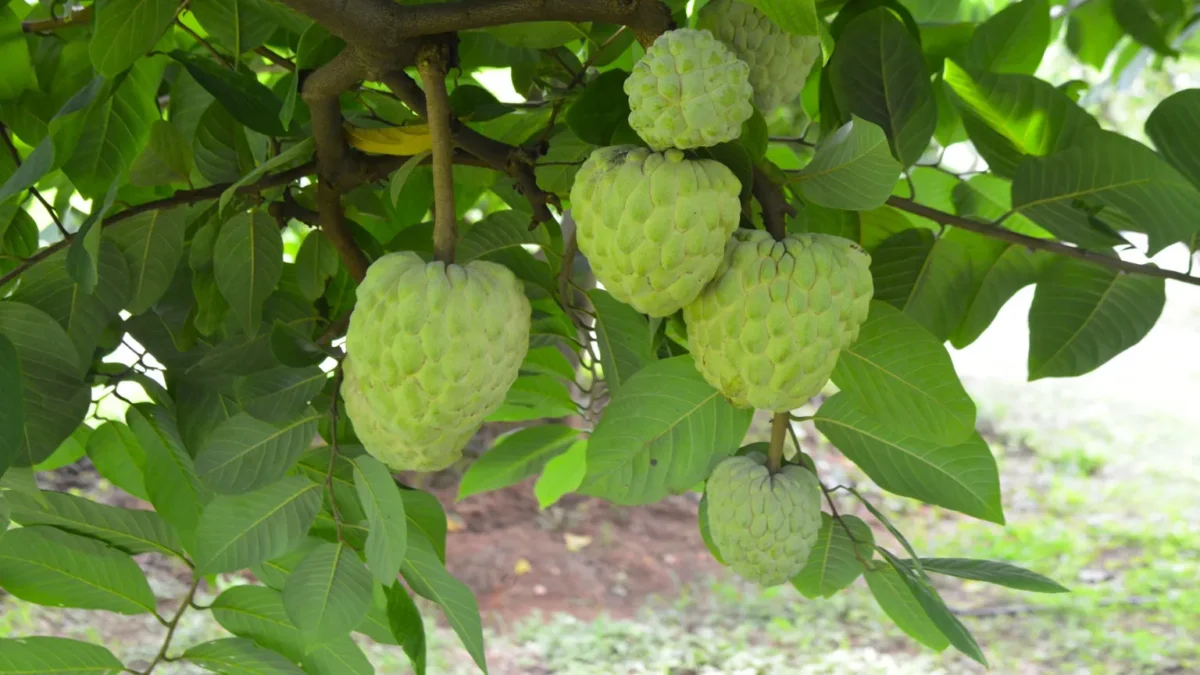
A Resilient Crop for Challenging Climates
In the drought-prone Kolar district of southern India, where rainfall averages a meager 60 to 70 centimeters annually and farmers often invest heavily in deep borewells, the custard apple has emerged as a beacon of agricultural resilience. Ashoka Shivareddy, hailing from a family of farmers, witnessed firsthand the struggles of traditional agriculture in this arid region. The financial strain of securing water led his family to abandon farming in 2005, relocating to Bengaluru to establish a vegetable shop. Despite pursuing a career as an AI software engineer, Shivareddy remained connected to his agricultural roots.
In 2018, a desire to revitalize the family farm spurred Shivareddy to adopt a more scientific and sustainable approach to cultivation. His primary objective was to identify a crop that required minimal water, could thrive on rainfall alone, and had a low dependence on pesticides. The custard apple, a fruit known for its creamy, sweet flesh that evokes the taste of custard, presented itself as an ideal candidate. These trees grow wild in Shivareddy’s native area, with local communities traditionally harvesting and selling the fruit, indicating a pre-existing market and adaptability to the local environment.
Shivareddy’s strategy involved planting the trees closer together than is typical on conventional farms, a method aimed at maximizing yield. He also meticulously selected three distinct custard apple varieties, each chosen for its specific advantages. This innovative approach has yielded promising results. Shivareddy reported producing approximately 20 tonnes of custard apples in the previous year, with an increase to about 25 tonnes in the current year, citing substantial demand both domestically and internationally.
Innovations in Custard Apple Varieties
While custard apples demonstrate remarkable hardiness in arid conditions, their cultivation is not without challenges. The traditional Balangar variety, for instance, suffers from a very short shelf life, often lasting only three to four days, which significantly restricts sales opportunities for farmers. Furthermore, its high seed content makes it less appealing to consumers. Dr. Sakthivel T, a principal scientist at the Indian Institute of Horticulture Research (IIHR) in Bangalore, highlighted these limitations, noting that traditional varieties, despite their excellent flavor, are hampered by low pulp content, numerous seeds, and poor shelf life.
In response to these issues, Dr. Sakthivel’s team at IIHR developed a hybrid variety named Arka Sahan. This improved cultivar boasts a shelf life of up to a week at room temperature, coupled with fewer seeds and a higher pulp content. Over the past two decades, the Arka Sahan variety has gained considerable traction across southern India. Dr. Sakthivel explained that the enhancement in pulp recovery, from 30% in wild varieties to 70% in hybrids like Arka Sahan, has effectively doubled the usable harvest for farmers without requiring additional land. The IIHR is currently exploring advanced processing techniques to extract and preserve the fruit’s pulp for wider use in processed food products such as ice cream and milkshakes. A key area of research involves addressing the rapid browning of custard apple pulp after extraction, with scientists experimenting with new equipment and methods to maintain its appealing milky color for extended periods.
The central Indian state of Maharashtra stands as the nation’s leading producer of custard apples, contributing nearly a third of the total national output. Navnath Malhari Kaspate, a farmer with decades of experience cultivating this fruit in Maharashtra, has been instrumental in its development. Through extensive travel across India, he collected seeds and cross-pollinated them on his farm, dedicating himself to improving the crop. Kaspate noted the lack of prior research and attention given to custard apples, which motivated his long-term commitment to experimentation, a process he acknowledges can take 12 to 15 years to yield a new variety.
His persistent efforts led to the creation of the NMK-01 variety, recognized for its high yield and introduced commercially in 2014. Kaspate reported cultivating custard apples on nearly 50 acres, achieving yields of approximately 10 tonnes per acre. This improved, spoilage-resistant variety has opened avenues for export, with shipments reaching Gulf countries and even Europe—a significant expansion for the fruit’s market reach. Kaspate continues his work, focusing on developing varieties with enhanced visual appeal and greater disease resistance.
Manoj Kumar Barai, an exporter specializing in the NMK-01 variety, supplies markets in the US, UAE, Saudi Arabia, and Europe. He favors NMK-01 for its superior shelf life, thicker skin, higher pulp content, and sweeter taste compared to other varieties. Exporting such a delicate fruit necessitates meticulous planning and execution. Barai emphasized the critical importance of precise coordination in harvesting times, transport to pack houses, airport transfers, flight schedules, and customs clearance, where every hour is crucial.
Temperature control is paramount for preserving the fruit’s quality. Custard apples are highly sensitive to heat; even brief exposure can drastically shorten their shelf life. To mitigate this, road transport is often conducted overnight to avoid high temperatures. In regions like Maharashtra, where ambient temperatures can soar to 40 degrees Celsius, and transit temperatures may reach 30–35 degrees, maintaining a cool environment is essential. The export process involves pre-cooling the fruit for five hours before packing, followed by transportation in refrigerated vans and storage in cold rooms prior to air freight. Specially designed corrugated boxes are used to protect the fruit and maintain coolness.
The export market is also seeing growth in processed forms of custard apple, such as pulp and powder, which Barai describes as a


