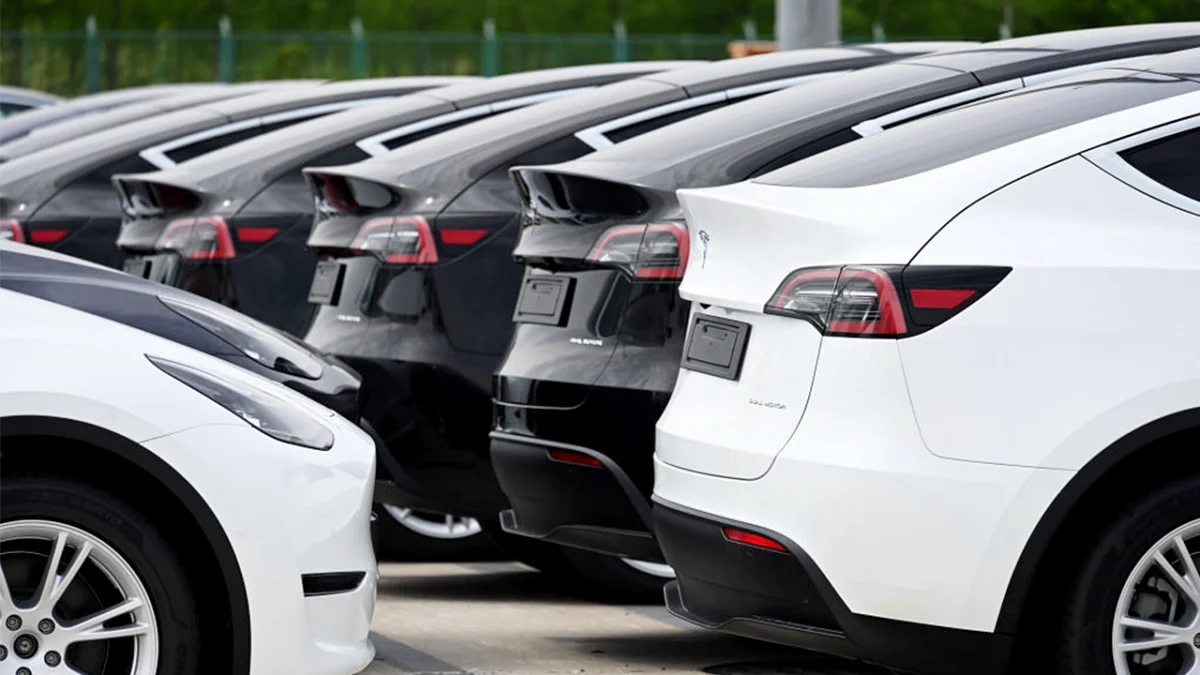
Tesla is initiating a recall for more than 218,000 vehicles due to a software issue that can cause delays in rearview camera images. The National Highway Traffic Safety Administration (NHTSA) announced the recall on Wednesday, citing that this malfunction could potentially increase the risk of a collision.
The recall encompasses a significant number of Tesla's popular models, including 218,868 units of the Model 3, Model Y, Model S, and Model X. The affected vehicles span various model years, from 2017 through 2023, with specific mention of the 2021, 2022, and 2023 Model Y; the 2021, 2022, and 2023 Model 3; the 2020 Model Y; and the 2021, 2022, and 2023 Model S and Model X. The 2017 Model 3 is also included in this extensive recall.
According to the NHTSA's recall notice, the impacted vehicles are equipped with hardware version 3, a component that Tesla ceased producing in January 2024. The core of the problem lies in the rearview camera display, which may experience a delay when the vehicle is shifted into reverse. This delay can impair the driver's visibility, a critical factor during reversing maneuvers.
The safety agency elaborated on the potential consequences, stating, "Loss of the rearview camera image may affect the driver’s rearview and increase the risk of a collision." While the system is designed to aid drivers, its malfunction necessitates alternative safety measures. The NHTSA noted that drivers might resort to performing shoulder checks and relying on their mirrors to continue reversing the vehicle safely.
Despite the widespread nature of the recall, Tesla has reported no instances of collisions, fatalities, or injuries directly linked to this specific rearview camera issue. However, the company has acknowledged receiving 27 warranty claims and two field reports that could potentially be associated with the problem. These reports, while not confirming accidents, indicate a potential for such events.
Tesla plans to address the defect through a free over-the-air software update. The faulty software version identified is 2026.8.6. The company is deploying a remedy software, version 2026.8.6.1, to rectify the issue. Tesla indicated in its announcement that a substantial majority of the affected vehicles have already received the update, with "More than 99.92% of the affected vehicle population have successfully loaded the remedy firmware."
This recall follows a recent development where the NHTSA concluded an investigation into approximately 2.6 million Tesla vehicles. That prior investigation concerned a feature that allowed cars to be moved remotely. The agency ultimately closed that inquiry, determining the issue was primarily linked to low-speed incidents and did not pose a widespread safety risk requiring a recall.
The current recall underscores the ongoing scrutiny of automotive software and hardware reliability by regulatory bodies like the NHTSA. As vehicles become increasingly reliant on complex electronic systems, manufacturers face the challenge of ensuring these systems function flawlessly to maintain driver safety and prevent accidents. The swift deployment of over-the-air updates by Tesla aims to mitigate the risks associated with the delayed rearview camera images, demonstrating a proactive approach to resolving the identified safety concern.


