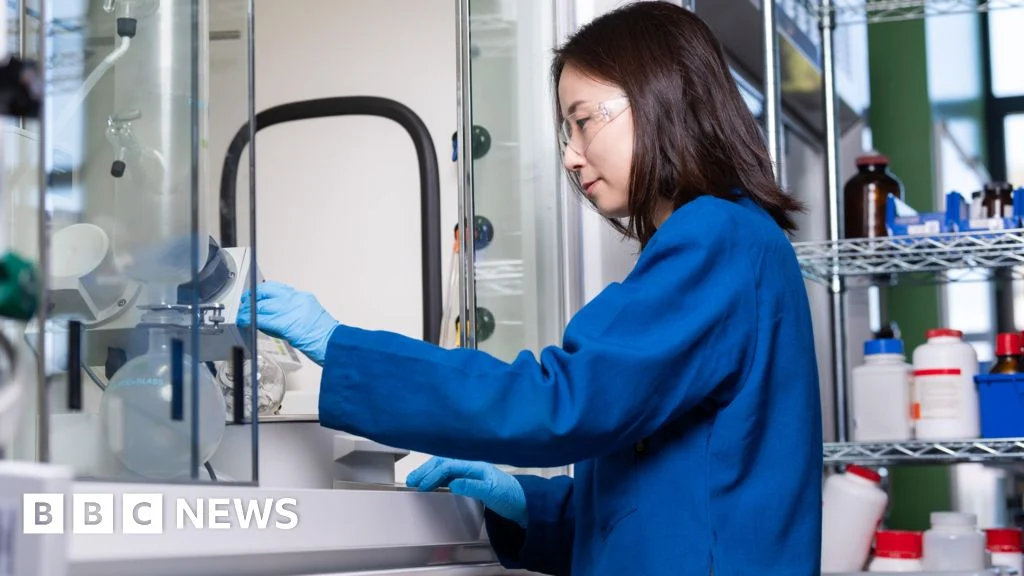
A chance observation of skin damage from the sun has led to a significant breakthrough in molecular solar thermal (MOST) energy storage, a technology that could offer a cheap and emissions-free way to generate heat. Professor Grace Han, now at the University of California, Santa Barbara, was inspired by the way DNA molecules in human skin change shape when exposed to ultraviolet radiation, a process that leads to sunburn. These molecules contort into a strained configuration, effectively storing energy. For decades, scientists have been searching for molecules capable of this shape-shifting behavior, aiming to harness the stored energy by prompting them to revert to their original form, much like a triggered mousetrap.
This phenomenon, known as molecular solar thermal energy storage, holds immense potential for long-term heat storage, potentially lasting for months or even years. While previous research in this area has seen limited success, Han's relocation to Southern California, with its abundant sunshine, provided the ideal environment to explore these possibilities further. She noted that nature itself has perfected this process over millions of years. Certain plants and animals utilize an enzyme called photolyase to repair sun-damaged DNA molecules. This biological precedent suggested to Han that such molecules would be excellent candidates for an energy storage system due to their small size and high energy storage capacity per unit of mass.
In a significant development, Han and her colleagues published findings in February detailing their MOST system, which has demonstrated remarkable energy density. According to Han, their system was potent enough to rapidly boil a small amount of water in a vial, an achievement her students excitedly shared with her via video. She highlighted the critical role of computational analyses performed by collaborator Kendall Houk's team at the University of California, Los Angeles, in predicting the molecule's performance. These theoretical predictions were instrumental in guiding the experimental work.
Kasper Moth-Poulsen, a leading researcher in MOST technology at the Polytechnic University of Barcelona and other institutions, who was not involved in the study, expressed his admiration for the results. He noted that the energy density achieved by Han's team, approximately 1.65 megajoules per kilogram, surpassed their own best systems, which were around one megajoule per kilogram. This figure is notably higher than the energy density of lithium-ion batteries, the dominant technology in portable electronics and electric vehicles today, underscoring the potential of this new molecular approach.
Despite the promising results, the MOST system developed by Han and her team is not without its challenges. A primary limitation is the specific wavelength of light required to induce the shape-shifting in the energy-storing molecules: 300 nanometers. John Griffin of Lancaster University pointed out that this is a form of "very harsh UV light," which, while present in sunlight, reaches the Earth's surface in only very small quantities. This necessitates a strong and consistent UV source for efficient operation, potentially limiting its widespread application in environments with less intense or varied sunlight.
Furthermore, the method used to trigger the release of stored energy in their current system involves hydrochloric acid. Han acknowledged that this highly corrosive substance, which requires neutralization after use, is "not the most ideal choice." This presents a significant hurdle for practical applications, as the handling and disposal of such chemicals add complexity and potential safety concerns. However, Han remains optimistic about overcoming these limitations, expressing hope that future iterations of the system can be made responsive to more natural light wavelengths and employ safer, non-toxic triggers for energy release.
The overarching goal of research in MOST technology is to decarbonize the heating sector, a notoriously difficult area to transition away from fossil fuels. Both MOST systems and fossil fuels represent forms of chemical energy storage, but Moth-Poulsen emphasizes that MOST "operates without burning anything." This fundamental difference positions MOST as a cleaner alternative. Additionally, the distributed nature of MOST systems means they could theoretically be deployed anywhere globally, unlike fossil fuels, which are geographically concentrated. Moth-Poulsen cited the recent issues with the Strait of Hormuz blockade as an example of how the concentration of fossil fuel resources can create significant geopolitical and logistical problems.
Another significant advantage of MOST technology, according to Moth-Poulsen, is its capacity for very long-term energy storage, potentially spanning decades. This contrasts with conventional thermal energy storage methods, which typically retain heat for only a few hours, days, or months at best. The ability to store solar energy captured during warmer periods for use in colder months, or even over multiple years, represents a substantial leap forward in renewable energy utilization and grid stability.
However, practical implementation faces further engineering considerations. Harry Hoster from the University of Duisberg-Essen noted that the light-sensitive molecules in a MOST system need to be dispersed relatively thinly to allow light penetration. He estimates that in an optimistic scenario, the system might only be 5 millimeters thick. If the molecules are suspended in a liquid, this necessitates pumping the liquid to store or transfer energy, introducing additional costs and mechanical complexity. "The moment you need to pump stuff around you have more things that can get broken," Hoster observed, highlighting potential points of failure and maintenance requirements.
In response to these challenges, Griffin and his colleagues are actively developing solid-state versions of MOST technology. Han is also exploring solid iterations, envisioning applications such as transparent window coatings. These coatings could capture solar energy and release heat on demand, potentially preventing condensation or even actively warming rooms. While Hoster remains skeptical about MOST's ability to meet all heating demands in buildings, he sees potential for specialized applications, such as warming temperature-sensitive components on satellites or aircraft, acknowledging it as "great science" with "beautiful functionality."
The field of MOST technology, though promising, remains relatively niche. Griffin recounted attending a recent conference on the subject with only about 70 attendees, remarking that this represented "basically the whole community in the world working on this stuff." This suggests that while the scientific foundation is strong, further development and broader adoption are needed to scale the technology. Continued innovation in material science and engineering will be crucial to overcome the current limitations related to light sensitivity, trigger mechanisms, and system integration, paving the way for a more sustainable and efficient energy future.
This ongoing research into molecular solar thermal energy storage, inspired by the very mechanisms that cause sunburn, exemplifies how understanding natural processes can lead to groundbreaking technological advancements. The pursuit of efficient, long-lasting, and environmentally benign heat storage solutions continues, with MOST technology positioned as a compelling candidate for future energy needs, particularly in decarbonizing heating applications and enabling specialized thermal management solutions in demanding environments. The journey from observing skin irritation to developing a potentially revolutionary energy storage system underscores the power of curiosity-driven scientific inquiry and its tangible impact on addressing global energy challenges.


