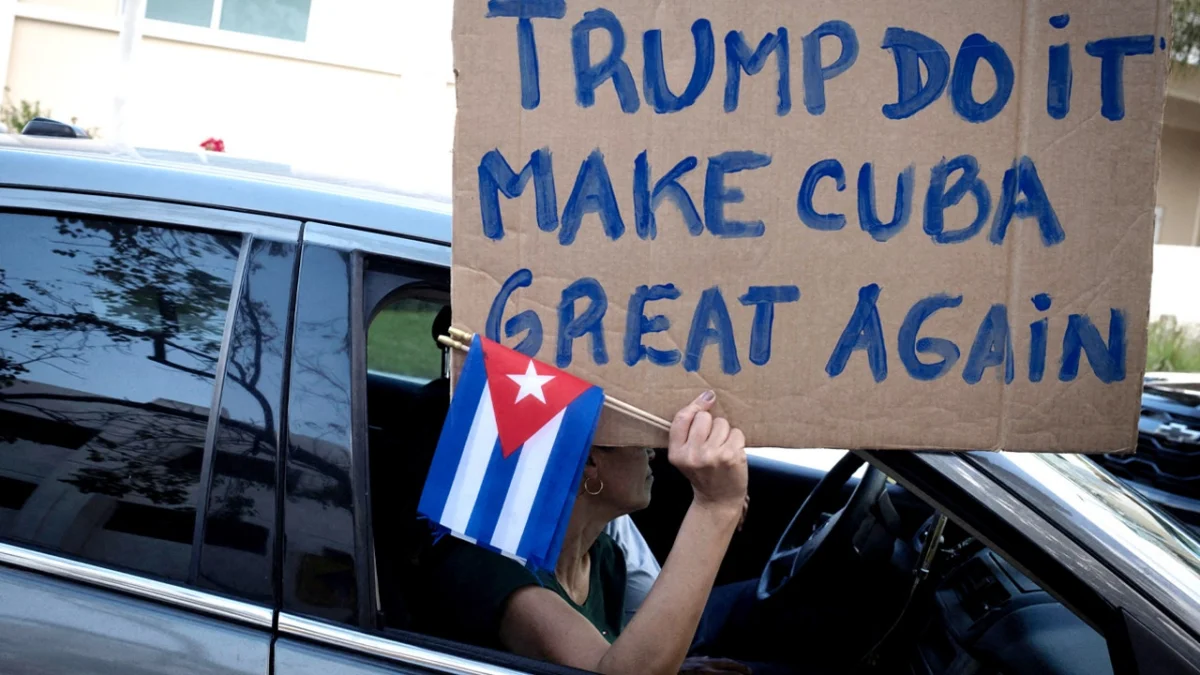
Senate Republicans have successfully blocked a Democratic initiative aimed at restricting President Donald Trump's authority to engage in military action against Cuba. The resolution, introduced by Senator Tim Kaine of Virginia, sought to preemptively limit the president's ability to deploy military forces near the island nation, located approximately 90 miles off the Florida coast. This move by Democrats was prompted by President Trump's earlier remarks suggesting potential actions against Cuba following the conclusion of U.S. involvement in Iran.
President Trump had expressed his ambition in March, stating, "All my life I've been hearing about the United States and Cuba — when will the United States do it? I do believe I'll be the honor, having the honor of taking Cuba." The war powers resolution proposed by Senator Kaine called for the withdrawal of U.S. forces from Cuba and its surrounding areas. It also stipulated that any use of the U.S. Coast Guard or other military components to establish a blockade or quarantine of Cuba would be considered a hostile act requiring explicit congressional approval.
Senator Rick Scott of Florida took the lead in opposing the resolution, moving to prevent it from receiving a full vote on the Senate floor. His procedural maneuver proved effective. However, the effort to advance the resolution saw support from a significant number of senators, including Republicans Rand Paul of Kentucky, Mitch McConnell of Kentucky, and Susan Collins of Maine, who joined nearly all Senate Democrats in pushing for a vote. Notably, Senator John Fetterman of Pennsylvania was the sole Democrat to vote against advancing the resolution.
Despite the resolution's failure to advance, President Trump has not yet initiated any military action concerning Cuba, particularly while the U.S. remains engaged in military operations in Iran. This vote occurred amidst ongoing efforts by Democrats to curb President Trump's presidential war powers, particularly concerning the Middle East. Republicans have consistently voted down previous Democratic attempts to halt hostilities in that region.
When asked about the Republican support for limiting Trump's war powers, Senator Kaine remarked to Fox News Digital, "You gotta ask Republicans about their position." He added, "There are many saying that the 60-day time frame is relevant to them. We’ll see that because we’ll have an Iran war vote close to the 60-day [deadline] by the end of this week."
The broader effort to constrain Trump's military authority has seen growing friction among Senate Republicans regarding the conflict in Iran. The 60-day deadline under the War Powers Resolution Act, which requires congressional input on military engagements, is approaching this week. This deadline has put pressure on lawmakers to reconsider their support for ongoing hostilities.
Several Senate Republicans have indicated they would not support extending the 60-day authorization for the war in Iran. Senators Susan Collins of Maine, Thom Tillis of North Carolina, and John Curtis of Utah have stated their opposition to an extension. Furthermore, Senator Lisa Murkowski of Alaska is reportedly working on an Authorization for the Use of Military Force (AUMF) to allow lawmakers to formally vote on the Iran conflict.
Senate Minority Leader Chuck Schumer of New York urged Republicans to support the Democrats' stance, suggesting they "do Trump a favor" by blocking future military engagements with Cuba without congressional consent. "The last thing working Americans need right now is another war, let alone one that’s 90 miles south of the United States," Schumer stated on the Senate floor. "Republicans must get out in front of a looming catastrophe in Cuba before it gets even worse, as they should have done with Trump's war in Iran."