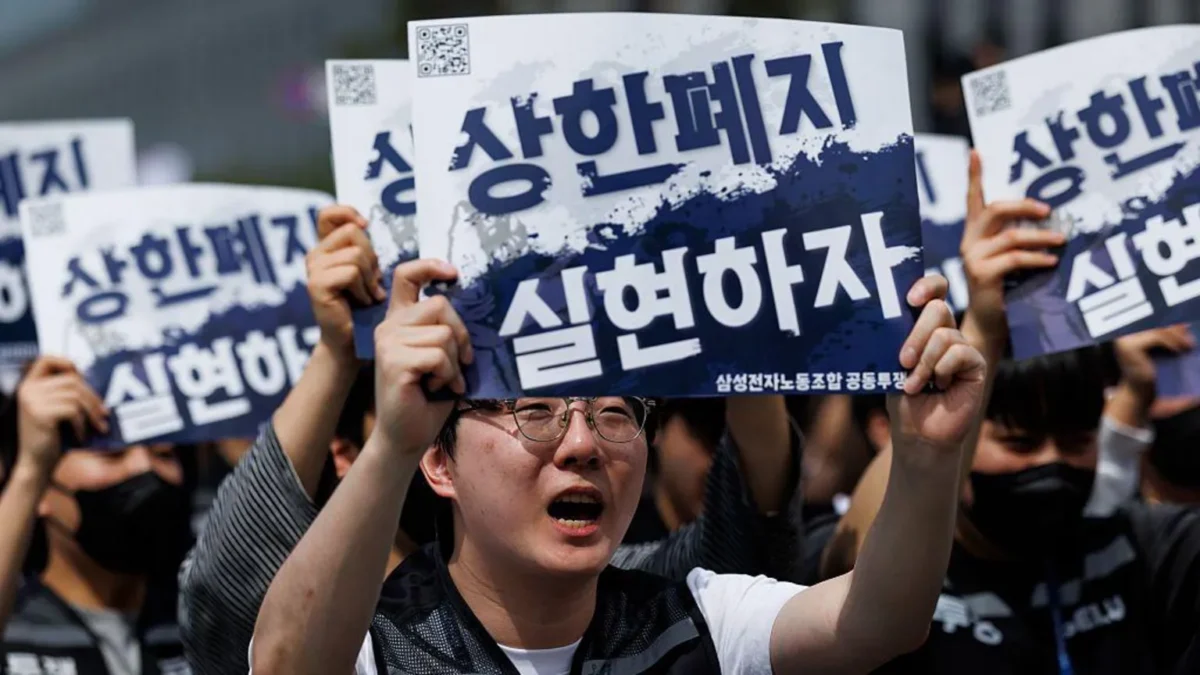
Samsung Strike on Hold as Tentative Pay Agreement Reached
The largest union at Samsung Electronics has suspended a planned strike after reaching a last-minute tentative pay agreement with the South Korean technology giant. This development temporarily eases fears of disruption at the world's largest memory chipmaker, a critical player in the current boom for artificial intelligence (AI) data centers. The union, representing nearly 48,000 workers, announced that industrial action scheduled to commence on Thursday would be paused while its members vote on the proposed deal between May 22 and May 27.
Dispute Over Profit Distribution Fuels Labor Tensions
The core of the dispute centers on the equitable distribution of profits generated by soaring demand for AI memory chips. Specifically, the disagreement revolves around bonus allocations between staff in the memory chip divisions and those in other company units. Samsung had initially planned to offer substantial bonuses to 27,000 employees working on memory chips, a sum reportedly at least six times greater than what workers in other chip and electronics divisions would receive.
The union has voiced concerns that 23,000 workers involved in producing less advanced chips, which are supplied to companies like Tesla and Nvidia, are being overlooked and should not be left behind in the profit-sharing. This disparity has fueled significant labor tension within the company.
Samsung's operating profit saw a dramatic increase, jumping approximately 750% in the first quarter of the year compared to the same period in the previous year. This surge in profitability, driven by the booming demand for AI chips, propelled Samsung's market valuation past $1 trillion (£744 billion) in May.
Broader Economic Implications and Market Reactions
The potential for a strike at Samsung carries significant implications not only for the company but also for South Korea's export-driven economy. Samsung is the leading global memory chip manufacturer and a key supplier for AI data centers, smartphones, and laptops. The broader Samsung Group contributes approximately one-fifth of South Korea's total economic output, highlighting the systemic importance of its operations.
Samsung bosses had previously warned that a strike could broadly impact South Korea's economy through reduced sales, investment outflows, and lower tax revenues. The American Chamber of Commerce in Korea emphasized the interconnected nature of the global economy, stating, "In today's interconnected global economy, disruptions in strategically important industries can create ripple effects extending well beyond a single company or market." They also noted that competing regional manufacturing markets could gain an advantage if concerns over predictability and continuity persist.
In response to the tentative agreement, Samsung's shares saw an increase of more than 5% on Thursday morning. This market reaction underscores investor relief over the averted disruption. However, the underlying issues regarding profit sharing and bonus structures remain a point of contention, suggesting that the labor-management relationship may require further development.
Court Intervention and Union Concessions
A potential strike was further limited by a South Korean court, which granted Samsung Electronics an injunction. The court mandated that staffing levels essential for safety, facility protection, and product quality must be maintained at normal levels to prevent damage to facilities and production. The injunction also prohibited the union and its leader from occupying or locking company facilities and obstructing workers from entering them. The union faces daily fines of approximately $74,000 if it breaches this court order.
Samsung's proposal included offering memory chip workers bonuses equivalent to 607% of their annual salary, a figure reportedly higher than that offered by rival SK Hynix. However, employees in other business units were slated to receive bonuses ranging from 50% to 100% of their annual salaries, according to negotiation documents. The union had also sought the abolition of a 50% bonus cap for other employees and the allocation of 15% of annual operating profit to a distributed bonus pool.
In a statement following the tentative deal, Samsung expressed a commitment to fostering a more mature and constructive labor-management relationship, aiming to prevent similar incidents in the future. Despite the suspension of the strike, the union's push for more equitable profit distribution and the company's efforts to manage labor costs in a competitive market suggest that the underlying tensions may persist.


