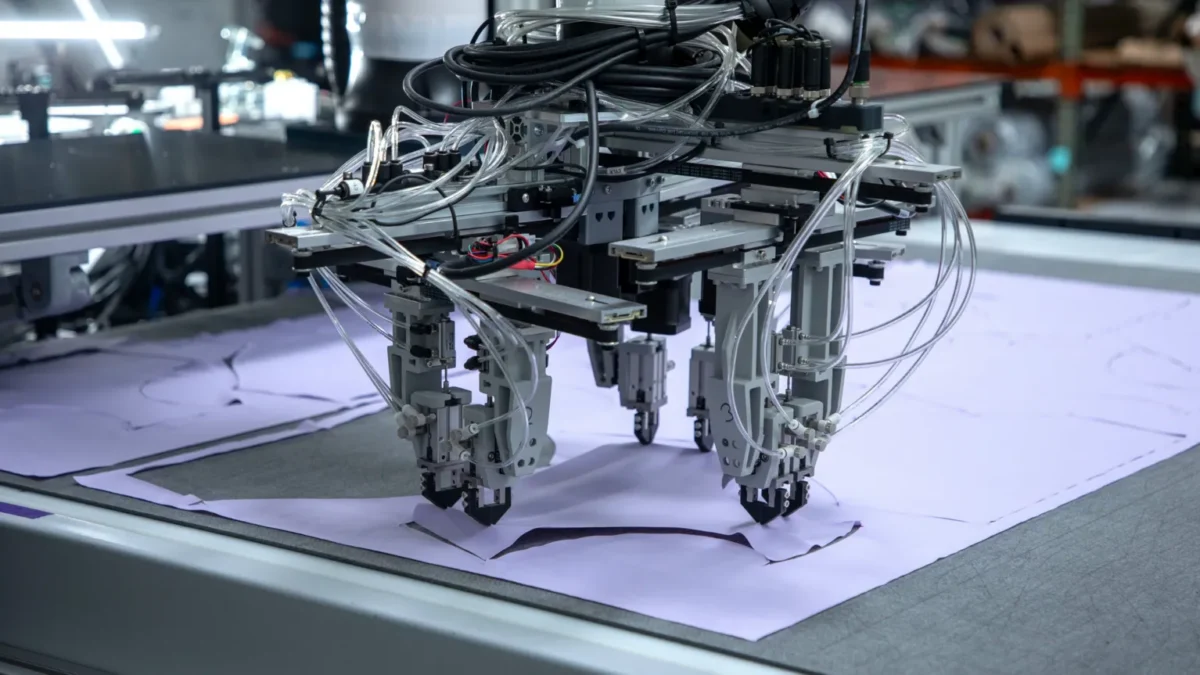
Robots have long mastered complex tasks like assembling cars, performing intricate surgeries, and managing airport cargo. However, the delicate art of sewing has remained a significant hurdle, leaving the vast majority of the world's clothing production reliant on manual labor, predominantly by low-paid workers in Asia. While these workers may utilize tools like sewing machines, the complete automation of garment assembly presents a formidable challenge.
Cam Myers, founder and CEO of California-based robotics firm CreateMe, highlights the core difficulty: "You have a problem if it's sewing. You have to keep [two pieces of fabric] in alignment under motion." CreateMe is pursuing an alternative approach, sidestepping traditional sewing altogether by employing adhesive bonding. "Once the adhesive is laid down, you simply line something over it and stamp," Myers explains. The company has developed robots capable of this process and is already producing women's underwear using this method. The production of t-shirts is slated to commence in the coming months, with mass production potentially following next year.
For decades, roboticists have recognized the potential to transform the garment manufacturing industry. The successful automation of clothing production could facilitate the reshoring of manufacturing to Western countries, significantly reducing the environmental impact associated with garment production. However, this technological shift also raises concerns about the future employment of millions of textile workers.
Currently, only a small fraction of clothing sold in the UK and the US is manufactured domestically. Myers notes a growing demand from clients interested in marketing garments as "made in the US," utilizing locally sourced materials like US-produced cotton. CreateMe's adhesive-based process is versatile, accommodating materials such as cotton, wool, and leather. Myers estimates that if even 10% of t-shirt manufacturing were to return to the US through automation, it would represent a substantial industry transformation.
The adhesive used by CreateMe is a thermoset type, engineered to withstand typical ironing and washing machine temperatures without compromising the garment's integrity. Myers further points out that the absence of seams in these garments results in a streamlined design, allowing for production on molds that can precisely contour to the human body. Despite these advancements, Myers acknowledges that apparel manufacturing is inherently "high flex," meaning the industry's demand for a wide variety of styles, colors, and designs presents a significant challenge for current robotic capabilities.
Palaniwamy Rajan, chairman and CEO of Softwear Automation, based in Georgia, USA, believes that sewing will remain an integral part of garment production. He emphasizes that visible stitching is a crucial design element in many fashionable garments, citing jeans as a prime example. Rajan indicates that his company is preparing to unveil its third generation of sewing robots, which he claims will enable t-shirt production at a cost comparable to importing them into the US. However, he has refrained from disclosing specific details about the underlying technology.
Many companies involved in this competitive sector are hesitant to share information about their robotic innovations due to the intense rivalry within the massive apparel market. The textile industry is already facing considerable pressure, exacerbated by factory closures during the COVID-19 pandemic and, more recently, by the conflict in Iran, which has disrupted polyester supplies. While automation industry representatives often advocate for workers to transition to higher-paying, less repetitive roles, the immediate displacement of t-shirt production by robots is unlikely to achieve this overnight.
One of the most compelling advantages of automating garment manufacturing is its potential to significantly mitigate the industry's substantial environmental footprint. Globally, an estimated 92 million tonnes of textile waste are generated annually, with vast quantities of unsold clothing being incinerated. The apparel sector also consumes enormous amounts of water.
Gerald Feichtinger from the Technical University of Leoben in Austria, who led a study on the feasibility of on-demand manufacturing, suggests that reshoring production could curb overproduction and reduce the carbon emissions associated with long-distance transportation. "We can see a significant reduction in greenhouse gas emissions," he stated. The study, which involved collaboration with Silana, an Austrian garment-making robot company, found that robotically produced t-shirts in Europe or the US could reduce associated emissions by approximately 45%. While a co-author of the study had prior ties to Silana, independent research has corroborated these findings.
While automation offers a path to reduced environmental impact, it's crucial to acknowledge that other stages of the supply chain, such as fabric dyeing and yarn production, may not be as readily amenable to reshoring. Feichtinger's research acknowledges these complexities, noting that reshoring multiple segments of the garment supply chain remains a considerable challenge.
Michael Fraede, co-founder of the German firm Robotextile, which specializes in gripper devices that enable robots to handle fabric with precision, notes that the market for textile automation in Europe might be confined to specialized applications. His company's robots have been instrumental in producing items like bicycle bags and automotive airbags. Fraede anticipates that widespread reshoring of garment manufacturing will take approximately another decade, citing the industry's historical focus on cost-saving measures. "This industry is not used to thinking that way. They are used to saving money wherever they can."
Conversely, others express greater optimism. Lauren Junestrand, innovation and sustainability network manager at the UK Fashion and Textile Association, believes the UK possesses significant potential for integrating robotics into its manufacturing processes. She observes an increasing adoption of robots for various tasks within the garment industry. However, Junestrand concedes that countries like the UK may struggle to match the sheer volume of production seen in Asian manufacturing hubs, suggesting a future of "co-existence" rather than outright competition.


