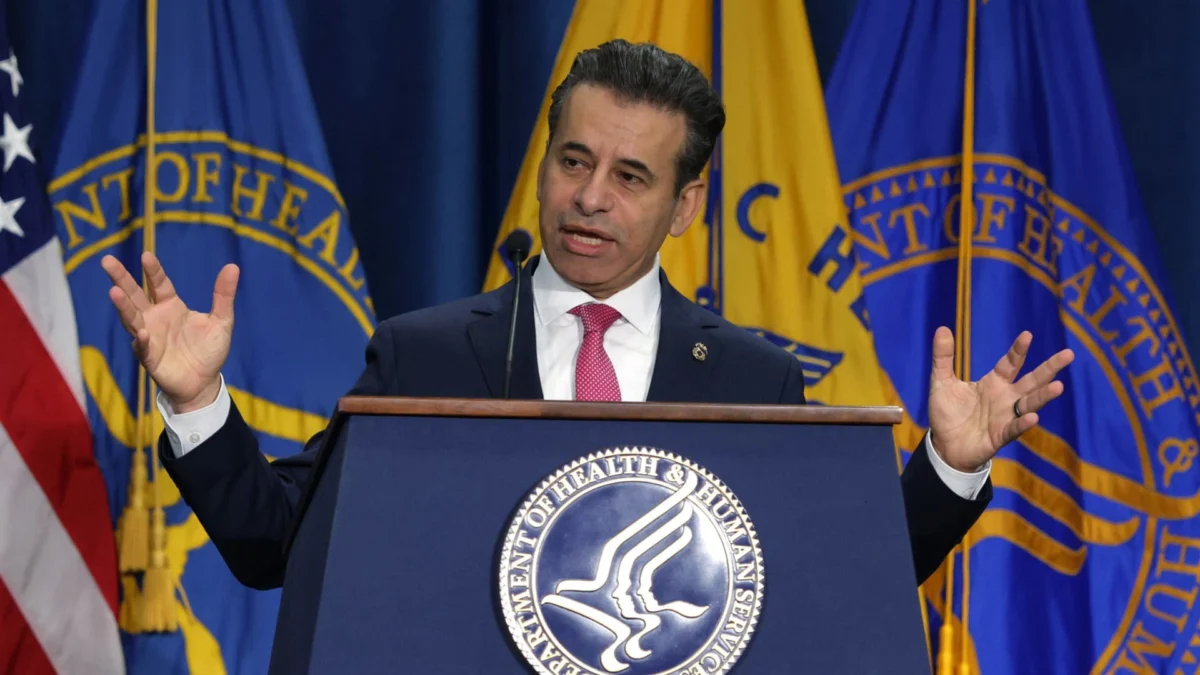
Dr. Marty Makary has been removed from his position as Commissioner of the Food and Drug Administration (FDA), President Donald Trump announced Tuesday. Trump stated that Makary, described as a "wonderful man," will be departing the agency, with a deputy set to assume leadership on an interim basis. Reports indicate Makary submitted his resignation on Tuesday, following days of speculation that the White House was preparing to dismiss him. Kyle Diamantas, who previously held the position of top food official at the FDA, is expected to step into the role of acting commissioner, though Trump did not officially name him during his remarks.
Makary, a surgical oncologist known for his critiques of the government's pandemic response, led the agency responsible for regulating food, drugs, and medical devices for over a year. His tenure was characterized by significant internal dysfunction and leadership instability within the FDA. This period also saw a growing wave of opposition from pharmaceutical companies, medical professionals, and patient advocacy groups concerning various regulatory decisions, including the high-profile rejection of several treatments for rare diseases.
Simultaneously, the White House reportedly grew increasingly frustrated with Makary's perceived slow progress on key policy objectives championed by President Trump, such as the legalization of flavored e-cigarettes. The influential organization Susan B. Anthony Pro-Life America had also publicly called for Makary's removal, citing the FDA's handling of the abortion pill mifepristone. Makary was reportedly hesitant to expedite a safety review of the pill, which can be distributed by mail to states with restrictions on abortion access. The incoming acting commissioner will inherit this contentious review and the associated political complexities.
Despite the controversies surrounding recent drug rejections, the pharmaceutical industry has expressed concern regarding a leadership transition at the FDA. The industry is currently engaged in negotiations for the reauthorization of the Prescription Drug User Fee Act (PDUFA), a critical piece of legislation that governs the fees collected by the FDA from drug manufacturers to fund its drug review processes. Makary had previously highlighted his achievements as commissioner, including the implementation of a priority voucher program designed to expedite the review timelines for certain medications.
However, staff morale within the FDA reportedly suffered a significant decline following layoffs and the departures of experienced agency scientists. Dr. Richard Pazdur, a long-serving regulator in the field of oncology, cited Makary's leadership as a primary reason for his decision to leave the agency. Concurrently, reports suggest that distrust in leadership has deepened among the remaining staff members.
Among Makary's more polarizing appointments was Vinay Prasad, who served as a key official overseeing vaccine and biotechnology treatments before his departure at the end of April. Prasad, an academic and podcaster known for his outspoken views, left the agency amidst mounting criticism of the FDA from within the biotech and pharmaceutical sectors, as well as from former health officials. For instance, the FDA initially declined to review Moderna's influenza vaccine, a decision the biotech company argued was inconsistent with prior agency guidance and attributed to Prasad's influence. The FDA later reversed its position on the vaccine.
Prasad also faced criticism earlier this year for his rejection of a gene therapy for Huntington's disease developed by uniQure. The company alleged that the FDA was demanding it conduct simulated brain surgery to assess the treatment's efficacy, a claim Makary appeared to allude to indirectly in a CNBC interview in March when discussing controversial treatments without naming them.
In April, the FDA issued a second rejection for Replimune's drug candidate for melanoma, following an initial rejection in July. The agency cited insufficient evidence of effectiveness and raised concerns about the design of the single-arm clinical trial. During a May interview with CNBC's David Faber, Makary defended the FDA's decisions, stating that three independent expert teams had reached the same conclusions regarding the drug and asserting that the FDA had not engaged in "corrupt sweetheart deals." He emphasized his commitment to the American people and the FDA's scientific staff, stating, "I don't work for Replimune, I work for the American people, and I stand by the scientists at the FDA."
In March, Senator Ron Johnson, R-Wisc., initiated an investigation into the FDA's decisions regarding the rejection of rare disease treatments. The process of installing a new commissioner may require President Trump to secure the support of Senator Bill Cassidy, a physician who previously posed challenges to the confirmation of Health and Human Services Secretary Robert F. Kennedy Jr. Trump has publicly supported a candidate seeking to unseat Cassidy in Louisiana, which could potentially complicate efforts to confirm a new FDA leader.


