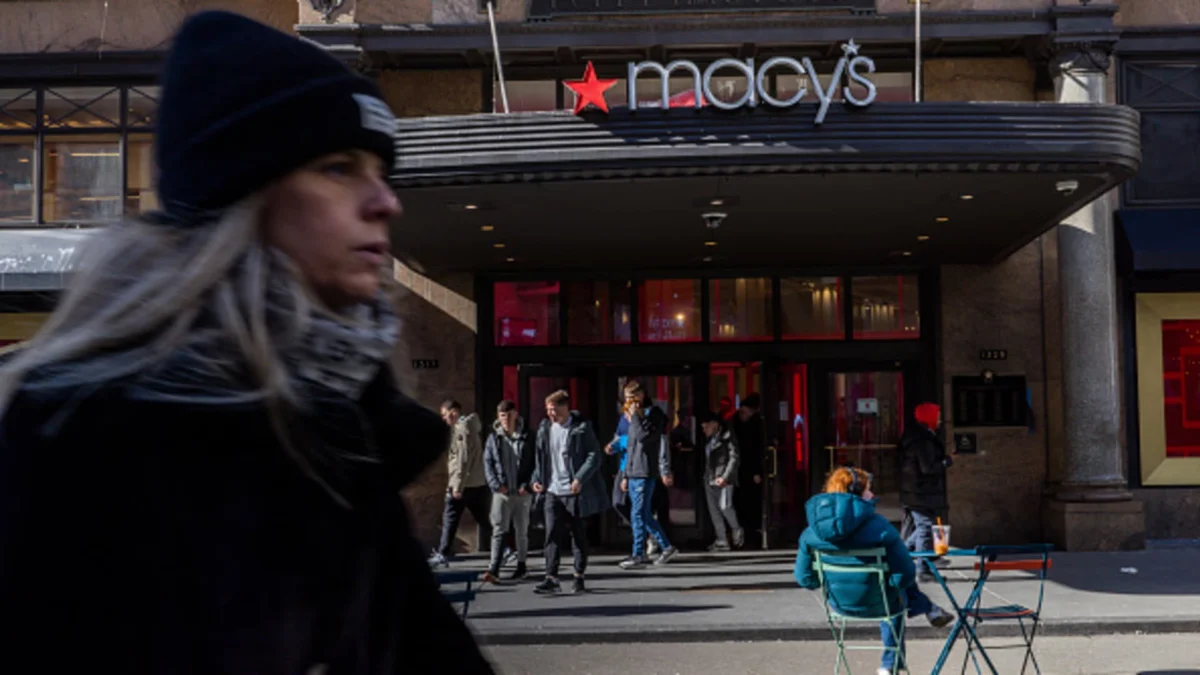
Macy's (M) announced better-than-expected fiscal first-quarter results for 2026, leading the department store chain to raise its full-year guidance. The company's comparable sales saw a 3% increase during the quarter, marking its strongest first-quarter performance in four years.
CEO Tony Spring, in an interview with CNBC, indicated that Macy's is actively reinvesting in fundamental aspects of its business, such as improving staffing levels and enhancing product assortment, to further drive sales growth. This strategic focus is part of a broader three-year turnaround plan that Spring has been leading since assuming the chief executive role.
The turnaround strategy involves closing underperforming stores located in less viable malls across the country and redirecting investments into the remaining, more promising locations. These investments prioritize retail fundamentals, ensuring stores are adequately staffed, offer an enjoyable shopping experience, and are stocked with desirable merchandise. Spring emphasized that the company is "not doing the fancy stuff, we're doing the stuff that makes the biggest difference in the business."
Comparable sales growth was observed across the company's banners, with the namesake Macy's brand seeing a 1.6% increase. Bloomingdale's, another key banner, reported a significant 10.2% rise in comparable sales. According to Spring, Bloomingdale's performance was bolstered by a range of popular brands, a distinct "fun factor" within the luxury market, and the recent bankruptcy of competitor Saks Fifth Avenue. While acknowledging that market disruption was "helpful," Spring clarified it was not the primary driver of growth.
Financial Performance and Outlook
The better-than-expected sales and profitability in the first quarter prompted Macy's to elevate its full fiscal-year guidance, after previously adopting a more cautious outlook. The company now projects 2026 net sales to fall between $21.5 billion and $21.75 billion, a range that largely surpasses the LSEG expectation of $21.59 billion. Furthermore, Macy's anticipates adjusted earnings per share (EPS) to be between $2 and $2.20, an increase from its prior forecast of $1.90 to $2.10.
For the full year, comparable sales are now expected to climb between 0.5% and 1.2%, a notable improvement from the previous outlook which ranged from a 0.5% drop to a 0.5% increase. Macy's shares responded positively to the news, rising more than 2% in premarket trading on Wednesday.
In its fiscal first quarter, which concluded on May 2, Macy's reported net income of $63 million, or 23 cents per share. This compares favorably to $38 million, or 13 cents per share, in the same period a year earlier. After adjusting for restructuring costs and other one-time charges, the company's adjusted earnings per share stood at 13 cents. Sales for the quarter reached $4.68 billion, an approximate 2% increase from $4.60 billion a year ago, surpassing Wall Street's anticipation of $4.61 billion, based on an LSEG analyst survey.
Spring noted that higher-than-usual tax refunds "definitely" contributed to the first quarter's growth, a trend many retailers have reported recently. However, he stressed that tax refunds were not the sole factor. Crucially, the positive business trends observed in the first quarter have continued into the second quarter. Spring stated, "We did raise our guidance in both sales and profit for the remainder of the year to reflect the business trends that we're seeing as we start the second quarter, so pleased with the second quarter to date and the breadth of the categories that are performing."
He further added that Macy's decision to hike its outlook was made "despite the macroeconomic and geopolitical uncertainty," indicating a steady consumer behavior across all three of its nameplates.


