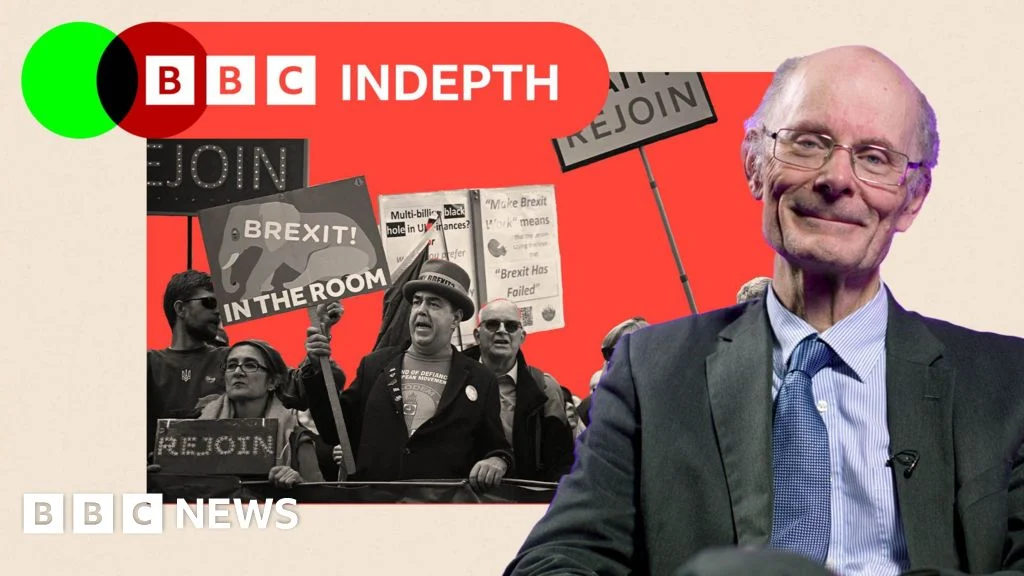
Chancellor Rachel Reeves has signaled a significant evolution in the Labour Party's approach to Brexit, stating that the policy "did deep damage" to the United Kingdom. This declaration, made during her Mais lecture, aligns with a broader trend among government ministers to acknowledge the economic repercussions of leaving the European Union. Reeves emphasized that while the government seeks a closer relationship with the EU, it is not advocating for a reversal of the Brexit decision.
This recalibration in rhetoric reflects a strategic imperative for Labour as it grapples with the nation's persistent economic sluggishness. The party aims to be more ambitious in redefining the UK's post-Brexit engagement with the EU, a move seen as crucial for stimulating economic recovery. Labour's 2024 election manifesto had outlined proposals for renegotiating aspects of the Trade and Cooperation Agreement negotiated by Boris Johnson. Key among these was the elimination of EU customs checks on food and agricultural exports, to be achieved by aligning British regulations with those of the EU. However, the manifesto maintained firm red lines, explicitly ruling out rejoining the EU's single market, customs union, or embracing freedom of movement.
The party's initial stance following the 2019 election defeat was to accept the outcome of the referendum and endorse the Trade and Cooperation Agreement. This position was a direct response to the electoral catastrophe of 2019, where Labour concluded that regaining power necessitated reconnecting with traditional working-class voters who had shifted their allegiance to the Leave campaign and supported the "get Brexit done" agenda. The defection of these voters was seen as instrumental in the collapse of the "Red Wall" constituencies in the Midlands and the North of England, which Labour deemed essential for a return to government.
However, recent pronouncements suggest a growing internal consensus that a more assertive approach to the EU relationship is necessary for economic revitalization. Prime Minister Sir Keir Starmer declared that "Brexit had significantly hurt our economy" and that Britain must "keep moving towards a close relationship with the EU." While maintaining the manifesto's red lines, his speech indicated a growing conviction within the party that greater ambition in resetting the EU relationship was required to address the UK's ailing economy. This sentiment is echoed by other senior figures, with Health Secretary Wes Streeting noting that "Brexit is a problem whose name we now dare speak" and acknowledging its hindrance to delivering promised economic growth. Deputy Prime Minister David Lammy has also publicly stated that Brexit's economic damage is "self-evident."
Further evidence of this internal pressure emerged when London Mayor Sadiq Khan advocated for the UK to rejoin the EU's customs union and single market before the next general election, and to campaign on this platform. While Chancellor Reeves reiterated that Labour's manifesto red lines remain in place, her Mais lecture clearly signaled a strategic shift. She indicated a willingness to align the UK's regulatory regime with the EU in more areas where it serves Britain's interests, identifying this as a key factor in achieving the economic growth that has thus far eluded the government. The UK economy grew by 1.3% in 2025, a modest improvement from 1.1% in 2024, but below official forecasts of 1.5%.
These economic considerations carry significant political weight. The central question is whether pursuing a closer relationship with the EU risks alienating Brexit-supporting voters and courting electoral disaster, or if the political landscape has shifted to a point where such a change in tack is politically advantageous for Labour. The party's previous strategy was rooted in the painful lessons of the 2019 election, where a pledge to renegotiate the Brexit deal and hold a second referendum with a Remain option proved electorally damaging. Labour's subsequent focus was on regaining the trust of working-class voters who had backed Leave.
Despite winning the 2024 election, Labour's progress in winning back working-class Leave voters between 2019 and 2024 was relatively limited. Data from the British Election Study and the National Centre for Social Research indicate that approximately 80% of Labour's support in 2024 came from individuals who would vote to rejoin the EU, a figure only slightly lower than the 86% recorded in 2019. The party was more successful in attracting 2019 Conservative voters who favored rejoining the EU than those who wished to remain outside it. Concurrently, Labour's gains among working-class voters were no more pronounced than among middle-class voters, and possibly even weaker. Consequently, working-class voters were no more inclined to vote Labour in 2024 than those in middle-class occupations, mirroring the trend from 2019.
Currently, the political landscape presents Labour with even greater electoral challenges than in 2019. Recent polls place the party's support at around 19%, trailing Reform UK, a party drawing heavily from Brexit-supporting voters, by eight points. Notably, one in ten voters who supported Labour in 2024 are now reportedly backing Reform. While it might seem logical for Labour to focus on recapturing these defecting voters, the rise of Reform is not the primary driver of Labour's current electoral difficulties. The data suggests that for every voter who has switched from Labour to Reform since 2024, nearly twice as many (19%) have moved to the Green Party, and another 8% have defected to the Liberal Democrats.
Crucially, while those switching to Reform predominantly voted to remain outside the EU, the majority of voters moving to the Greens and Liberal Democrats are Remain supporters. This indicates a significant shift: although Labour's vote share has decreased by nine points among Leave voters since 2024, it has fallen by a more substantial 19 points among Remain voters. This trend underscores that Labour cannot solely rely on appealing to Brexit-backing Reform voters to improve its electoral standing. The party must also win back pro-EU voters who have gravitated towards the Greens and Liberal Democrats, parties that, unlike Labour, advocate for eventual EU re-entry.
Labour's previous strategy of resetting its relationship with the EU without seeking re-entry was predicated on the assumption that this approach would satisfy its pro-EU supporters without alienating its minority of Brexiteer members. Polling data from June 2024 indicated that 76% of Labour voters supported a closer relationship with the EU, short of rejoining the EU, the Single Market, or the Customs Union, with only 11% opposed. However, this does not necessarily translate to a preference for the "reset" over the more ambitious goal of rejoining the EU.
In the same YouGov poll, a significant 82% of Labour voters expressed support for "Britain rejoining the European Union," with only 12% against. More recent polling in December further reinforced this sentiment, with 73% of 2024 Labour voters favoring "starting negotiations for Britain to rejoin the European Union," while 18% opposed. This suggests that while the party's current strategy might be acceptable to its base, a more direct path towards rejoining the EU holds even greater appeal.
The popularity of the core elements of Labour's current reset strategy also warrants closer examination. The party's primary objective has been to eliminate customs checks on food and agricultural exports to the EU. Initially, this proposal appeared popular, with a January 2025 BMG poll showing 63% of Labour voters supporting a veterinary agreement to streamline food and drink exports, and only 10% opposed. However, the framing of the question significantly influences voter response.
When Redfield & Wilton presented voters with a trade-off scenario in January 2025, the results differed markedly. Voters were asked whether it would be "better for Britain" if the UK followed EU laws for food sold domestically and abroad, thereby avoiding EU border checks on exports, or if the UK maintained its own laws, accepting that its food exports would face border checks. In this context, Labour voters narrowly favored the former option (aligning with EU laws) over the latter (maintaining UK laws) by a margin of 45% to 40%. These divergent poll findings suggest that Labour cannot assume its voter base will automatically embrace its reset proposals, even if successful negotiations are achieved.
Ultimately, the success of Labour's strategy will depend on its ability to persuade voters of the merits of its approach. Opposition parties, such as Reform UK and the Conservatives, are likely to frame any closer alignment with the EU as a betrayal of Brexit and a capitulation to Brussels' rule-making. The polling data indicates that Labour supporters are not entirely immune to such arguments. The potential difficulty with Labour's reset strategy lies in the fact that the associated trade-offs are readily apparent to a segment of the party's supporters, making it a potentially challenging message to sell.


