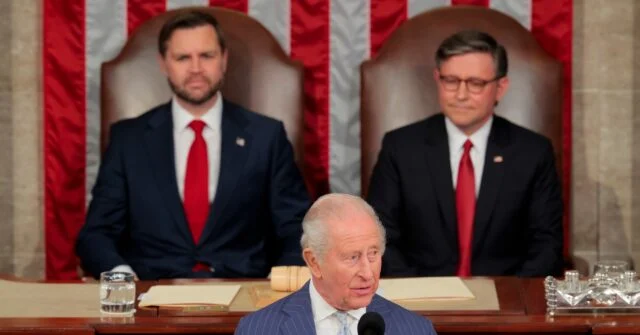
King Charles III delivered a historic address to the United States Congress, marking the 250th anniversary of American independence. In his speech, the monarch underscored the profound and enduring alliance between Great Britain and the United States, a relationship he described as grounded in shared values, history, and kinship. The King's address followed a meeting with President Donald Trump and First Lady Melania Trump at the White House.
Arriving at the Capitol, King Charles became only the second British monarch to speak before the American Congress. He followed in the footsteps of his late mother, Queen Elizabeth II, who made history as the first reigning British sovereign to address the body in 1991. The King began his remarks by expressing his sincere gratitude to the American people for their hospitality during this significant occasion, the "Semiquincentennial" anniversary of the Declaration of Independence.
With a touch of humor, King Charles assured the assembled lawmakers that his visit was not a "cunning rear guard action." However, he acknowledged the current global climate, noting that his address comes at a time of "great uncertainty." He specifically referenced ongoing conflicts in Europe and the Middle East, as well as the recent attempted assassination of President Trump and cabinet officials during the White House Correspondents’ Dinner.
Addressing the complexities of international relations, the King stated, "Whatever our differences, whatever disagreements we may have, we stand united in our commitment to uphold democracy, to protect all our people from harm, and to salute the courage daily risk their lives in the service of our countries." These words seemed to resonate with the current diplomatic landscape, potentially alluding to recent strains in the U.S.-U.K. relationship concerning responses to international crises.
Echoing sentiments previously expressed by President Trump regarding the shared heritage of the two nations, King Charles reflected on the deep historical roots of their connection. "Standing here today, it is hard not to feel the weight of history on my shoulder, because the modern relationship between our two nations, and our own peoples, spans not merely 250 years, but over four centuries," he remarked. He noted the long tradition of British sovereigns closely observing American affairs, stating, "It is extraordinary to think that I am the 19th in our line of sovereigns to study with daily attention the affairs of America."
The King conveyed immense respect for the U.S. Congress, referring to it as a "citadel of democracy" established to represent the will of the American people and champion fundamental rights and freedoms. He drew a parallel to his mother's 1991 address, recalling her presence in the same chamber and her words spoken under the gaze of the Statue of Freedom. "Today I am here to express the highest regard and friendship of the British people to the people of the United States," he affirmed.
King Charles highlighted that while disagreements are natural, the process of resolving them through democratic means often strengthens the bond between the two countries. He emphasized the unique historical foundation of their shared values, which are built upon open debate and deliberation. "time and again, our two countries have always found a way to come together, and by jove, Mr Speaker, when we have found that way to agree, what great changes brought about, not just for the benefit of our peoples, but of all peoples. This, I believe, is the special ingredient in our relationship."
He concluded by quoting President Trump's description of the U.S.-U.K. bond as "priceless and eternal, it is irreplacable and unbreakable." The King reiterated that the alliance forged over centuries is "truly unique," referencing Henry Kissinger's description of an Atlantic relationship built on the "twin pillars" of Europe and America. He stressed that this partnership is more critical now than ever, stating, "The challenges we face are too great for any one nation to bear alone. But in this unpredictable environment, our alliance cannot rest on past achievements, or assume that foundational principles simply endure. Ours is an indispensable partnership. We must not disregard everything that has sustained us for the last 80 years. Instead, we must build on it."