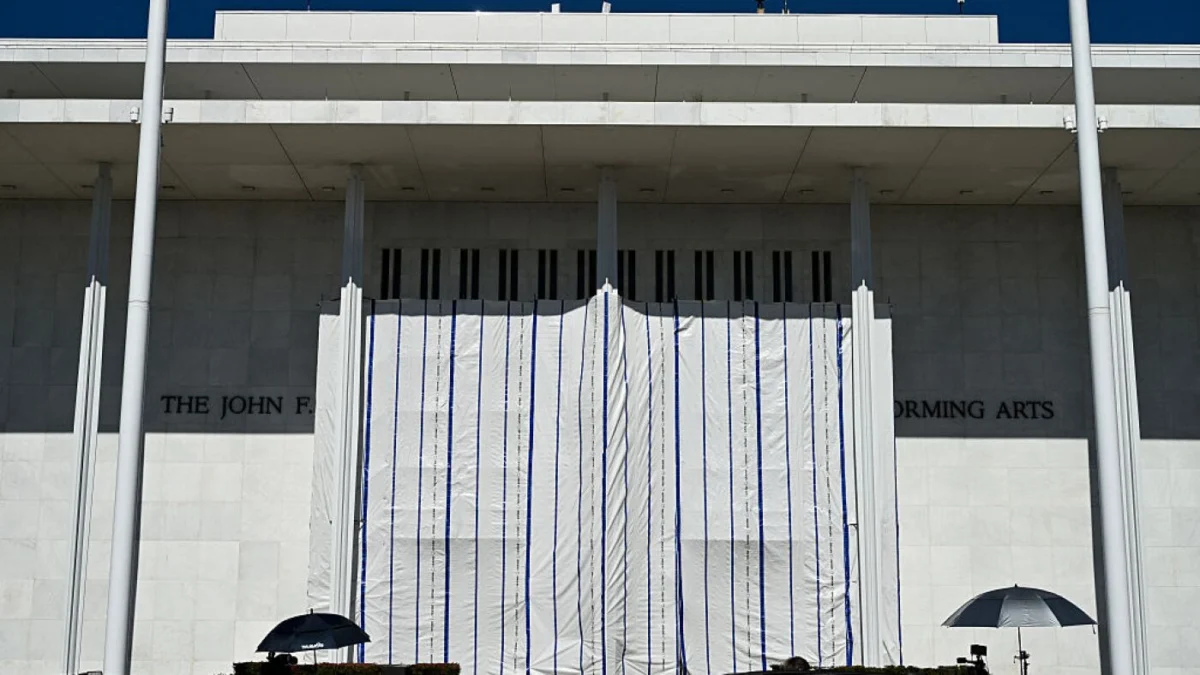
The Kennedy Center for the Performing Arts in Washington, D.C., completed the removal of President Donald Trump’s name from the building’s exterior, more than six months after it was originally affixed. Workers finished the operation early Saturday, following a court-ordered deadline issued for references to Trump to be eliminated from the site. The removal involved scaffolding around the section of the facade where the letters were installed in December 2025. In a pre-dawn effort, laborers covered the scaffolding with tarpaulins and then removed the large bronze letters. By Saturday morning, references to Trump on the exterior and on the center’s website had been removed.
The court had ruled that the Kennedy Center could not be renamed without Congressional approval, a decision that preceded the removal. In a court filing, Kennedy Center Executive Director and Chief Operating Officer Charles Matthew Floca confirmed that Trump’s name had been removed, noting weather-related delays cited by officials. The center’s website references to Trump were also taken down. The administration had argued in court that Trump’s name on the building aided fundraising for the Center’s renovation, but an appeals court denied a stay on the ruling Friday night.
Scaffolding was erected Friday around the facade portion where the name had been added in December 2025. Officials had sought a brief extension of the deadline due to Friday night thunderstorms forecast for the area, but the removal proceeded as planned once weather allowed. The event drew hundreds of observers, some documenting the moment and reacting in mixed fashion as tarpaulins concealed the removal work.
Among those present was Rep. Joyce Beatty of Ohio, who helped initiate the lawsuit seeking the removal of Trump’s name from the building, and several onlookers who commented on the symbolism of the action. Some observers, including a nurse named Mary Foltz, described the moment as illustrative of broader concerns about transparency and governance at federal institutions.
The episode highlights the interaction between branding, fundraising, and the oversight of public institutions, showing how legal rulings and governance choices can shape a cultural venue’s identity and its relationship with donors and the public.


