Long Beach, Calif. — Amidst a global automotive industry recalibration away from electric vehicles and significant financial losses, Ford Motor Company is steadfastly advancing its next generation of EVs. CEO Jim Farley has characterized these upcoming models as potentially industry-defining. This commitment persists despite a notable deceleration in EV adoption rates, the company incurring $19.5 billion in restructuring charges specifically for its electric vehicle division, the phasing out of U.S. consumer incentives for EV purchases, and the recent, unexpected departure of Ford's prominent EV and technology leader.
Alan Clarke, Ford's EV product leader, emphasized the critical role of adaptability in navigating these turbulent market conditions. Speaking from Ford's new Electric Vehicle Development Center in Long Beach, California, Clarke stated, "Agility is key. We've been able to pivot around all the different market conditions. The EV industry has had massive headwinds, and so we've had to adjust." Ford's sustained confidence, though tempered with a more cautious capital deployment strategy than initially projected, is anchored in its newly developed "Universal Electric Vehicle," or UEV, platform. This platform has been engineered from the ground up, with the ambitious objective of enabling Ford to achieve profitability and cost competitiveness against leading global EV manufacturers, particularly those from China and Tesla.
The UEV platform is positioned as instrumental in Ford's strategic pivot to transform its Model e EV division from incurring billions of dollars in annual losses to reaching breakeven by the year 2029. The company has publicly stated its expectation that future EVs built on this platform will achieve profitability within twelve months of their market introduction. The inaugural product slated for release based on the UEV platform is a midsize electric pickup truck, anticipated to be priced around $30,000 for the U.S. market, with a launch planned for the following year. This will be followed by a broader family of vehicles utilizing the same foundational platform.
Clarke expressed strong conviction regarding the forthcoming midsize pickup's market position, stating, "The midsize pickup truck, there won't be anything that competes with it, either in price or product form, and so I think it sort of stands alone in that sense." Clarke, who was employee number one of the previously clandestine "skunk works" team responsible for the UEV's development, has recently been elevated from a senior director to vice president of Advanced Development Projects. This promotion occurred shortly after the departure of Doug Field, Ford's highly regarded head of EV and technology, who announced his exit on April 15th. Clarke, who was recruited by Field, continues to speak positively about his former superior, and CEO Jim Farley has also maintained his praise for Field, a veteran of Tesla and Apple.
"He's set us up for success, as has Jim," Clarke remarked, referring to Field. "It's certainly not that nothing changes. I think it's at the stage we're in; this is the thing that's best for Ford, and I think Doug certainly recognized that, and it was the right time for him." Despite Field's departure and a less optimistic outlook for the domestic EV market, Ford's UEV initiatives are progressing. The rapid expansion of Chinese EV manufacturers, even before their formal entry into the U.S. market, has served as a significant motivator for Ford's UEV program. Farley has publicly acknowledged the innovation and quality of Chinese automakers' products, while simultaneously advocating for protective measures within the U.S. market.
"We are really fully committed to a level playing field here in the U.S. and also safeguarding our home market, because of the importance of the auto industry and our industrial base," Farley stated recently. Beyond the U.S., Ford and other global automakers are engaged in defending their market positions in regions like Europe and South America, having faced challenges from domestic competitors in China. Data from GlobalData indicates that the market share of Chinese brands has surged by nearly 70% over the past five years, prompting concerns among U.S. automakers about the potential impact of Chinese brands entering the American market.
Clarke conveyed a high degree of confidence in the UEV platform's ability to compete effectively against Chinese vehicles, while also noting the distinct operational environments. "The companies play by 'different rules,'" he explained, referencing the substantial government backing Chinese companies receive, coupled with their lower labor costs, among other factors. "We only win with speed, and we have to play by the rules here. We're pretty confident that we're going to be competitive, and we're really hungry to be seen as competitive, and we won't win, ultimately, unless we get down to the prices that American consumers are willing to pay for EVs like this."
While Ford has conducted extensive studies and teardowns of Chinese vehicles, the competitive landscape remains dynamic. Hundreds of Chinese automakers are introducing new models at an unprecedented pace. According to consulting firm AlixPartners, Chinese startups are capable of developing vehicles in approximately 20 months, which is half the timeframe of traditional global automakers. This accelerated development cycle means Chinese models are often two to three years fresher than their non-Chinese counterparts. "It's really not one thing, but it's series of things that lead them to be able to get to a sub-two year, very repeatable cycle of launching a vehicle," commented Mark Wakefield, AlixPartners' global automotive lead and executive partner, adding that Chinese companies dedicate approximately one-third less time to product validation. "It's a big challenge for all the car companies."
This rapid development cycle is a key reason why the UEV's initial product is targeted for North America. Concurrently, Ford is exploring partnerships with other automotive manufacturers, including France-based Renault, Germany-based Volkswagen, and reportedly, some Chinese firms, to enhance its global competitiveness. "Our focus in UEV right now is making a vehicle that can be sold anywhere, but our focus right now is really on the North American market," Clarke reiterated.
Ford harbors exceptionally high expectations for the UEV, a project that Clarke and his colleagues have referred to as a "moon shot." The company anticipates that the new EVs will achieve cost parity with internal combustion engine vehicles through the implementation of novel technologies and enhanced efficiencies. Key innovations include a more compact battery pack utilizing new, domestically produced lithium iron phosphate cells and a 48-volt electrical architecture designed to boost efficiency and reduce overall vehicle weight. Historically, the substantial size and cost of EV batteries have been major impediments to profitability and affordability.
Ford projects its Model e EV division will report a loss of $4 billion to $4.5 billion for the current year, an improvement from the $4.8 billion loss recorded in the previous year. The Detroit automaker has indicated that the new EVs will feature a 20% reduction in parts compared to the Ford Mustang Mach-E, with 25% fewer fasteners, a 40% decrease in the number of workstations required from dock to dock on the assembly line, and an assembly time that is 15% faster. CEO Jim Farley has drawn parallels between the significance of the UEV project and the historical impact of Ford's Model T, which he described as having "put the world on wheels." He has also characterized this U.S.-produced initiative as a $5 billion "bet" on American manufacturing.
"It represents the most radical change on how we design and how we build vehicles at Ford since the Model T," Farley stated last year at the Louisville Assembly Plant in Kentucky, which is slated to produce the electric midsize pickup. However, this is not the first instance where Farley has set ambitious expectations for Ford's EV endeavors that have not fully materialized. He previously described the all-electric F-150 Lightning as a "Model T moment" for the company, yet it fell short of expectations and is currently undergoing a redesign to incorporate hybrid technology. Furthermore, a planned three-row EV SUV was initially touted by Farley as a "personal bullet train" before the project's cancellation in 2024, attributed to the inability to ensure its profitability in the foreseeable future.
Ford executives believe they have assimilated lessons from these past challenges by concentrating on smaller, more accessible vehicles powered by the UEV platform, rather than larger trucks and SUVs where battery costs represent a more significant portion of the overall vehicle expense. The new pickup is designed with only two primary structural components—front and rear—a stark contrast to the 146 such components found in the current gasoline-powered Maverick small pickup. This simplification is achieved through the adoption of megacasting, a manufacturing technique involving pouring molten materials like aluminum into large molds to create integrated parts, thereby reducing the total number of components required for vehicle assembly.
Mitch Shinn, a thermal systems engineer on Ford's advanced EV team, elaborated on this philosophy during the media event at the facility: "We like to say that the best part is no part, and the second best part is a part that serves multiple purposes." Farley has more recently emphasized that the advanced EV team's impact extends beyond product development; the division and its new facility are instrumental in redefining how Ford conceives, develops, and manufactures products across its entire vehicle portfolio. The "skunk works" team was initially established in California around 2022 with the objective of forming a compact, agile unit operating with reduced bureaucracy and streamlined processes compared to the typical operations of a large corporation like Ford.
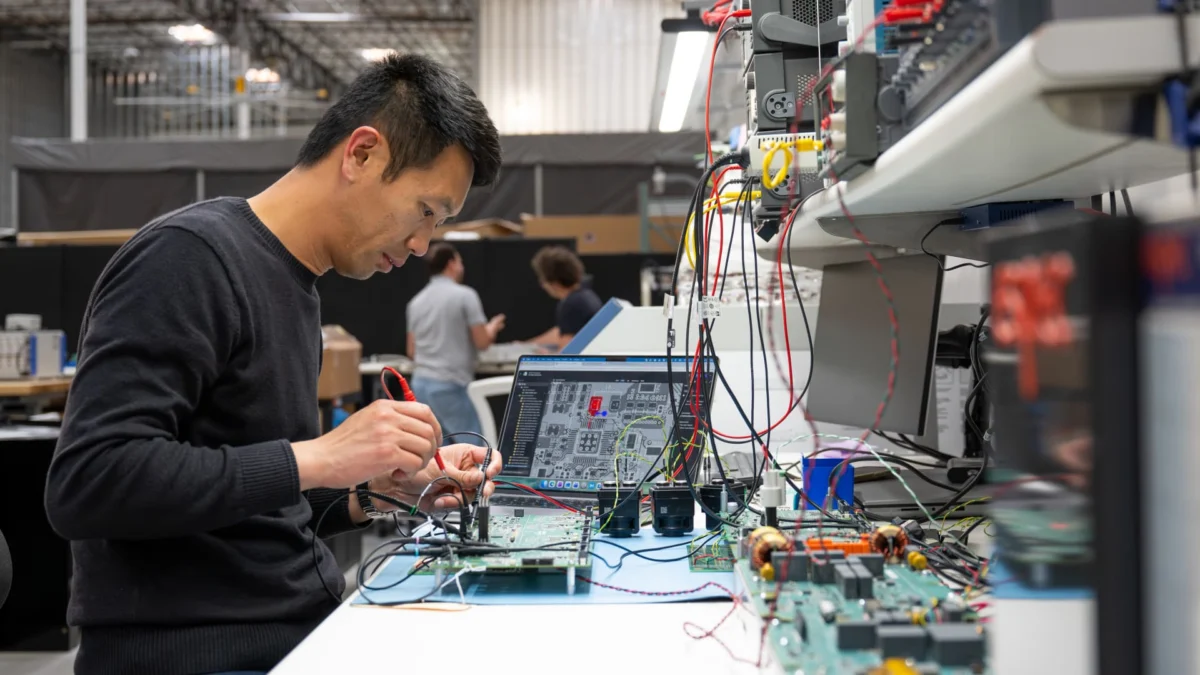
"We're also leaning into the skunk works model to improve all of Ford," Farley stated. "They've done an incredible job creating the UEV platform, which represents a step change in efficiency and cost, especially for the EV market. But, at Ford, we're now integrating these skunk work breakthroughs back into our mainstream products and processes." The new Electric Vehicle Development Center in Long Beach, California, offers a tangible insight into Ford's continued commitment to its all-electric vehicle ambitions and its specialized "skunk works" team. The facility, comprising two buildings totaling 270,000 square feet, is situated in an expanding industrial park near the Long Beach airport. Approximately 350 employees from diverse professional backgrounds, including former employees of Tesla, aerospace, and defense industries, as well as Ford veterans, are actively engaged in laboratories, design studios, and office spaces within the complex.
Ford is also developing a 150,000-square-foot testing and validation facility at the same location. Clarke indicated to CNBC that while the pickup truck's development was handled by the original, confidential skunk works team, the new facility is being equipped for the development of future EVs. Although he declined to provide specific details about upcoming EV models, Clarke confirmed that the facility provides the capacity to work on additional vehicles for the UEV platform, as well as next-generation products. This forward-thinking approach, often associated with the consumer electronics sector, appears to be a deliberate strategy for the automotive industry. "We can hit this goal of getting it out next year," Clarke concluded. "What you saw here is a big investment in … future products in general. We want to go faster than we were able to go."


