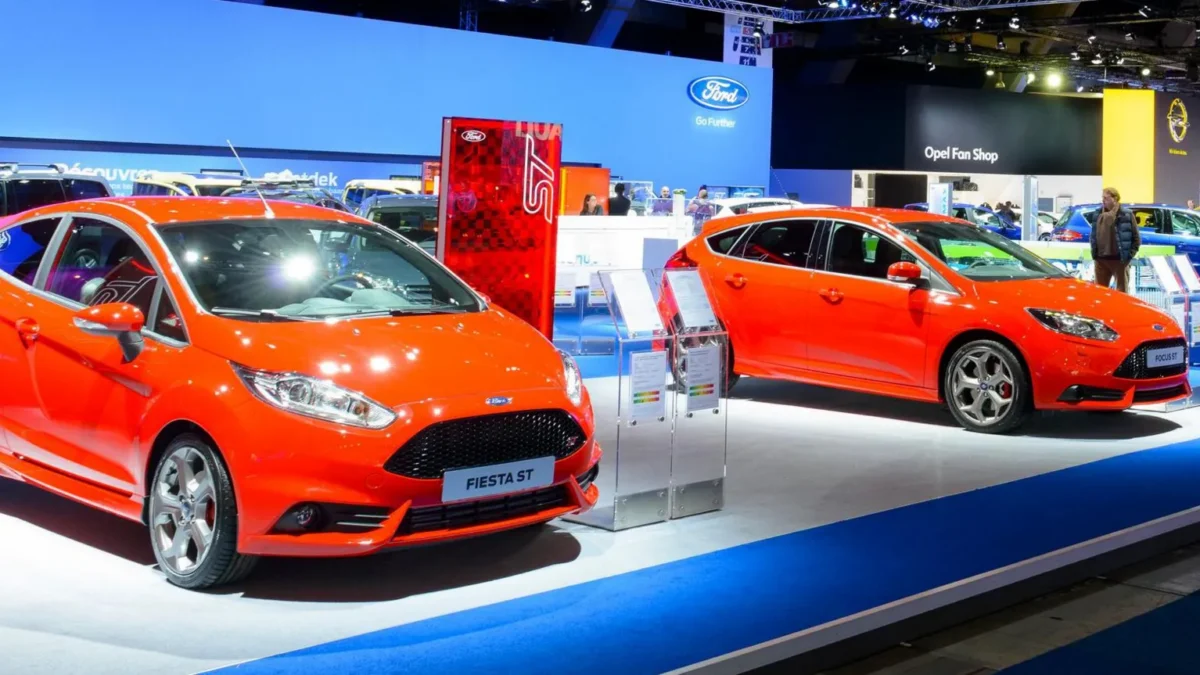
The iconic Ford Fiesta, a beloved fixture on UK roads for nearly half a century, may be poised for a revival as an affordable electric vehicle (EV). Jim Baumbick, the president of Ford in Europe, has strongly indicated that the popular brand could return, signaling a potential shift in Ford's strategy back towards mass-market appeal.
For 47 years, the Fiesta served as a dependable and accessible vehicle, cherished by a wide range of drivers, from young commuters to budget-conscious motorists. However, declining sales, escalating production costs, and Ford's strategic pivot towards more premium models led to the discontinuation of the Fiesta. The last model rolled off the assembly line in 2023, marking the end of an era for one of Britain's best-selling cars.
Baumbick recently told the BBC that he would have "news to share in the future" regarding the Fiesta brand. This statement comes as Ford announced ambitious plans to introduce seven new models in Europe, including a compact electric hatchback that is already being informally dubbed the "electric Fiesta" within automotive circles. This new strategy, according to Baumbick, signifies a renewed commitment to the European mass market with a focus on developing affordable vehicles.
He addressed concerns about competing with Chinese brands, which have been rapidly expanding their market share in Europe. Baumbick asserted that Ford's plans are not too little, too late. The upcoming lineup will feature three all-electric vehicles: the aforementioned hatchback, a small SUV, and an electric van named the Transit City. The remaining four models will be "multi-energy" vehicles, designed to accommodate various powertrains, including hybrid options.
Five of these new passenger vehicles are slated for production in Europe, specifically for the European market. When questioned directly about the possibility of reviving the Fiesta nameplate, Baumbick stopped short of a definitive confirmation but provided a strong hint. "I have nothing to share today," he stated, "but I can assure you that there is no doubt in my mind. I know there's so much love for the Fiesta and the Fiesta name, and we'll have some news to share in the future."
First introduced in 1976, the Fiesta quickly established itself as a popular choice for consumers seeking smaller, fuel-efficient cars. It consistently ranked high on bestseller lists, and over its production run, more Fiestas were sold in the UK than any other car model. Globally, a remarkable 22 million units were produced before the final car left the factory in 2023.
However, by the time of its discontinuation, the Fiesta's dominance had waned. In 2022, it ranked as the 10th most popular model in the UK, reflecting a broader shift in consumer preferences away from small hatchbacks towards larger vehicles. Concurrently, Ford began to move away from its traditional focus on affordable, everyday cars, exemplified by the discontinuation of the Mondeo the previous year, to concentrate on more upmarket offerings. The company also set an ambitious target to become an all-electric manufacturer by 2030.
By 2024, it became evident that this strategy was not yielding the desired results. Ford announced significant job cuts across Europe, attributing them to weak demand for EVs and intense competition from Chinese manufacturers. This led to a strategic reassessment, bringing the company's focus back to the development of affordable vehicles. While still investing in new EVs, Ford is also planning new hybrid models that will incorporate internal combustion engines.
Baumbick explained that the industry's rapid push towards electrification may have outpaced consumer readiness. "I think the whole industry's been focused on that, but the reality is customers, real people are getting lost in the middle of this," he remarked. Ford has publicly urged policymakers in Brussels and London to reconsider their approach to electrification, advocating for support and encouragement of technologies like plug-in hybrids and extended-range EVs as part of a "practical pathway" to an electric future.
A significant challenge for Ford is whether its return to mainstream production comes too late. During Ford's strategic shift away from the mass market, Chinese automakers like BYD and Chery have aggressively entered the European market, posing a substantial threat to established players. Nevertheless, Baumbick remains confident in Ford's ability to compete. "Yes, there are a lot of Chinese firms that are actually flooding the market," he acknowledged. "What's different about Ford is we've been here for 100 years, and I have one mission on this assignment, and that is to build a sustainably profitable business in Ford for the next 100 years."
Ford has also faced financial headwinds, reporting an additional $900 million tariff hit last year. The company's leadership has voiced opposition to taxing electric vehicles at this stage of their development, arguing that such measures could hinder adoption. The automotive industry, particularly the electric car sector, is navigating a complex landscape of evolving consumer demand, intense global competition, and shifting regulatory priorities.


