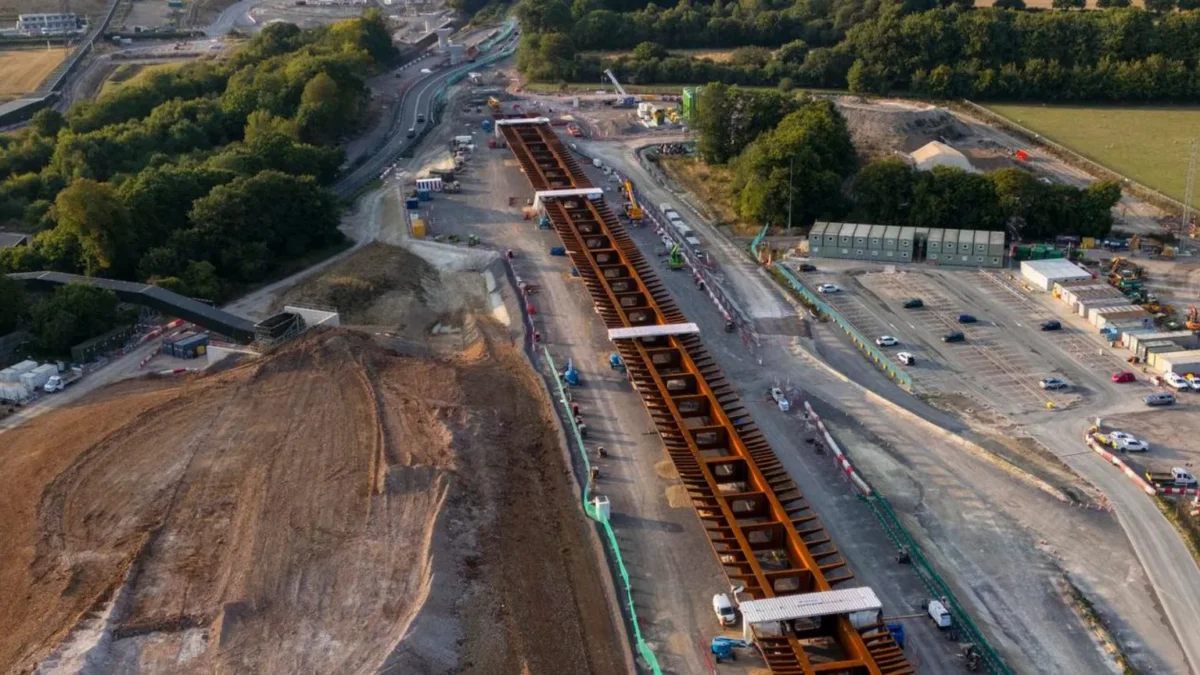
The High Speed 2 (HS2) rail project stands at a critical juncture, presenting a stark choice between complete abandonment or the completion of a significantly scaled-back version. Economics editor Faisal Islam highlights that despite the considerable investment already sunk into the project, including numerous viaducts, tunnels, and specialized facilities, the path forward remains uncertain.
One potential outcome is the outright cancellation of HS2. However, HS2 boss Mark Wild has estimated that the costs associated with such a cancellation, including necessary remediation efforts, would be comparable to the expense of completing the line from its current stage. This estimated cost for cancellation and remediation is approximately £60 billion. When added to the expenditures already made, the total investment in what is described as the world's most expensive railroad could reach around £100 billion.
The alternative path involves proceeding with a truncated version of HS2. This scaled-back ambition would see the line connecting only west London with Birmingham, with an expected completion date in the late 2030s. This represents a significant reduction from the original vision.
The initial concept for HS2 was an ambitious Y-shaped network designed to link London with Birmingham, and then extend branches to Manchester and Leeds. The strategic rationale behind this extensive plan was to enhance both capacity and speed on the UK's rail network. The aim was to foster economic growth and rebalance the nation's economy by improving connectivity between major service sector hubs.
However, the subsequent decisions to scrap the legs to Leeds and then Manchester have fundamentally undermined this original strategic case. A senior civil servant from the Department for Transport acknowledged that the project's stated objective of generating transformational benefits and rebalancing the economy by connecting northern England and the Midlands with London "no longer applies." This leaves the project with a justification that no longer aligns with its physical scope.
The current iteration of HS2, which stops at Birmingham, has seen its budget significantly increased, partly to manage costs south of Birmingham and potentially to appease concerns in certain counties. Furthermore, the planned connection to the West Coast Main Line (WCML) is not anticipated to be operational until between 2040 and 2043. This delay introduces further complications.
Adding to the challenges, HS2 trains were originally designed for the straighter, high-speed HS2 lines. When these trains transition onto the WCML, they will be unable to tilt around its bends. Consequently, they will operate at a slower speed of 110 mph, compared to the existing Avanti pendolinos which can reach 125 mph. This creates a paradoxical situation where new, expensive trains will run slower than existing services on the crucial WCML.
The WCML itself is already operating at maximum capacity, handling up to 15 trains per hour, making it the busiest mixed-use line in Europe. The continued reliance on this Victorian-era infrastructure, built in the 1840s, as a critical component of the modern rail network is unsustainable. This complex web of issues, including cost overruns, reduced scope, and infrastructure limitations, paradoxically suggests that the western leg of HS2 might still be completed in its entirety.
This is partly due to the government's existing commitment to Northern Powerhouse Rail, which utilizes HS2's legal powers and the established route in central Manchester. Once the significant costs for the London-Birmingham section and the Cheshire to Manchester segment are incurred and considered sunk, completing the line from Birmingham to Manchester Airport could offer the maximum benefit for the least additional cost. Lower land acquisition expenses and a reduced need for costly engineering solutions, such as extensive tunnels and viaducts seen elsewhere on the line, would contribute to a significantly lower cost per mile for this remaining section. This development occurs at a time when numerous countries globally, from Japan to Spain and Morocco to Uzbekistan, are demonstrating an enhanced ability to deliver high-speed rail lines more affordably and efficiently. The UK government aims to demonstrate that lessons have been learned from HS2's overspecification and the hasty awarding of contracts, though it will have been an expensive lesson indeed.


