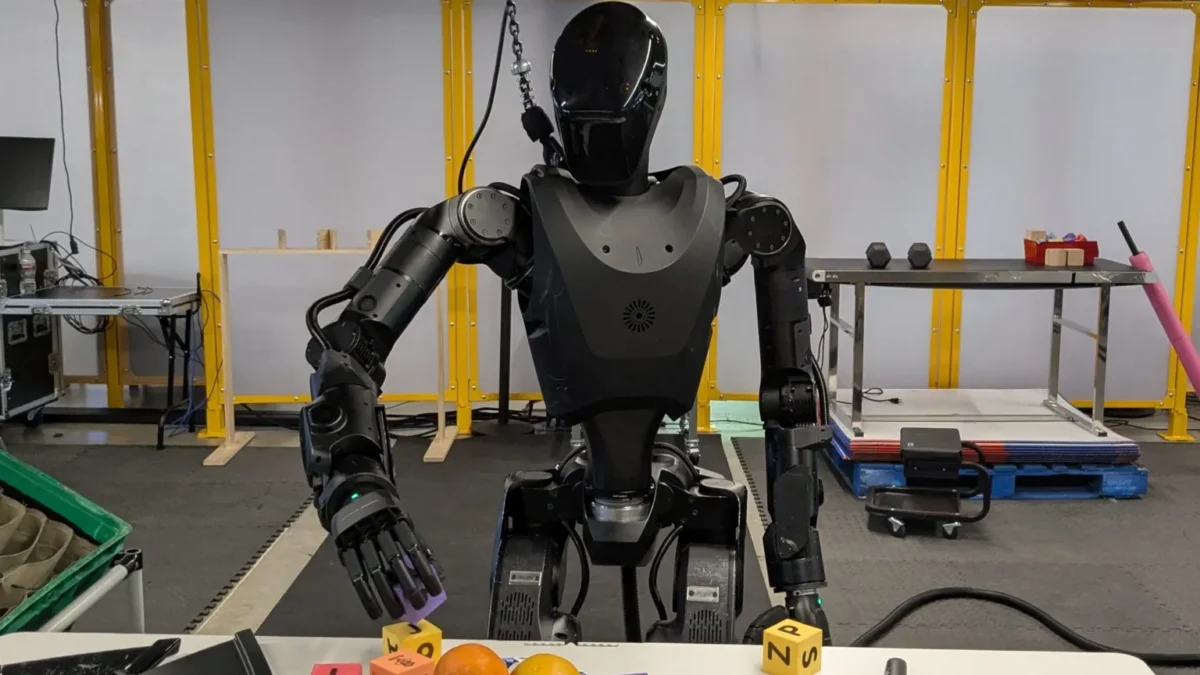
In a San Francisco industrial complex, a sleek, black Phantom humanoid robot sits idle, its glossy exterior reflecting the room’s lights as it plays with colorful blocks. The moment underscores a broader story about Foundation Robotics, a two-year-old company with a vision that stretches from factories to battlefields. Its co-founder and chief executive, Sankaet Pathak, explains that data will come from the robot’s interactions with its environment, describing this “free play” as today’s demonstration menu.
The demonstration shifts as Pathak rolls the 80-kilogram, steel-covered machine across the floor to show its stability and walking ability. Foundation asserts it is the only U.S. firm pursuing a humanoid platform explicitly designed for a broad set of defence applications. The company envisions roles ranging from supply pickup and reconnaissance to the recovery of equipment or casualties and hazard inspection. More controversially, Pathak frames frontline weaponisation as a potential use case, arguing that arming robots could keep human soldiers out of harm’s way and improve entry into buildings where chokepoints threaten lives. He contends land-based autonomy can be more precise than air strikes in some contexts, though he stresses the need for human oversight before any lethal action.
The Phantom’s current generation, Phantom MK-1, has no battery, is not dust- or waterproof, and cannot self-right after a fall. A second-generation model is under development in a restricted area of the facility. Pathak says Phantom MK-2 will be weather‑proof, feature a larger battery delivering roughly six hours of runtime, and be able to recover from a fall while withstanding greater forces. The next phase includes hands with improved dexterity and wrists that could enable weapon handling, according to Pathak.
Foundation’s ambition is ambitious: to produce at least 40,000 units per year by the end of 2027, with long‑term costs trending below $20,000 per unit. Pathak argues that China is pursuing similar capabilities and urges the West to keep pace. He also notes that Synapse, a financial services firm he co-founded and once led, filed for bankruptcy in 2024, framing the Foundation venture as a proving ground for his leadership.
Pathak offers a cautious view on the battlefield potential. He says, “If there was a war in Taiwan today, the likelihood that China is going to militarise these humanoids and fight effectively is fanciful,” but he does not dismiss the possibility entirely. Analysts and researchers point to a broader debate about the role of humanoids in warfare and the ethical issues surrounding lethal autonomous weapons, with proponents arguing they could reduce risk to soldiers and opponents warning of dehumanised conflict and accountability challenges.
Researchers at the Florida Institute for Human and Machine Cognition, including a scientist named Griffin, study humanoid robots funded in part by military projects focused on non-combat uses. Griffin cautions that unpredictable environments remain a major hurdle, noting that robots must cope with open-ended uncertainty in real-world settings. He also highlights the power demands and six-hour runtime as continuing engineering challenges, especially for robotic hands capable of manipulating tools or weapons designed for humans.
Meanwhile, the ethical dimension draws scrutiny from groups like Stop Killer Robots. Nicole van Rooijen, its executive director, warns that lethal autonomous weapons lower barriers to warfare and blur accountability. She argues for international rules to de‑escalate the arms race as civilian applications of humanoid robots expand and public familiarity grows with human-like machines.
The debate also features competing views on technology choices. Some in the field question whether humanoid forms are the most effective platform for battlefield tasks, pointing to quadruped and other legged robots that can traverse terrain more efficiently. Still, Pathak maintains humanoid robots align with the human-centric world, arguing that tools—from screwdrivers to weapons—can be used in familiar ways, provided humans remain in the loop to authorize lethal force when necessary to avoid catastrophic outcomes.
Foundation’s current testing includes two units in use by the Ukrainian military, and a U.S. military pilot program limited to non‑weapon handling, with weaponisation still under testing in Ukraine, Pathak says. The company has attracted attention earlier in the year after Eric Trump became an investor and adviser. Pathak emphasizes that the Foundation project is about pushing technology forward, even as the broader military-industrial complex weighs the real-world demands and ethical limits of humanoid soldiers.
In a field where rapid advances collide with moral questions, the Phantom project maps onto a larger trend: as AI and robotics mature, the potential for autonomous systems in defense grows increasingly plausible. The outcomes—both strategic and ethical—will hinge on engineering breakthroughs, international norms, and how decision-makers balance human oversight with the pace of machine capability.


