According to the original report, communists and socialists globally marked their traditional May Day holiday on Friday, engaging in a variety of events including parades, marches, and official pronouncements. In China, the ruling Communist government, through its state-run publication Global Times, anticipated a surge in travel and consumer spending during the May Day holiday. The newspaper projected that strong economic growth in the first quarter of 2026 would fuel this “May Day travel and consumption boom,” which it claimed would serve as validation for the “strong resilience, inherent vitality, and steady upward momentum of China’s economy.” The Global Times focused heavily on the potential economic benefits of increased consumer activity, describing the anticipated boom as a “vivid manifestation of the holiday economy” and an “organic integration of residents’ consumption upgrading and high-quality economic development.” This emphasis on consumption and economic metrics appeared to overshadow the historical ideological underpinnings of May Day, a focus that might have been met with dismay by the holiday’s original proponents.
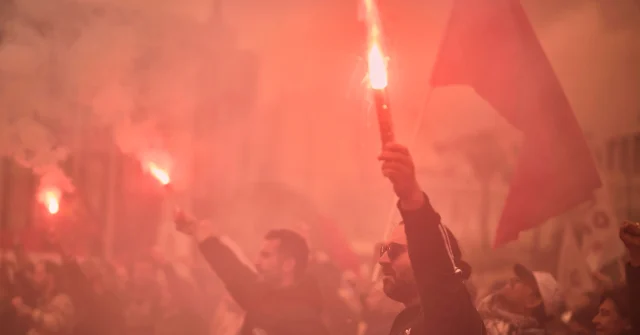
Meanwhile, Vietnam maintained a more traditional observance. In Hanoi, a parade took place on Tuesday, organized to “recognize the contributions by Vietnamese workers to national socio-economic development.” Approximately 1,000 participants waved red flags and chanted slogans. The Vietnam General Confederation of Labor (VGCL) highlighted that May Day 2026 marked the 140th anniversary of International Labor Day. This day of observance originated with a significant strike in Chicago’s Haymarket Square in 1886, protesting long working hours. The socialist Second International officially declared May Day in 1889, retroactively linking it to the Haymarket events.
Thai Thu Xuong, Standing Vice President of the VGCL, spoke about the enduring significance of May Day over its 140-year history. He stated that the holiday has evolved into a potent symbol for the global labor movement, serving to celebrate the inherent value of work and the collective strength of the working class. This sentiment underscores the holiday’s continued relevance in recognizing labor’s role in societal progress.
The Cuban Communist government held a rally in Havana, with notable attendance from Army Gen. Raul Castro Ruz, a key figure in the Revolution, and President Miguel Diaz-Canal. The Cuban event adopted a more confrontational tone compared to the marches in Vietnam. Speakers at the rally vehemently denounced the “intensified economic, commercial, financial, and energy blockade imposed by the United States government.” Yolaidis Hernandez Valdes, representing the Chemical Industry Business Group, invoked the legacy of Fidel Castro, stating, “Fidel Castro continues to call us to resist and win. In the most difficult circumstances, there has not been, and will not be, an impossible task.”
Further emphasizing resilience and defiance, Osnay Miguel Colina Rodriguez, president of the Organizing Commission of the 22nd Congress of the Central Workers of Cuba (CTC), declared, “Our enemies have tried and tested everything. They thought they would see us afflicted, surrendered, and here we are, committed and firm with our foot in the stirrup and fighting.” These statements reflect a determination to persevere despite external pressures.
North Korea’s May Day celebrations were characterized by mandatory expressions of unwavering loyalty to the Kim dynasty and its guiding “Juche” ideology. All state-run publications were required to publish editorials praising the regime’s accomplishments. The Rodong Sinmun, a prominent state newspaper, described May Day as a “significant holiday powerfully demonstrating the revolutionary spirit of the Korean working people who have made epoch-making miracles and changes through their unyielding struggle under the leadership of the great Workers’ Party of Korea despite all sorts of trials.”
The Rodong Sinmun editorial further elaborated on the connection between the working people and the state’s achievements. It proclaimed that “The Juche weaponry carrying the absolute strength of the DPRK and the proud creations symbolizing the era of overall transformation are associated with the boundless loyalty of our working people, and the pure patriotism of our working class and agricultural workers is also reflected in the independent development foundations of the national economy and the rapid growth of agricultural production.” The publication concluded by asserting, “As there are the working people upholding the Party and the state with their precious sweat and passion while sharing the destiny with the country, our Party is so strong and Korean-style socialism is always emerging victorious.”
In the United States, American socialists organized a call for an economic “blackout” on Friday, urging people to participate in “no school, no work, no shopping.” This action was intended as a protest against “a nation that puts workers over billionaires.” The coalition behind the May Day protest also advocated for an end to immigration enforcement, cessation of military conflicts, and increased taxation on the wealthy.