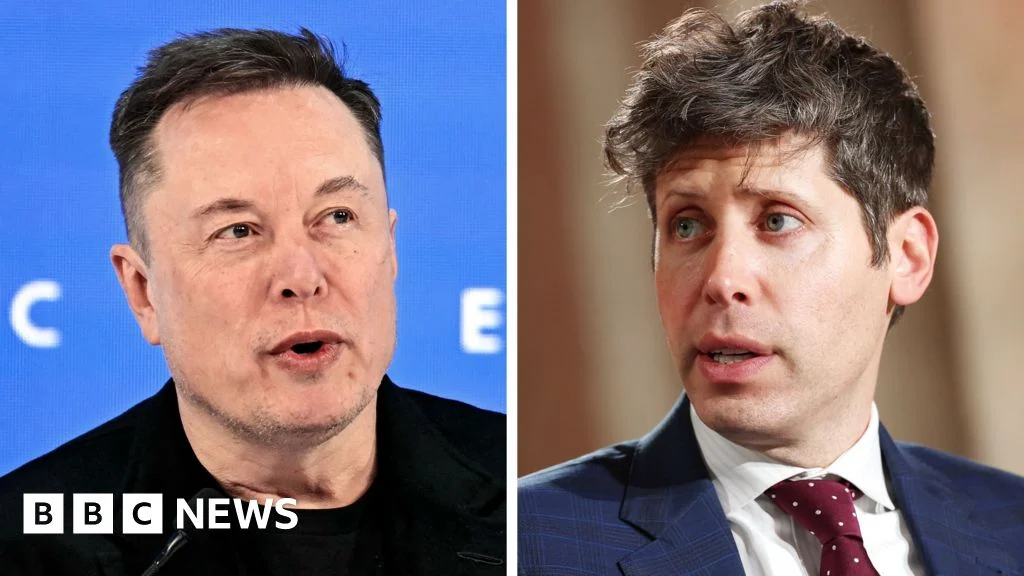
The high-stakes legal battle between tech titans Elon Musk and Sam Altman, centered on the future of OpenAI, has concluded its evidentiary phase, leaving a jury to deliberate on claims of betrayal and a fortune allegedly lost. The trial, which unfolded over three weeks in a California federal court, delved into the complex relationship between the OpenAI co-founders and exposed the inner workings of power dynamics within one of the world's most valuable startups. At the heart of the dispute is Musk's assertion that Altman, his former friend and the current CEO of OpenAI, "stole a charity" and defrauded him out of a significant sum, a charge Altman vehemently denies.
However, the courtroom drama extended far beyond this central accusation. Reporters covering the proceedings witnessed a cascade of evidence, including explosive text messages and allegations of preferential treatment, such as free Teslas purportedly offered in exchange for crucial power agreements. Presiding over the case was a judge known for her no-nonsense approach, who will ultimately weigh the jury's verdict. For those who have followed the intricate details, five pivotal moments and revelations emerged from this intense legal confrontation.
**Beyond the Binary: A Chorus of Contradictions**
Elon Musk's primary contention in the lawsuit is that Sam Altman misled him regarding his commitment to maintaining OpenAI's non-profit status. Yet, the trial evolved into more than just a direct conflict between two prominent figures. A significant number of witnesses, many of whom are themselves influential personalities in the technology sector, testified. These individuals stated they had no recollection of, nor had they seen any evidence of, such a commitment from Musk himself. Among the notable witnesses were OpenAI co-founder Ilya Sutskever, former board member Tasha McCauley, and Microsoft CEO Satya Nadella. Nadella emphasized that Microsoft conducted extensive due diligence before investing billions into OpenAI, a company for which Microsoft serves as a co-defendant, accused by Musk of complicity in Altman's alleged scheme.
The sheer volume of testimony contradicting Musk's claims was striking. The narrative presented was not solely Musk versus Altman; rather, it featured a broad spectrum of voices challenging the assertions of one of the world's wealthiest individuals. This collective testimony underscored a significant divergence from Musk's central argument, suggesting a more complex reality surrounding his alleged commitment to OpenAI's original mission.
**Scrutiny of Altman's Character and Dealings**
Despite receiving strong support from various witnesses on the stand, Sam Altman's trustworthiness remained a focal point of intense scrutiny throughout the trial. In the weeks preceding the legal proceedings, a profile in The New Yorker by Ronan Farrow had already cast a critical light on Altman's career, particularly his dramatic ousting from OpenAI in 2023, portraying him as a "pathological liar." Musk's legal counsel, Steven Molo, effectively leveraged this narrative during cross-examination. When asked if he was "completely trustworthy," Altman responded affirmatively, only for Molo to press further, questioning his certainty. While Altman sought to clarify his answer to a definitive "yes," his character was subjected to rigorous examination.
Former OpenAI board members and executives provided firsthand accounts of instances where Altman allegedly lacked candor. The court also heard about Altman's substantial investments in private startups, some of which had secured business agreements with OpenAI. A power purchasing agreement with Helion Energy, a nuclear energy startup that has not yet generated any power, was highlighted as a particular concern. This was especially notable given Altman's recent role as chairman of Helion's board and his ownership of a stake valued at over $1.5 billion.
**The Judge's Firm Hand: A Courtroom Managed with Precision**
The trial, dubbed "Musk v Altman," was not solely defined by the tech magnates; other significant figures played crucial roles. Judge Yvonne Gonzalez Rogers, who presided over the proceedings, maintained a disciplined courtroom environment. She enforced a strict schedule for jurors, legal teams, and the media, allowing only two twenty-minute breaks daily and no lunch recess, aiming to maximize alertness. The judge demonstrated complete control, readily reprimanding anyone who violated the established rules, whether it was observers taking unauthorized photographs or lawyers straying into areas the court had deemed off-limits.
However, the judge also displayed moments of levity. When audio issues disrupted the court early on, she acknowledged the problem with a dry remark: "What can I tell you? We are funded by the federal government." The visual narrative of the trial, which was not live-streamed, was vividly captured daily by sketch artist Vicki Behringer, whose watercolor renderings brought the courtroom drama to life.
**Personal Revelations and Shifting Alliances**
Once, Elon Musk was a figure of admiration for Sam Altman. The unraveling of their relationship, however, was not the only deeply personal aspect brought to light. Musk, initially projecting confidence and even combativeness as the first witness, appeared visibly unsettled when questioned about his relationship with Shivon Zilis, an executive at his company Neuralink and the mother of four of his children. He acknowledged they "live together" and described her as a senior advisor.
Zilis testified that Musk had offered her his sperm after noting she had no children, an unusual interaction within a professional context. She later revealed to OpenAI colleagues that Musk would be the father of her children only when a media report was imminent. Her demeanor on the stand was described as almost robotic, contrasting with a warmer tone evident in text messages where she appeared to function as an "Elon whisperer." Zilis eventually departed the OpenAI board after Musk launched xAI, a move she explained in a text to a friend: "When the father of your babies starts a competitive effort and will recruit out of OpenAI, there is nothing to be done."
**Silicon Valley Power Plays: Free Teslas and Frantic Texts**
The Musk v Altman case offered an insider's view into the mechanisms of power in Silicon Valley. The trial illustrated how influence is exerted, from alleged attempts to lowball co-founders with free Teslas by Musk, to claims of securing loyalty through side payments to key partners by Altman. Musk's legal team sought to undermine Altman's credibility by portraying him as someone who exploited his connection with Musk to enhance his own standing. Conversely, Altman alleged that Musk had proposed that control of OpenAI should be transferred to his children.
Text messages presented during the trial provided a candid look at behind-the-scenes power struggles. These communications revealed Altman's frantic reaction to his unexpected dismissal in 2023, including a message to a former colleague asking, "still don't want me?" The colleague, in turn, referred to Emmett Shear, the then-CEO of Twitch, as a "rando Twitch guy" in a message discussing Altman's replacement. While such seemingly casual messages, alongside images of these prominent figures sipping lattes, might suggest a diminished sense of importance, these individuals nonetheless wield considerable influence over technologies that affect billions globally. Their dispute, now before the jury and ultimately Judge Gonzalez Rogers, is valued in the billions of dollars, with the final decision pending.


