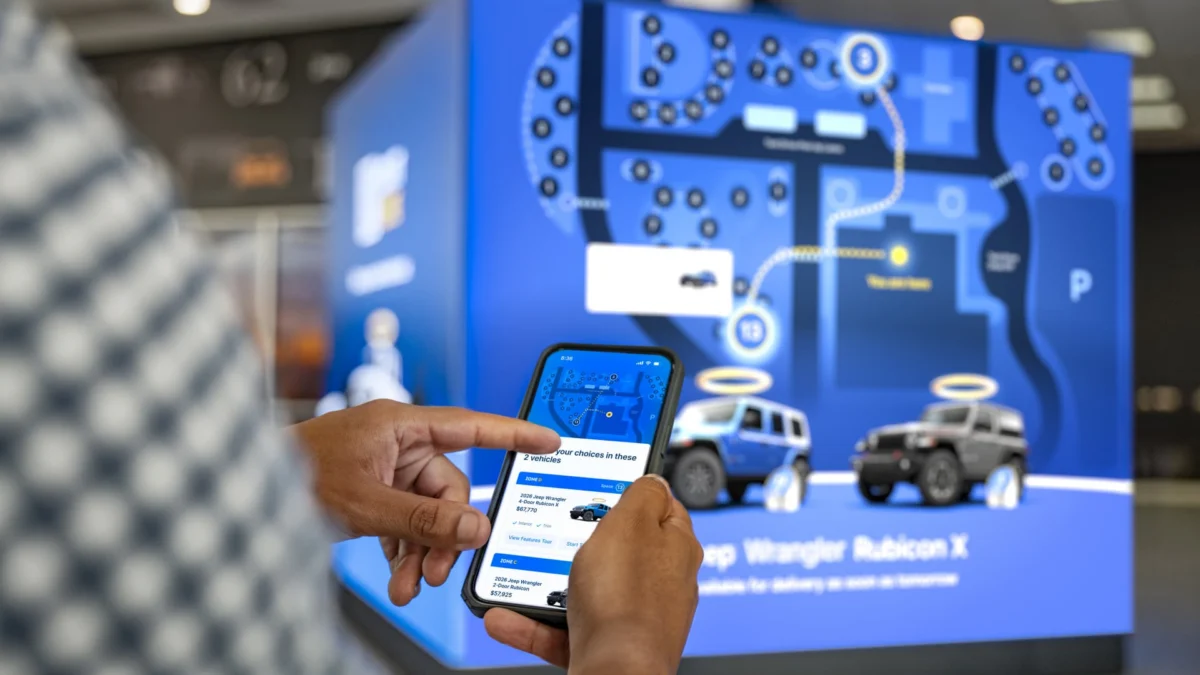
DALLAS — Carvana is testing a novel approach to selling new vehicles by repurposing Stellantis franchised dealerships into spaces that prioritize online transactions, test drives, and hands-on displays over traditional on-site sales pressures. The Dallas location functions not as a conventional showroom, but as a hybrid space where customers can explore, customize, and arrange test-drives largely through Carvana’s online platform. The aim, according to Carvana, is to keep the core buying journey online while offering on-site services and a self-guided shopping environment that minimizes in-person negotiation.
Inside the Dallas facility, the former showroom has been reimagined into themed zones and a play area with roughly 50 display vehicles, divided by brand lines such as Jeep, Dodge, Chrysler, and Ram. Shoppers use smartphones and QR codes to learn about features, configure options, and schedule test-drives, with the final purchase taking place on Carvana’s online platform. There is no traditional finance office on site; instead, associates are hourly staffers available to assist as needed, reflecting Carvana’s emphasis on a streamlined, “hassle-free” experience and transparent pricing.
Tom Taira, Carvana’s president of special projects who leads the new-vehicle push, told CNBC that the principle is clear: every car sold, whether used or new, is online. He framed the Dallas concept as a controlled deployment of Carvana’s online-first model into new-vehicle sales, while still offering on-site service and maintenance in a more conventional fashion.
Carvana’s objective for its new-vehicle initiative is to expand market share and attract new customers, while leveraging trade-ins and other methods to support used-vehicle sales. Taira described the plan as a way to scale the Carvana approach rather than replicate the exact in-store experience from the used-vehicle business. During a Dallas media event, he emphasized that the strategy targets consistency with Carvana’s existing methods for selling cars to used-car customers, stating, “When we got into new cars, we said the only way we’re going to make this happen is to ensure that it goes the Carvana way.”
The Dallas playground houses about 50 display vehicles aligned with Stellantis brands, creating zones tailored to Jeep, Dodge, Chrysler, and Ram. The design enables a self-guided shopping flow: customers scan QR codes to access product information, explore features, and arrange test-drives before deciding whether to complete a purchase online. If a preferred model isn’t immediately available on-site, Carvana’s online system aims to match a close alternative to fit the buyer’s preferences.
Carvana disclosed a substantial investment in acquiring Stellantis dealerships to pursue this strategy, spending about $171 million on these acquisitions, excluding a recent Ohio retailer purchase, according to public filings. Taira indicated that the investment is intended to raise market share and expand Carvana’s “pie,” though he declined to provide current or future new-vehicle sales figures or expansion plans for additional Stellantis stores.
The Dallas rollout also shines a light on how Carvana intends to blend its online selling model with on-the-ground operations. CNBC reported that Carvana achieved a certification as a Stellantis website provider, enabling integration of new-vehicle sales into its site without third-party intermediaries. Stellantis confirmed to CNBC that Carvana operates as a corporate owner of its brands and applies standardized dealer-partner criteria, with certified providers undergoing onboarding and program standards.
Carvana’s approach appears to be designed to reduce the friction of the traditional sales process while maintaining the company’s broader logistics network and nationwide footprint. The Dallas location is not presented as a blueprint for an immediate nationwide rollout; Carvana’s executives stressed that the primary objective is to validate the model at one site, with a measured pace for potential replication.
Inventory constraints are central to the Dallas experiment. Unlike conventional dealerships that stock a broad array of vehicles for immediate test drives, Carvana’s Dallas playground features about 50 on-site vehicles. Nationwide, Carvana’s new-vehicle inventory is relatively small compared with its vast used-vehicle catalog, and the company declined to disclose exact new-vehicle sales or detailed expansion plans beyond the initial implementation. In practice, customers may not find the exact vehicle they want to test-drive on-site, but the online process aims to guide them toward the closest match.
Taira noted that Carvana’s choice of Stellantis as the partner for this venture reflects the automaker’s breadth of brands and product options, acknowledging that this can be a double-edged sword if the exact model is unavailable for on-site testing. He emphasized that Carvana plans to refine which stock to keep based on customer feedback and ongoing learning from the Dallas experiment, while prioritizing clarity that customers are purchasing a new vehicle rather than a used one.
Regarding financing and payment, Carvana continues to offer cash and company-backed financing, with auto loans originated by Carvana itself and sold to institutional investors and partner banks, including Ally Financial, to maintain liquidity. While leasing or tapping Stellantis’ financial services remains a possibility, any such offerings would need to integrate seamlessly into Carvana’s online purchasing flow. Taira stressed that the on-site experience leverages existing systems and could evolve with future integrations as the company learns from ongoing testing.
Looking ahead, Carvana does not commit to expanding the Dallas format to other Stellantis stores, but executives say the overall process of online sales, vehicle testing, and service is expected to be consistent across locations if the model is scaled. The Dallas test is positioned as a learning exercise to determine whether the online-leaning path can extend to new-vehicle sales without sacrificing the core Carvana experience.
As Carvana’s Dallas test unfolds, investor reactions remain sensitive to how the market evaluates online-only sales transitions in the auto sector. The shares had moved after the market opened, with investors watching how the measure of online integration, brand partnerships, and the efficiency of the Dallas format could translate into broader profitability and growth for a company that has become the most valuable pure-play used-vehicle retailer in the U.S. based on a market capitalization exceeding $70 billion. The outcome could have implications for other franchised networks if the model proves scalable and profitable.


