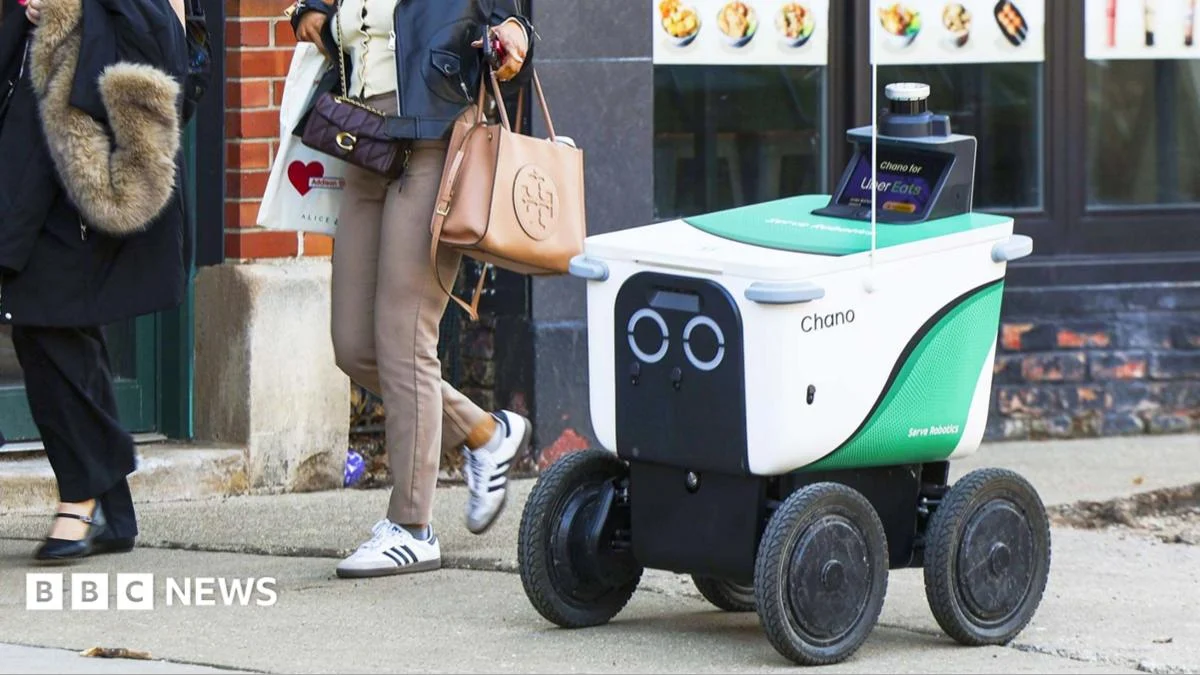
Chicago resident Josh Robertson recalls his first impression of delivery robots on the pavement: “I actually thought they were kind of neat – it felt futuristic.” Yet that sense of novelty faded after a walk with his family when another robot rolled toward them and they had to dodge it. “To us it felt a little off – the fact that we were on the one strip reserved for walking, and we were having to get out of the way,” he said. He now worries about a future where dozens of robotic couriers fill sidewalks, transforming pedestrian space and safety.
Autonomous urban delivery vehicles have begun to appear in several cities across the United States and in the United Kingdom, Japan, South Korea and Germany, transporting groceries and fast food via cameras, sensors and GPS. The operators contend the machines can reliably identify and avoid objects, cross streets safely and respond to their environment. They argue the service reduces traffic and emissions, while easing delivery pressure for workers and businesses.
But concerns are mounting among local officials and residents. In Glendale, California, for instance, the city council is weighing a temporary ban after reports of unsolicited robot traffic on crowded sidewalks. Councillors described the robots as appearing without warning and noted they initially did not know which company operated them. “What triggered the concern and the discussion was a number of factors,” said Councillor Ardy Kassakhian, noting heightened visibility, questions about accessibility and pedestrian flow, plus doubts about regulatory authority and permission to use sidewalks for a private service. Glendale’s sidewalks are narrow, and Kassakhian cited observed stand-offs and broken-down units obstructing paths. The council is seeking a regulated framework with operating rules, insurance requirements, accessibility standards, permitting fees, and limits in high-pedestrian zones.
In the United Kingdom, pilots are underway in several cities, and concerns have spilled into the public sphere, including instances of Uber Eats robots being vandalised in Sheffield. Starship Technologies, the supplier behind the Sheffield machines, argues the robots are safe and that public perception should evolve. “We know it’s a new experience for a lot of people to share a pavement with a robot,” said Danny Pass, Starship’s European operations director. He added the robots have become part of communities since the company launched in the UK in 2018.
The debate also touches on employment. The Independent Workers Union of Great Britain (IWGB), which includes delivery drivers among its members, says it is watching developments closely and has urged government action. IWGB president Alex Marshall warned that a countrywide expansion could threaten precarious workers’ livelihoods and provoke political pressure on authorities to restrict or ban the technology until workers are protected.
Analysts say the market for autonomous delivery is far from settled. A Transformа Insight report published last summer projected global deployments reaching 2.1 million by 2034, underscoring a potential boom even as regulation remains inconsistent. In Chicago, where the technology has faced hurdles, residents like Robertson argue for safety testing and clear usage rules before sidewalk automation becomes ubiquitous. “There’s a sense that change like this, even when it’s unwanted, is inevitable. But even if none of us can stop the future, we can at least choose which future we move into.”


