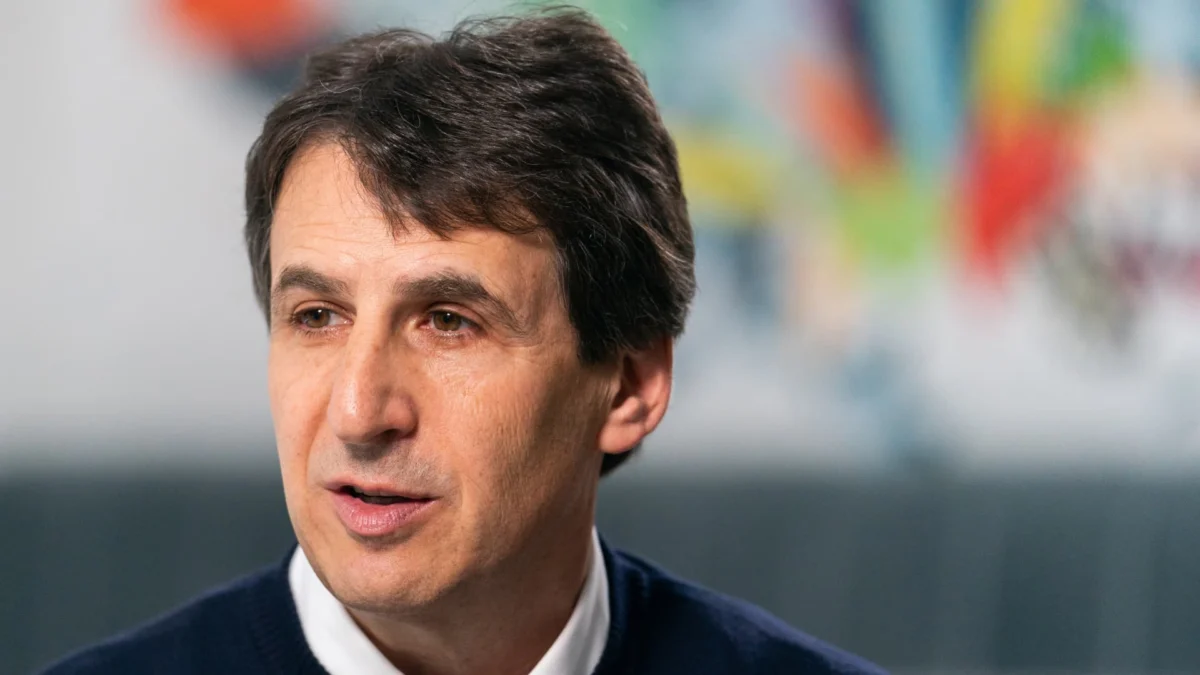
Marc Rowan, chief executive officer of Apollo Global Management LLC, has issued a warning to investors, stating that his firm is preparing for a potential market downturn. Rowan indicated that while the current economic landscape appears robust on the surface, it masks an increasing susceptibility to unforeseen shocks. He expressed concerns about external factors that could destabilize markets, suggesting a higher probability of significant disruptions than typically observed.
Rowan elaborated on the confluence of forces that could trigger such instability. He pointed to a potential "total geopolitical reset," alongside policy decisions that might foster inflation by restricting labor and trade. Furthermore, he highlighted the transformative impact of artificial intelligence, predicting widespread socioeconomic upheaval as jobs are reshaped or eliminated.
"Everything we see in front of us is actually quite strong," Rowan said, acknowledging the solid economic backdrop that has benefited Apollo, leading to a banner quarter with $1 trillion in assets under management and record fee-related earnings. However, he cautioned that this surface strength belies a growing risk of "out of the box" shocks, increasing the odds of "out-of-sideline results."
Rowan, who co-founded Apollo in 1990 and oversaw its transformation into an alternative asset and insurance giant, stated that he is now more concerned about outside factors derailing the economy than at any time in his four decades on Wall Street. His remarks, which come as the U.S. stock market is trading near record highs, add to concerns voiced by other financial executives, including JPMorgan Chase CEO Jamie Dimon.
Rowan put the odds of an exogenous shock at somewhere between 30% and 35%, a figure significantly above the norm, he said. A convergence of forces could destabilize markets, according to Rowan. These include a "total geopolitical reset," policies that could prove inflationary by restricting labor and trade, and the sweeping artificial intelligence cycle reshaping jobs and economic growth.
"Almost everything we're doing, whether intentional or not, has the potential to be inflationary," Rowan said. He specifically referenced President Donald Trump's tariff and U.S. immigration policies as examples of actions that could restrict the supply of goods and labor. "Restricting the supply of goods, restricting the supply of labor and the free movement of goods and labor — maybe for good and valid reasons that need to be done — are all inflationary in the short term, even if we are not seeing signs of it," he explained.
Regarding the impact of artificial intelligence, Rowan predicted a substantial societal shift, forecasting that "almost every job will be enhanced or replaced." He foresees a significant transformation, with "blue-collar ascendancy and white-collar stress" as a likely outcome. He also noted that while corporate and consumer balance sheets remain strong, government finances are strained.
Despite Apollo's current strong performance, Rowan detailed the firm's proactive measures to navigate potential turbulence. The firm has moved up the credit quality of its fixed-income investments, cut exposure to riskier sectors such as software, and stockpiled about $40 billion in cash within its insurance business. "It means we're investing with an eye toward protecting our capital and making sure that we are here to ride through cycles if there are corrections, which we quite frankly expect," Rowan said.
Rowan's critique extended to certain practices within the insurance industry, a sector central to Apollo's strategy since its expansion through Athene in 2009. Athene, a seller of annuities and retirement products, has become a key source of stable capital for Apollo, mirroring the "float" model popularized by Berkshire Hathaway. "Not everyone in our industry is doing what they should do. Not everyone runs their business the way we have run our business," Rowan asserted.
He voiced concerns about potential contagion within the insurance sector, where stress in one part of the industry could spread, potentially necessitating intervention from regulators or central banks to safeguard policyholders. While declining to name specific companies, Rowan pointed to what he described as "egregious" practices employed by some insurers. These include the use of offshore Cayman structures, complex collateralized loans, and aggressive credit assumptions, which he suggested might artificially inflate the appearance of balance sheet strength.
In contrast, Rowan emphasized Apollo's commitment to transparency, maintaining high credit ratings, robust capital reserves, and a long-term business perspective. This strategy, he believes, positions Apollo to weather market volatility and capitalize on opportunities that may arise during periods of correction, ensuring its continued stability and operational capacity.


