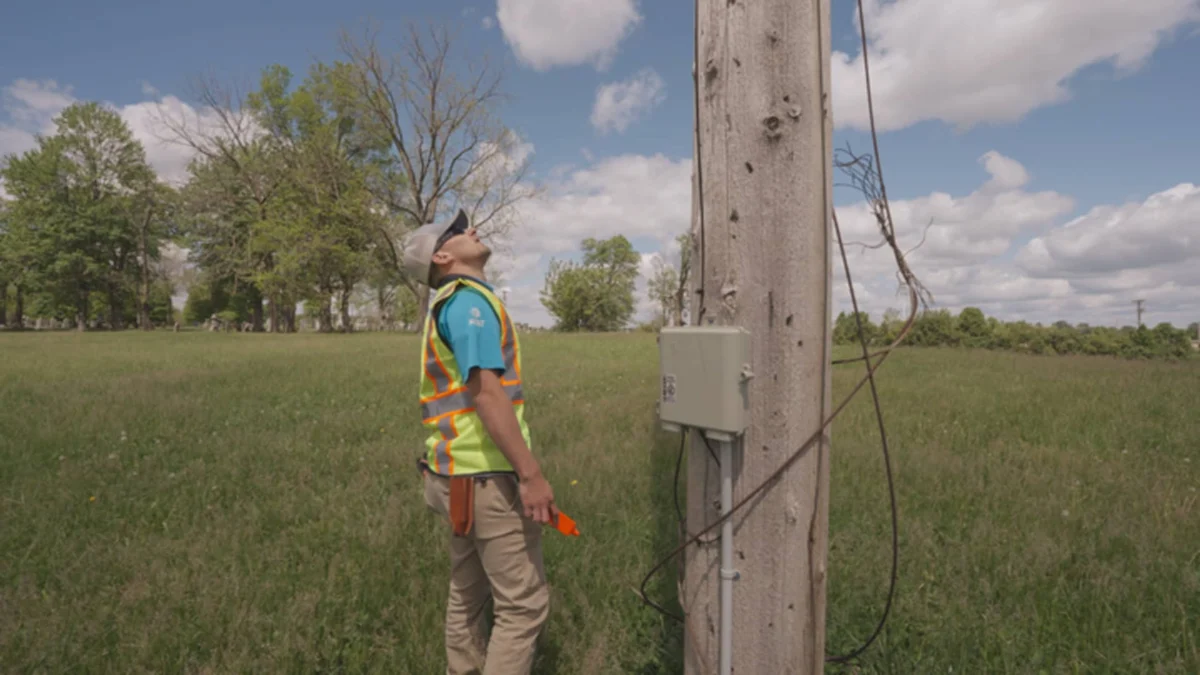
The rapid integration of artificial intelligence across corporate America is creating an unexpected economic shift, leading to a slowdown in entry-level hiring for college graduates in AI-exposed industries. Concurrently, major companies like Ford, Nvidia, and AT&T are highlighting a burgeoning need for skilled trade workers essential for constructing and maintaining the infrastructure that underpins the AI economy. AT&T, for instance, has announced plans to invest approximately $38 billion over the next five years, focusing on hiring and training blue-collar front-line workers, predominantly skilled technicians, to bolster its fiber network expansion.
This evolving landscape challenges the traditional post-war notion of the American Dream, where a college degree was widely considered a guaranteed pathway to middle-class stability. From the suburbs of Dayton, Ohio, to corporate offices in Dallas, the workforce driving AT&T's growth is increasingly comprised of skilled blue-collar professionals rather than recent college graduates. AT&T CEO John Stankey emphasized this need in a recent interview, stating, "We need people who know how to actually work with electricity. We need people who understand photonics. We need people who can go into folks' homes and connect this infrastructure to make it work right." He further noted the difficulty in finding and training such workers, remarking, "It's not like we're growing them on trees in the United States."
AT&T's challenge in sourcing blue-collar talent, especially as a record number of college students prepare to graduate, underscores a significant crisis for new degree holders navigating the initial phases of the AI revolution. Historically, a four-year diploma symbolized upward mobility, transitioning the U.S. economy from manufacturing to service-based industries that valued credentials over manual labor. However, as AI technologies automate entry-level tasks previously performed by new graduates, this promise is becoming less certain. While widespread layoffs have not yet materialized due to AI, many recent graduates, particularly in fields susceptible to AI automation, are finding their degrees no longer ensure the career opportunities they once did.
John Stankey, Chairman and CEO of AT&T, articulated this sentiment at CNBC's Invest In America Forum on April 15th, 2026. As AI implementation accelerates, companies are discovering efficiencies that reduce the need for certain types of labor, leading to a hiring slowdown. This downturn disproportionately affects workers with limited experience and those in sectors deemed vulnerable to AI, including marketing, legal services, accounting, human resources, and information technology. If this trend persists, AI could fundamentally reshape the U.S. workforce and the global economy, altering the landscape of opportunity in ways that even leading economists and technologists are still trying to comprehend.
"Is the American Dream going away because of AI?… I think the fears are all very valid," commented May Hu, a 26-year-old former tech consultant who transitioned to social media influencing. Hu, who was laid off from Deloitte the previous year under circumstances she described as nonperformance-related, explained her rationale for pursuing higher education: "I pursued college because… I think [for] most people who want to be working professionals … college is the route. That's starting to change now."
Technological revolutions historically generate new job categories, and the AI boom is no exception. However, a notable consequence for college graduates is that many of these emerging roles are in the skilled trades, requiring hands-on expertise rather than a four-year degree. These positions are primarily centered around the construction and maintenance of data centers, the physical backbone of the AI-driven digital world. Nevertheless, the long-term sustainability of this blue-collar job surge remains uncertain as companies complete the initial phases of building AI-related infrastructure, such as chip factories and data centers.
Companies like Ford and Nvidia are actively emphasizing the growing demand for workers involved in these large-scale construction projects. Nvidia CEO Jensen Huang, speaking at the World Economic Forum in January, described the current period as "the largest infrastructure buildout in human history that is going to create a lot of jobs." He specifically mentioned roles such as plumbers, electricians, construction workers, steelworkers, network technicians, and equipment installers, predicting that many of these positions would command six-figure salaries due to a significant "great shortage" of qualified workers in the United States.
In March, AT&T unveiled a substantial investment plan, committing $250 billion over the next five years to expand its fiber network. This initiative aims to accommodate the escalating demands of AI data centers and a surge in network usage, driven by both AI advancements and increased mobile streaming and uploading. Approximately 15% of this considerable investment is earmarked for hiring and training employees. Crucially, these funds are not primarily directed towards white-collar corporate positions but rather towards blue-collar front-line workers, particularly skilled technicians, as confirmed by the company.
Stankey reflected on societal values, noting, "As a society and within the United States, we've put a huge premium in value socially on a college degree, maybe for good reason, but in some cases … we maybe have missed the mark." He elaborated that this societal emphasis may not have been optimal, especially considering the rising costs of education, which are outpacing inflation, while simultaneously facing shortages in essential skilled trades like HVAC repair, electricians, and fiber optic technicians.
The historical trajectory of the American Dream reveals a significant transformation. At the dawn of the 20th century, only about 1 in 10 17-year-olds in the U.S. completed high school, with higher education being a rarity. The post-World War II era, however, marked a pivotal shift. The GI Bill provided veterans with access to college education, and the expansion of public universities fueled an "explosion" in higher education, as described by labor historian Shannan Clark. This period saw a widespread bipartisan belief that investing in education was beneficial, enhancing human capital and leading to a more productive workforce.
In the subsequent decades, millions of Americans transitioned from physically demanding jobs in factories to more comfortable roles in air-conditioned offices, exchanging manual tools for keyboards. This era also witnessed increased participation of women and minorities in the workforce, leading to wage growth, improved quality of life, and advancements in innovation, globalization, and GDP. By the close of the 20th century, a consensus had formed: education coupled with diligence was the established route to achieving the American Dream.
While data continues to indicate that four-year degrees generally correlate with higher lifetime earnings and lower unemployment rates, the unwavering belief in college as the sole path to the American Dream has been challenged in recent years. The escalating cost of higher education and the burden of student debt have prompted questions about the return on investment. Although the average return remains around 12.5% as of 2024, a figure still considered substantial, it has shown little fluctuation beyond 13% over the past three decades, according to research from the Federal Reserve Bank of New York.
Now, the proliferation of AI introduces further pressure on the perceived value of a traditional college diploma. Aaron Cheris, global head of Bain & Company's retail practice, likens AI's capability to "an infinite supply of 21-year-old interns that are smart but have no context." He argues that AI is increasingly performing the entry-level tasks that were once the domain of recent graduates, making it more difficult for them to secure initial employment. Data from the Federal Reserve Bank of New York indicates a rise in the average unemployment rate for recent college graduates aged 22 to 27, from 4.5% historically since 1990 to approximately 5.4% in 2025. This impact appears particularly pronounced among early-career professionals in fields highly exposed to AI technologies. A 2024 research paper from Stanford's Digital Economy Lab, titled "Canaries in the Coal Mine?", explored these early trends in the job market.


