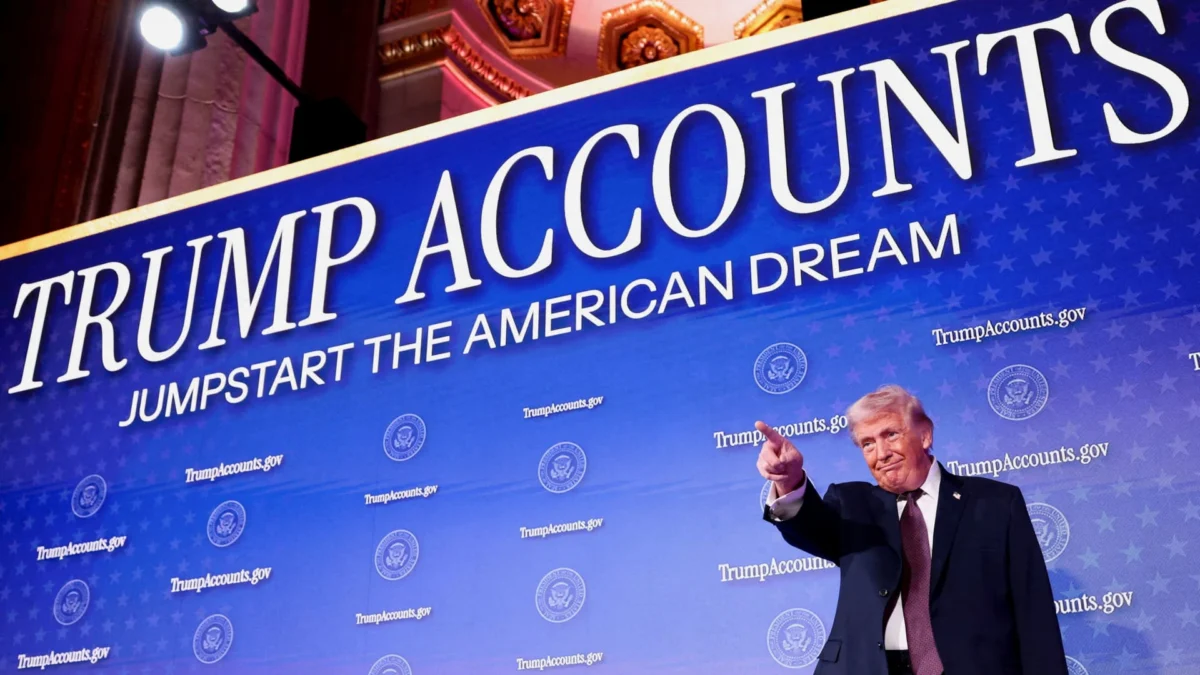
The Trump administration is reportedly considering allowing wealthy donors to contribute appreciated stock to "Trump Accounts," a move that could offer a significant double tax benefit. These accounts, designed for American children, currently accept only cash contributions. If the policy shifts to include stock donations, individuals could offload shares that have increased in value without incurring capital gains tax. Furthermore, they would be able to deduct the stock's fair-market value from their income, mirroring the tax advantages already available for contributions to donor-advised funds and other charitable entities.
This potential change has sparked discussion among tax policy experts regarding the legal mechanisms for its implementation. Some believe legislative action by Congress would be necessary, while others suggest that guidance from the Treasury Department or an executive order could suffice. The hedge fund manager Brad Gerstner, who was instrumental in developing the investment accounts, expressed enthusiasm for the possibility of "multi-billion gifts into kids accts & the gifts may be cash / shares!" on the social media platform X. The Dell family, for example, has committed to donating $6.25 billion to establish "Trump Accounts" for 25 million children in specific low-to-moderate income ZIP codes.
The existing structure of "Trump Accounts" already provides tax advantages. Donors can utilize pre-tax funds for charitable contributions that benefit a designated group of beneficiaries. However, the inclusion of appreciated stock would amplify these benefits considerably. "It's a popular practice for particularly high-income taxpayers that would otherwise be paying a high rate," noted Will McBride, chief economist at the Tax Foundation. He suggested that extending this established practice to "Trump Accounts" would be a logical step, especially given the initiative's association with President Trump. "This initiative has Trump's name on it so I think they're going to try to make this as taxpayer-friendly as possible," McBride added.
A White House official indicated that the administration is "always open to finding new ways to build on the immense success of Trump Accounts," but offered no specific updates on the stock donation proposal. The Treasury Department, through a spokesperson, reiterated its commitment to "maximizing the impact of Trump Accounts, driving sign-ups for all eligible children, and achieving our goal of having every American child own a Trump Account." The spokesperson declined to comment directly on the potential for accepting stock donations.
McBride elaborated on the potential impact, stating that such a change would likely serve as a strong incentive for donors. He pointed out that many of the wealthiest individuals hold a substantial portion of their assets in highly appreciated stock, representing significant unrealized gains. Allowing these assets to be donated without immediate capital gains tax implications could unlock substantial charitable giving. "We know that for many of the very top billionaires, much of their wealth is held in stock that's appreciated a great deal, so they're sitting on a lot of unrealized gains," he explained.
However, the practice of donating appreciated stock is not novel and is already permissible through various existing charitable vehicles. Joseph Rosenberg, a senior fellow at the Urban-Brookings Tax Policy Center, commented that this aspect might not be a "game-changer" because individuals can already achieve similar outcomes via private foundations and other established methods. "My sense is it's not, like, a game-changer in that sense, because people already have the ability to do it through private foundations and other vehicles," Rosenberg stated.
Furthermore, any deductions for such donations would likely remain subject to existing limitations. For long-term appreciated capital gain property, the deduction is typically capped at 30% of the donor's adjusted gross income (AGI). This limitation, along with other tax benefit reductions enacted in recent legislation, could temper the overall impact for some high-income taxpayers. The tax benefits associated with charitable giving for top earners were notably reduced by a significant tax and spending bill passed in the previous year.
Manoj Viswanathan, a law professor and co-director at UC Law San Francisco's Center on Tax Law, suggested that more substantial changes might be needed to significantly enhance the tax appeal of "Trump Accounts." He proposed that increasing the AGI cap for donations to these accounts could be one such measure. However, Ellen Aprill, a senior scholar in residence at UCLA School of Law, noted that for the ultra-wealthy, whose income often pales in comparison to their vast asset holdings, an increased AGI cap might not yield a dramatic difference. "Raising that cap wouldn't make a huge difference for the ultra-wealthy, as their income pales in comparison to their assets," Aprill observed.
Despite potential limitations on income tax deductions, donating stock can be a powerful tool for minimizing or eliminating estate tax liabilities. Unlike income tax deductions, charitable deductions for gift and estate tax purposes are unlimited. "The gift tax treatment deduction matters a lot to the super rich," Aprill explained. "Making charitable gifts gets the assets out of their estate and still avoids tax on the built-in capital gain." This aspect is particularly attractive to individuals with substantial estates who are looking to transfer wealth efficiently while minimizing tax burdens.
The specific legal pathway for enabling stock donations remains a point of contention among legal and tax experts. Some argue that a legislative act is indispensable, particularly if the "Trump Accounts" are to be permitted to hold individual stocks directly. Gerstner had previously suggested that all funds within "Trump Accounts" could be invested in a free index fund tracking the S&P 500. In contrast, Invest America, the nonprofit organization behind the accounts, has hinted at the possibility of children receiving shares in prominent companies like SpaceX, Berkshire Hathaway, or OpenAI, which would necessitate the holding of individual securities.
McBride cautioned that any expansion of tax benefits for "Trump Account" donors could face significant hurdles in Congress. With a narrowly divided Republican majority, securing the necessary votes for such a proposal might prove challenging. The political climate and the specific details of any proposed legislation would play crucial roles in determining its feasibility. The administration's ability to garner bipartisan support or to push the measure through with its existing majority will be key factors.
This potential policy shift underscores the ongoing efforts to enhance the attractiveness of "Trump Accounts" as a vehicle for charitable giving and wealth transfer. The interplay between tax policy, charitable incentives, and the financial strategies of high-net-worth individuals continues to shape the landscape of philanthropic endeavors. The ultimate decision on allowing stock donations will likely depend on a combination of legal interpretations, administrative actions, and potentially, legislative directives, all while navigating the broader economic and political environment.
While the exact timeline and final form of any potential changes remain uncertain, the discussions highlight a strategic focus on leveraging tax advantages to encourage greater participation and larger contributions to programs aimed at benefiting children's financial futures. The debate over the optimal structure and tax treatment of such accounts is indicative of broader trends in philanthropic finance, where tax efficiency is often a paramount consideration for major donors seeking to maximize their impact.


