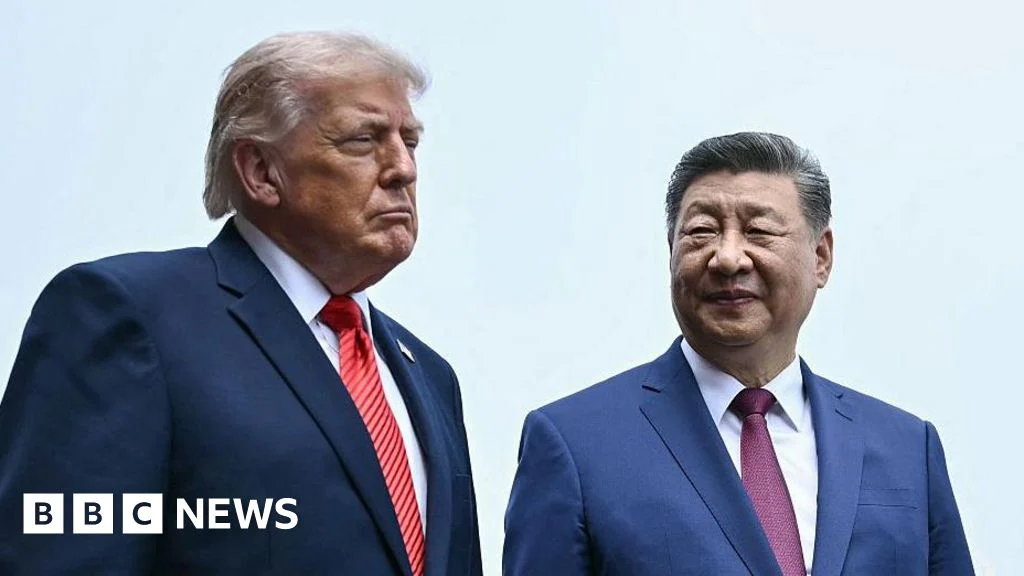
U.S. President Donald Trump met with Chinese President Xi Jinping in Beijing for over two hours of discussions, a summit Trump described as potentially "the biggest summit ever" and characterized the U.S.-China relationship as "the world's most consequential economic relationship." The White House officially labeled the meeting "highly productive," despite the absence of a major trade breakthrough or significant structural business agreements.
Instead of a new deal, both leaders indicated a continuation of the trade truce established in October. Under this arrangement, Washington had previously suspended substantial tariff increases on Chinese goods, and Beijing had eased its restrictions on rare earth exports. The White House announced that the leaders had agreed to establish a "Board of Trade," a new mechanism intended to manage the bilateral relationship without necessitating a reopening of tariff negotiations. However, U.S. officials have cautioned that considerable work remains before this board becomes fully operational.
President Xi acknowledged that previous trade negotiations held in South Korea had yielded "progress," according to China's foreign ministry. However, he coupled this observation with a stark warning regarding Taiwan, stating that any mishandling of the issue could lead to the two nations colliding or even entering into conflict. This underscores the delicate balance of diplomacy and the deeply entrenched sensitivities that continue to define the U.S.-China dynamic.
The summit was notable for the presence of prominent technology leaders, including Elon Musk, CEO of Tesla, and Jensen Huang, CEO of Nvidia. Their inclusion, particularly Huang who was not initially listed on the delegation, fueled speculation that sensitive topics such as artificial intelligence (AI) and semiconductor access were central to the discussions. Both Tesla and Nvidia have significant economic ties to China, with Tesla relying heavily on its Shanghai gigafactory and Chinese consumers, and Nvidia's advanced chips being crucial to the global AI race and subject to U.S. export controls aimed at limiting China's access to cutting-edge computing power.
Discussions also covered market access and broader economic cooperation. The White House indicated that talks included expanding market access for U.S. companies in China and encouraging increased Chinese investment into U.S. industries. Beijing signaled its intent to boost purchases of U.S. agricultural and energy products. While U.S. farmers have been eager for greater access to the Chinese market for products like soybeans, beef, and poultry, specific details on these commitments were not immediately announced. U.S. Treasury Secretary Scott Bessent downplayed expectations of major new agricultural breakthroughs, suggesting some soybean commitments were already addressed in prior agreements, but noted potential for increased Chinese purchases of U.S. energy, including liquefied natural gas (LNG).
President Xi conveyed to U.S. business leaders that China's "doors will open wider" and that American firms could anticipate "broader prospects" within the Chinese market, according to the news site Xinhua. He also advocated for enhanced cooperation across various sectors, including trade, agriculture, healthcare, tourism, and law enforcement, describing the bilateral ties as "mutually beneficial" and conducive to "win-win results." For American businesses, China continues to represent a vast market, albeit one that presents operational challenges due to regulatory complexities, bureaucratic hurdles, and geopolitical uncertainties.
One of the most significant undercurrents of the summit appeared to be Beijing's increasingly direct linkage of Taiwan to the broader economic relationship with the United States. Previously, Taiwan had been considered one of several friction points, alongside issues like U.S. collaboration with semiconductor companies, U.S.-Taiwan trade ties, and arms sales to Taipei. However, the messaging from Beijing following the meeting suggested that Taiwan is now being framed more prominently as a prerequisite for the U.S.-China trade relationship. According to Beijing's readout, President Xi stated that the two sides had agreed to a "new positioning" for their relations based on "constructive strategic stability," but reiterated that Taiwan remains the most sensitive issue.
"The Taiwan question is the most important issue in China-US relations," Xi warned during the talks, according to Chinese state media. "If mishandled, the two nations could collide or even come into conflict," he added, highlighting the gravity with which China views the island's status.
Technology continues to be a primary area of divergence between the two global powers. U.S. export controls on advanced semiconductors and chipmaking equipment, designed to curtail China's access to frontier AI capabilities, remain in effect. China, in turn, persists in its pursuit of greater access to advanced technologies while criticizing what it perceives as U.S. efforts to impede its industrial development.
Beyond trade and technology, President Trump also sought Chinese cooperation on managing the conflict in Iran and stabilizing global oil markets. The volatility in oil prices and recurrent disruptions to supply routes have notably increased China's import costs and contributed to rising prices worldwide. Trump has expressed the view that China could leverage its influence to encourage Iran to stabilize energy flows through the Strait of Hormuz, a critical global energy artery.
U.S. Treasury Secretary Scott Bessent had previously indicated expectations of significant Boeing orders being announced during the visit, alongside broader Chinese acquisitions of U.S. energy and agricultural goods. While the summit did not yield a sweeping trade deal, the establishment of the "Board of Trade" suggests an effort to create a more structured framework for managing ongoing economic dialogues and potential disputes. The continued emphasis on the trade truce signifies a desire to avoid further escalation of trade tensions, even as fundamental disagreements persist on critical issues like technology and Taiwan.
The meeting between Trump and Xi, while short on concrete new agreements, served to reaffirm the immense significance of the U.S.-China economic partnership on a global scale. The discussions highlighted the economic interests, technological competition, and geopolitical sensitivities that shape the relationship. The continued reliance on existing trade truce mechanisms and the cautious optimism expressed by both sides regarding future cooperation suggest a path forward focused on managing, rather than resolving, the most contentious issues in the short term.
The presence of tech leaders like Musk and Huang underscored the critical role of advanced technologies in the bilateral economic equation. Their engagement in the discussions signals the growing importance of AI and semiconductors as strategic assets, influencing trade policies and international relations. The U.S. administration's focus on limiting China's access to these technologies reflects a broader strategic objective to maintain a technological edge, while China's persistent efforts to acquire advanced capabilities highlight its ambition for technological self-sufficiency and global leadership.
The reiteration of China's stance on Taiwan as the paramount issue in bilateral relations serves as a stark reminder of the potential flashpoints that could derail any progress in economic cooperation. The warning from President Xi about the consequences of mishandling this issue underscores the deep-seated national interests and historical narratives that underpin China's position. This sensitivity will likely continue to cast a long shadow over future trade negotiations and diplomatic engagements between the two nations.
Ultimately, the summit between President Trump and President Xi, while not producing a landmark trade deal, provided a platform for direct dialogue on a range of critical economic and geopolitical issues. The outcomes, though incremental, suggest a continued, albeit fragile, effort to manage a relationship that is undeniably the world's most consequential. The focus on establishing new communication channels like the "Board of Trade" indicates a strategy of managing ongoing dialogues and potential disputes rather than immediate resolution of core disagreements.


