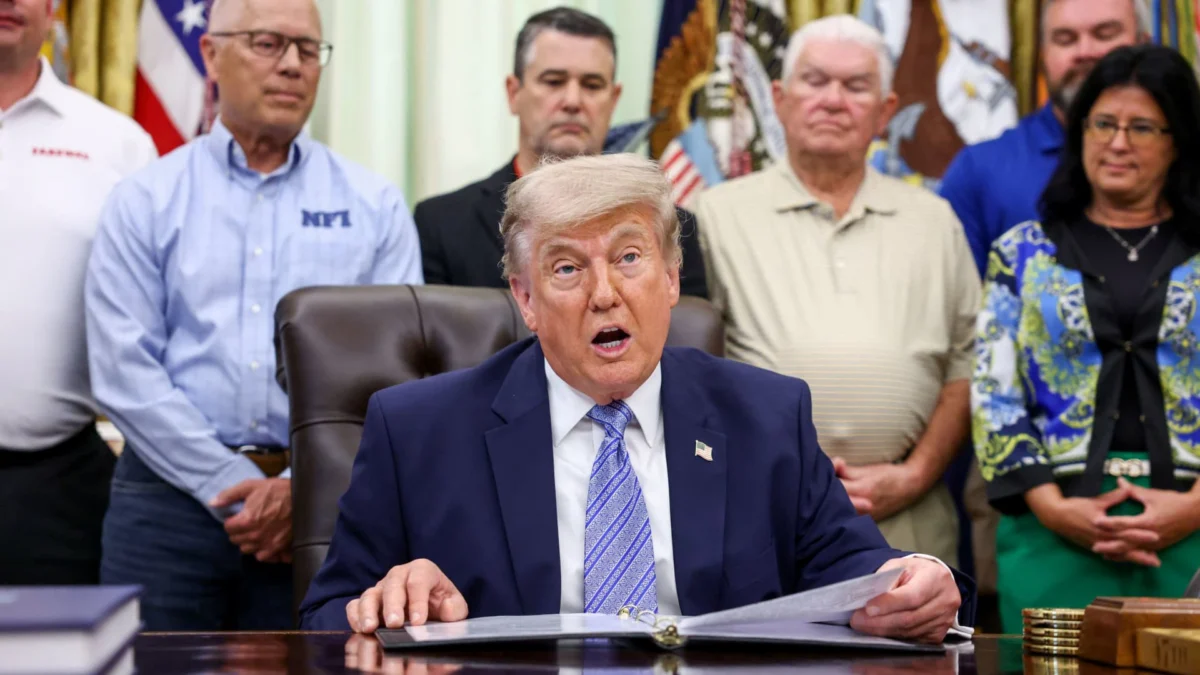
President Donald Trump announced on Thursday a delay to two Biden-era Environmental Protection Agency (EPA) refrigerant rules, asserting that the move will reduce costs for businesses and ultimately lead to lower prices for consumers at the grocery store. The White House stated that this policy shift is expected to save businesses and families more than $2.4 billion.
These regulations, originally finalized by the EPA in 2023, targeted hydrofluorocarbons (HFCs), potent greenhouse gases commonly used in refrigeration and air conditioning systems. The Biden administration had argued that these rules would cut leaks and emissions, leading to significant long-term savings for businesses and consumers, estimated at $4.5 billion over time through improved energy efficiency and the use of lower-cost refrigerants.
The delayed rules affect a wide array of industries, including grocery stores, food distribution networks, and semiconductor manufacturing, all of which rely heavily on refrigeration infrastructure. Compliance with the original regulations would have necessitated upgrades, the implementation of leak detection systems, and potentially the adoption of new refrigerants for some operators.
However, the effectiveness of these projected savings in translating to lower consumer prices remains uncertain. The administration's messaging appears to be strategically aimed at inflation-weary consumers, particularly as food prices continue to be a sensitive political issue ahead of upcoming elections. Critics and industry groups have previously warned that the transition to new equipment and compliance measures could impose billions of dollars in upfront costs on the industry.
While large grocery chains such as Walmart, Kroger, and Costco have already been investing in more environmentally friendly "natural refrigerant" systems, potentially positioning them to absorb the transition costs more readily, smaller regional grocers and independent stores might face a more significant financial burden. EPA Administrator Lee Zeldin remarked in a statement that the administration's actions would permit businesses to select refrigeration systems that best suit their needs, thereby saving them billions of dollars.
Kroger CEO Greg Foran, speaking at a White House event, indicated that an orderly transition of equipment could reduce both capital and operating expenses, which could ultimately benefit consumers through lower prices. When questioned about passing savings on, Foran stated that Kroger is actively working to ensure consumers are paying the right price. Notably, Bloomberg News reported earlier on Thursday that Foran had plans for price reductions at Kroger to enhance its competitive standing against rivals like Walmart and Costco.
It is important to note that food inflation is influenced by a multitude of factors, including labor, transportation, feed costs, and commodity prices. Some of these expenses have seen recent increases, partly attributed to geopolitical events. The costs associated with refrigeration compliance represent a relatively small portion of overall grocery operating expenses. The revised EPA timeline now delays compliance, with the agency revising both the 2023 rule and a related regulation from 2024.


