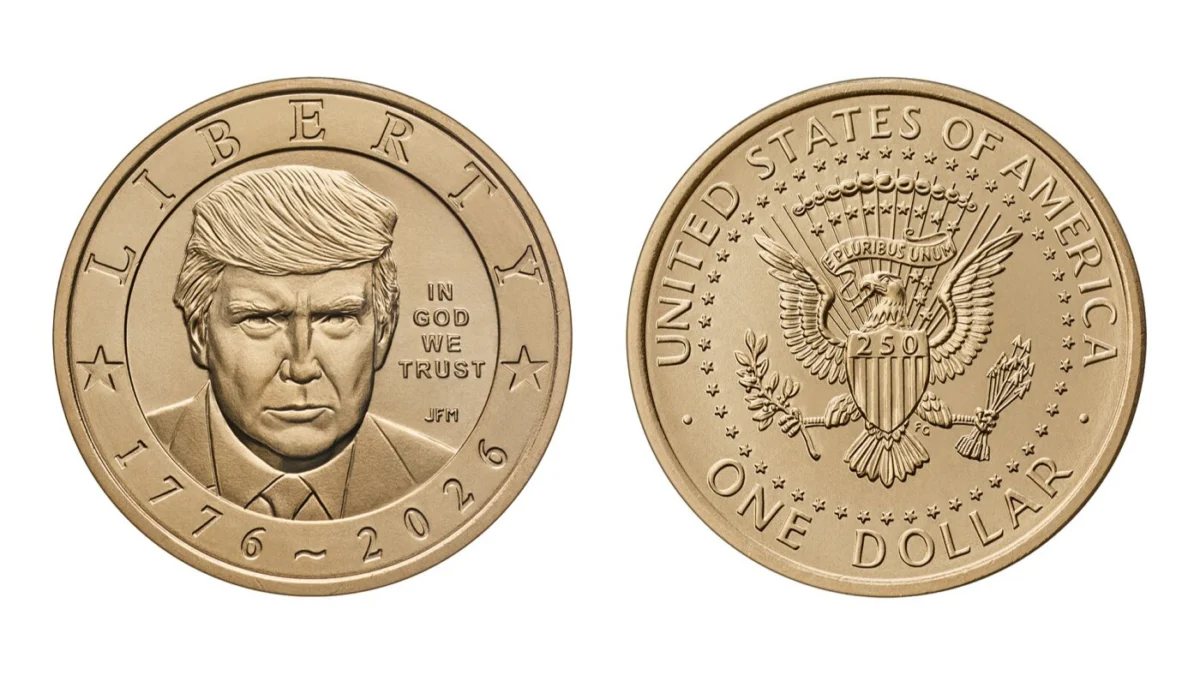
The U.S. Mint is preparing a commemorative $1 coin featuring President Trump’s image, a move tied to the nation’s Semiquincentennial celebrations and drawing scrutiny from lawmakers and constitutional scholars. Treasury Secretary Scott Bessent unveiled designs this week for a gold-colored coin that, according to the Treasury, will be minted in Philadelphia and offered for sale in the fall. The design shows a close-up of President Trump wearing a suit, encircled by the inscriptions “Liberty” and “1776-2026,” with the other side displaying the bald eagle from the U.S. seal. The coin’s appearance follows a broader push by the administration to place Trump’s likeness on public money and other national symbols, including updated passports and government-building displays, in the lead-up to the 250th anniversary of the United States.
Legal scholars quickly raised questions about the coin’s compliance with longstanding currency rules. Jeremy Paul, a constitutional law expert, noted that current law prohibits the likeness of living persons on currency, not just the president, which would apply to Trump if the coin is treated as currency rather than a commemorative item. He warned that such a move could invite legal challenges and argued that it politicizes an instrument meant to be neutral. Treasury officials say that commemorative coins are legal tender and that pricing and proceeds from sales typically fund community and cultural programs, with additional details to be announced later.
The Commission of Fine Arts approved the coin’s design in March, though Treasury officials contend the public release differs from the commission’s choice. The mint notes the coin will have a “gold-like finish,” will be minted in Philadelphia, and is expected to go on sale in the fall as part of a broader set of measures recognizing the 250th birthday of the United States. Treasury officials have also indicated that they will not move forward with Harriet Tubman’s appearance on the $20 bill, a decision that has attracted its own political commentary.
Reaction to the coin spans party lines. Rep. Joyce Beatty, D-Ohio, questioned why Harriet Tubman’s image has not appeared on the $20 bill while a living president is being placed on a $1 coin, calling the Treasury’s approach a vanity project. Critics argue that the initiative reflects a broader trend toward politicizing money, while supporters describe it as a symbolic celebration of a historic milestone. Analysts note that presidential imagery on coins has few precedents; Calvin Coolidge’s 1926 living-portrait coin is typically cited, though many observers consider it an exception rather than a rule.
Beyond questions of legality, the program puts attention on the regulation of currency imagery. The 2005 Presidential $1 Coin Act authorized a series of coins commemorating past presidents, with eligibility tied to a two-year posthumous requirement; the program ended in 2016 but released a final coin in 2020 for George H. W. Bush, two years after his death. The 2020 law authorizing “emblems of the United States Semiquincentennial” during the 2026 cycle is cited by Treasury and Mint officials to defend the Trump coin’s legality, though critics argue that the broader norm of nonpartisan money remains in play.
Legal questions have already surfaced in court filings. In March, James Rickher, a retiree in Portland, Ore., sued to block the coin’s creation, arguing it would harm him as a coin collector. A federal judge recently ruled that Rickher had not shown he was injured enough to pursue the case, leaving the central legal issue unresolved. The question of injury remains a potential hurdle for any successful challenge, according to constitutional law specialists.
As the coin moves toward distribution, the Treasury and Mint have declined to disclose the price or the destination of proceeds beyond the general statement that surcharges support community projects. The Mint’s public materials explain that a portion of commemorative coin prices goes toward museums, historical preservation, and Olympic programs, among other beneficiaries. Critics, however, question whether this is the primary motive, noting that the broader push to place Trump’s likeness on various national symbols has been a recurring theme for the administration.
Meanwhile, supporters argue the 250th anniversary affords a chance to highlight national milestones and memory. They point to Trump’s continued presence in government-related items—from passports to national park passes and federal buildings—as evidence of efforts to imprint the presidency onto national artifacts. Opponents warn that such symbolism risks politicizing money and undermining the neutrality once expected of currency, a concern echoed by constitutional scholars who emphasize the legal boundaries surrounding living-person portraits on United States money.
The broader debate about the coin intersects with concerns about transparency and accountability in government projects. Analysts say the legal landscape remains unsettled, with potential litigation hinging on how the coin is classified (currency versus commemorative item) and whether any injury can be shown in court. The outcome of any court challenge could further redefine the acceptable boundaries of likenesses on U.S. currency and the role of living presidents in the nation’s monetary symbols.
As details continue to emerge, investors and observers will watch how the market responds to the coin and its accompanying initiatives tied to the 250th anniversary. The episode underscores ongoing questions about the intersection of national symbolism, constitutional norms, and the role of public money in contemporary political life.


