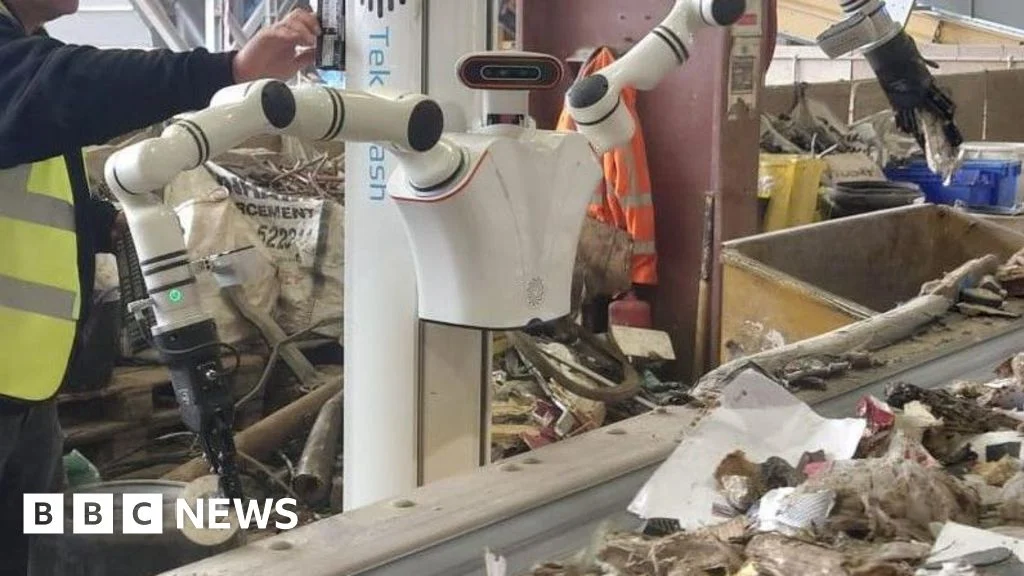
The dust at a busy recycling plant in Rainham, east London, owned by Sharp Group, is pervasive, and the steady noise of hoppers and conveyor belts makes it a challenging environment to work in. This family-run skip and waste management firm processes up to 280,000 tonnes of mixed recycling every year, relying on 24 agency workers to manage materials moving along its rapid conveyor belts. These materials range widely, from everyday items like shoes and old VHS cassettes to construction debris such as concrete blocks.
The waste management sector is a hazardous industry. While Sharp Group is proud of its safety record, the work-related injury and ill-health rate in the sector is reportedly 45% higher than the national average for other industries. Furthermore, the fatality rate is a sizeable multiple of the national average. These inherent risks, coupled with the generally unpleasant nature of the work, contribute to significant challenges in retaining staff. Annual staff turnover reportedly runs at 40%.
Line supervisor Ken Dordoy described the constant demand on workers, stating, "The belt is moving all the time, you're constantly picking. I go through a lot of pickers because they just aren't up to the job." To mitigate the strain, the firm rotates pickers through different materials every 20 minutes, and the conveyor belts are periodically stopped to allow for respite.
A potential solution to this ongoing staffing issue was observed during a recent visit: a robot named Alpha (Automated Litter Processing Humanoid Assistant) was undergoing training on the processing line. Built by RealMan Robotics in China, Alpha is being adapted for real-world recycling operations by the British firm TeknTrash Robotics. While automated robots are not entirely new to the waste management sector, the use of a humanoid design is distinctive.
Al Costa, founder and CEO of TeknTrash Robotics, argues that Alpha's humanoid form factor is designed to integrate seamlessly into existing plant infrastructure without requiring extensive modifications to current machinery. Currently, Alpha is in a training phase, with its arm movements being guided. To facilitate this learning process, a plant worker was observed wearing a VR headset, recording his own actions to demonstrate effective picking and sorting techniques. This dual approach to training involves teaching the robot to identify objects on the conveyor and then to physically grasp and move them.
Costa emphasized that the market often misunderstands the complexity of deploying these robots, suggesting they are not simply plug-and-play solutions. "The market thinks these robots are prêt‑à‑porter, that all you need to do is to plug them to the mains and they will work flawlessly. But they need extensive data in order to be effectively useful," he stated. He demonstrated how a system called HoloLab delivers data from multiple cameras to train Alpha. This system reportedly warns the robot what's coming, guides its arms, and flags instances where items are missed. The continuous flow of thousands of items daily generates millions of data points, crucial for refining the robot's performance.
Chelsea Sharp, plant finance director and granddaughter of the company's founder, Tom Sharp, highlighted the potential benefits of successful robot deployment. "The attraction of a humanoid is that you can put it here and it stays here. It will pick all day, 24 hours a day, seven days a week. It's not going to apply for a holiday, it's not going to have a sick day," she commented. This contrasts with the alternative of either constructing entirely new, bespoke recycling plants or retrofitting existing facilities with advanced equipment from companies like Colorado-based AMP.
AMP operates three of its own plants and has supplied its equipment to dozens of other facilities worldwide, including in the UK and Europe. CEO Tim Stuart explained that AMP's system utilizes air jets to direct items into designated chutes. Artificial intelligence plays a key role in continuously enhancing the system's ability to identify and sort materials. Stuart claimed, "Our robots are much more efficient than humans, probably eight or 10 times the pace. The AI technology and jets have really increased the capacity and efficiency and accuracy of what we can do."
Glacier, a company co-founded by Rebecca Hu-Thrams, employs a different approach using mounted robotic arms and AI for waste sorting. Hu-Thrams noted that the inherent variability of waste materials presents a significant challenge for sorting equipment. She cited instances of liquid-spraying beer cans potentially damaging machinery and even the discovery of "unbelievable things like hand grenades and firearms coming through their facility." Glacier's AI models are trained on over a billion items, leading to continuous improvement. Hu-Thrams also pointed out that their technology is designed to be effective for both large urban plants and smaller, semi-rural facilities with more constrained budgets.
Despite the varying technological approaches, all three companies agree that the current human-intensive model of waste sorting is unsustainable. Academics specializing in waste processing concur, viewing the shift towards automation as both inevitable and necessary for the industry's future. Professor Marian Chertow of Yale University stated, "Robotics coupled with AI-driven vision systems offers the greatest potential for improving material recovery, worker experience, and economic competitiveness in the recycling sector."
Back at the east London plant, Chelsea Sharp acknowledged the difficult working conditions. "This is a really dirty place to work. You can see the dust, you can hear the noise. It's not that nice." Robots, however, are unaffected by these environmental factors. The question of what happens to human workers as automation scales up is being addressed by Sharp, who indicated plans to redeploy staff into new roles. "The plan is to upskill those staff. They'll be maintaining and overseeing the robots. And it brings those same people away from any dangers, including the unpleasant environment, heavy lifting and noise," she explained, suggesting a transition towards roles that involve managing and maintaining the automated systems, thereby removing them from the hazardous and unpleasant aspects of manual sorting.


