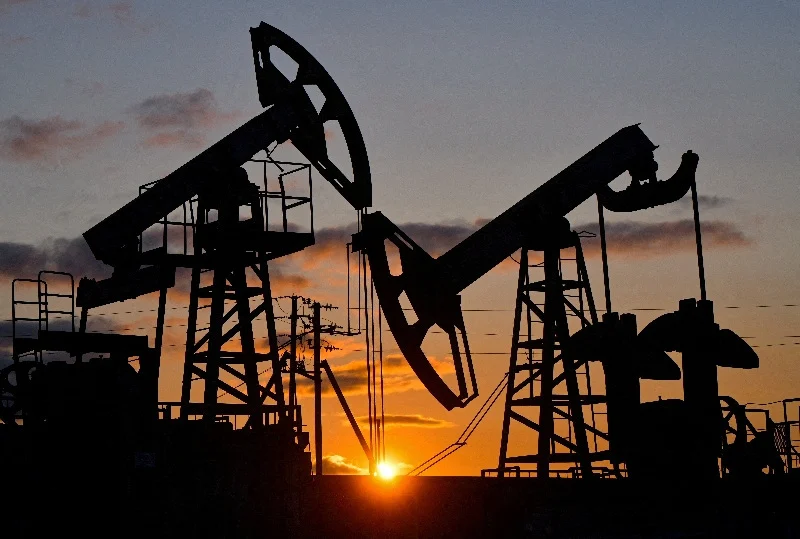
Oil prices experienced a notable increase, with Brent crude futures rising by $1.32, or 1.25%, to settle at $107.04 a barrel. Concurrently, U.S. West Texas Intermediate (WTI) futures saw a gain of $1.33, or 1.31%, reaching $102.50. These upward movements occurred as President Donald Trump expressed diminishing patience with Iran and persistent concerns lingered regarding the security of maritime traffic, particularly in the Strait of Hormuz. Despite these anxieties, Iran's Revolutionary Guards reported that approximately 30 vessels had transited the critical waterway since Wednesday evening.
For the trading week, both major oil benchmarks demonstrated significant strength. Brent crude futures climbed nearly 6%, while WTI futures surged by more than 7%. This weekly performance was largely attributed to the uncertainty surrounding the fragile ceasefire in the ongoing conflict involving Iran. The geopolitical backdrop continues to be a primary driver for market sentiment and price action in the oil sector.
President Trump articulated his stance in an interview aired on Thursday night, stating, "I am not going to be much more patient." He further emphasized the need for a resolution, adding, "They should make a deal." This direct commentary from the U.S. President underscored the escalating diplomatic pressure and the potential for further actions if a resolution is not reached.
Adding to the complex geopolitical landscape, U.S. Trade Representative Jamieson Greer commented on Friday morning that China was adopting a pragmatic approach to its involvement with Iran. Greer highlighted the strategic importance for China in maintaining open access to the Strait of Hormuz, a crucial chokepoint for global energy shipments. His remarks were made during an interview with Bloomberg, providing insight into the delicate balance of international relations and trade.
The market's attention was also focused on the summit between President Trump and Chinese President Xi Jinping, which concluded on Friday. The two-day state visit was characterized by diplomatic engagements and discussions on various economic and political matters. However, the summit did not yield any significant breakthroughs concerning the situation with Iran, leading market participants to shift their focus back to the existing deadlock and the potential for renewed military escalation in the region.
Vandana Hari, founder of the oil market analysis firm Vanda Insights, noted the market's reaction to the summit's outcome. "With the Beijing summit not delivering any breakthrough on Iran, market focus is back on the deadlock and a blockaded Strait, with a tail risk of renewed military escalation," she stated. This sentiment reflects the underlying anxiety among investors about the potential for disruptions to oil supply.
Among the potential outcomes discussed during the summit, President Trump indicated that China expressed interest in purchasing oil from the United States. This potential shift in trade dynamics could have implications for global oil flows and U.S. energy exports, although specific details and volumes were not disclosed.
The Strait of Hormuz, a vital artery for global oil transportation, has been a focal point of recent security concerns. Incidents in the region have included a report of a ship being seized by Iranian personnel off the coast of the United Arab Emirates and an Indian cargo vessel sinking in waters near Oman. These events have heightened fears of further disruptions and attacks on shipping.
Despite these security concerns, Iran's Revolutionary Guards reported that approximately 30 vessels had passed through the Strait of Hormuz since Wednesday evening. While this number is significantly lower than the typical daily traffic of 140 vessels prior to recent escalations, it represents a substantial increase if confirmed. This data point offers a mixed signal regarding the actual volume of traffic versus the perceived risk.
Yang An, an analyst at Haitong Futures, commented on the primary drivers influencing oil prices. He suggested that tight supply remains the fundamental factor underpinning the market. "Oil prices swung several times yesterday but still closed near the day’s high," Yang observed. "Ships passing through the strait eased some market concerns, but not enough to change the strong trend driven by tight supply."
The market's reaction to the news from the summit and the ongoing tensions in the Strait of Hormuz highlights the delicate balance between geopolitical developments and fundamental supply-demand dynamics. While fears of supply disruptions due to increased tensions with Iran have pushed prices higher, the underlying strength of the market is still largely dictated by the global supply-demand equilibrium.
Investors and analysts are closely monitoring the situation for any signs of de-escalation or further escalation, as well as any concrete developments regarding China's potential oil purchases from the U.S. The interplay of these factors will continue to shape the trajectory of oil prices in the coming weeks and months. The market's sensitivity to geopolitical events in the Middle East, particularly concerning the Strait of Hormuz, remains a key characteristic, influencing trading strategies and investment decisions.
The broader context of global oil supply also plays a crucial role. Reports of tight supply, coupled with potential disruptions, create a supportive environment for higher prices. The Organization of the Petroleum Exporting Countries (OPEC) and its allies, known as OPEC+, continue to manage production levels, which also influences the global supply picture. Any changes in their output decisions could have a significant impact on market balances.
Furthermore, the economic outlook for major oil-consuming nations is another factor that traders are watching. Signs of robust economic growth typically translate into higher oil demand, while economic slowdowns can dampen consumption. The current global economic environment, with its own set of challenges and uncertainties, adds another layer of complexity to oil price forecasting.
The strategic importance of the Strait of Hormuz cannot be overstated. It is a narrow waterway that connects the Persian Gulf to the open ocean, and a significant portion of the world's oil supply passes through it daily. Any threat to its security has immediate and far-reaching implications for global energy markets and the world economy.
The statements from President Trump and U.S. Trade Representative Greer suggest a coordinated effort to manage diplomatic relations and economic interests. The emphasis on China's role and its interest in maintaining open shipping lanes indicates a recognition of the interconnectedness of global trade and security. The outcome of these diplomatic maneuvers will be closely watched by market participants.
In summary, the rise in oil prices is a multifaceted phenomenon driven by a combination of geopolitical tensions, security concerns in critical shipping lanes, and fundamental supply-demand factors. The ongoing diplomatic efforts and the potential for further escalation or de-escalation will continue to be key determinants of oil price movements.


