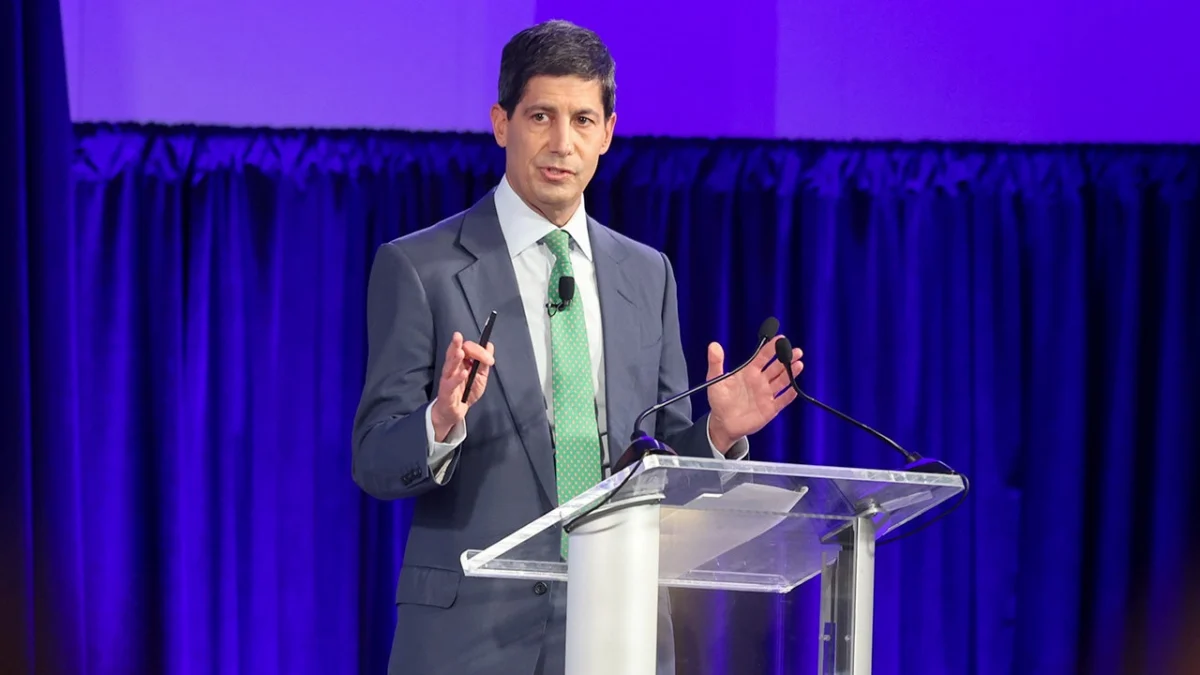
Kevin Warsh, a former Federal Reserve governor and nominee to lead the central bank, is set to undergo a crucial confirmation hearing where senators are expected to scrutinize his views on the Federal Reserve's long-standing 2% inflation target. This focus comes at a time when the U.S. economy has grappled with persistent price pressures in the post-pandemic era. Warsh, who served on the Fed's board from 2006 to 2011, will appear before the Senate Banking Committee as his nomination to succeed current Fed Chair Jerome Powell is considered. Powell's tenure as head of the central bank is scheduled to conclude in May.
In his prepared opening statement, a copy of which was obtained by FOX Business, Warsh outlined his perspective on the Fed's dual mandate, which encompasses both price stability and maximum employment. While he affirmed his support for this mandate, he did not explicitly endorse the Fed's current policy objective of maintaining inflation at 2% over the long term. Instead, he offered a statement that signaled a potential departure from the Fed's established approach.
"First, Congress tasked the Fed with the mission to ensure price stability, without excuse or equivocation, argument or anguish. Inflation is a choice, and the Fed must take responsibility for it," Warsh stated in his remarks. He further elaborated on the critical role of price stability, describing it as the central bank's "plot armor" and its "vital protection against slings and arrows." He warned that when inflation surges, as it has in recent years, significant harm is inflicted upon citizens, particularly those with lower incomes, who experience a decline in purchasing power and a reduced standard of living.
Warsh also highlighted the potential for high inflation to erode public faith in the economic governance system and to raise questions about the true effectiveness of monetary policy independence. His emphasis on price stability and his expressed skepticism regarding an overreliance on a precise 2% inflation target stem from concerns about measurement inaccuracies and the potential for policy missteps. These views were further articulated during a 2023 hearing before the British House of Lords' Economic Affairs Committee.
During that earlier hearing, Warsh described price stability as the "North Star" for economic policy. He argued that without stable prices, achieving full employment and enabling economies to grow at their full potential becomes exceedingly difficult. He noted that volatile prices create an environment where households and businesses struggle to make sound, long-term decisions. "Frankly, we would not know the difference whether inflation was running at 1.7%, 2.0% or 2.3% in the United States or in the United Kingdom because we do not measure it that precisely," Warsh remarked, adding that "Economics is not physics – at least not yet."
This perspective leads Warsh to favor inflation targets expressed as ranges rather than specific point estimates. He cited both the inherent measurement errors in economic data and the imprecise nature of broad price stability as reasons for this preference. He suggested that the pursuit of such precise numerical targets may have contributed to the excessive economic stimulus implemented by many central banks in recent years, which in turn played a role in the subsequent surge in inflation that moved well above target levels.
"I broadly favor ranges. Price stability, in the numerical definition, will change in the times. The structures in the global economy are changing even as we speak. It strikes me that agreeing on some permanent basis to 2.0% is asking for trouble," Warsh stated. His comments suggest a belief that rigid adherence to a fixed numerical target, like 2%, may be ill-suited to the evolving global economic landscape.
Inflation in the United States reached a peak of 9.1% in June 2022. More recently, it has hovered around 3%. Over the past year, inflation has seen upward pressure attributed to factors including tariffs and the impact of energy price shocks, exacerbated by geopolitical events such as the conflict involving Iran. The Fed's favored inflation metric, the Personal Consumption Expenditures (PCE) price index, registered a 2.8% annual increase in February. The March data for this index is anticipated at the end of the upcoming week.
Another widely watched inflation indicator, the Consumer Price Index (CPI), revealed a notable acceleration in inflation. In March, the CPI jumped to 3.3% on an annual basis, a significant increase from the 2.4% reading recorded in February. This uptick in CPI was partly influenced by the impact of global energy market dynamics, which have been affected by ongoing conflicts and geopolitical tensions. The energy shock, particularly related to the situation in Iran, has contributed to these inflationary pressures, impacting the cost of fuel and subsequently broader price levels across the economy.


