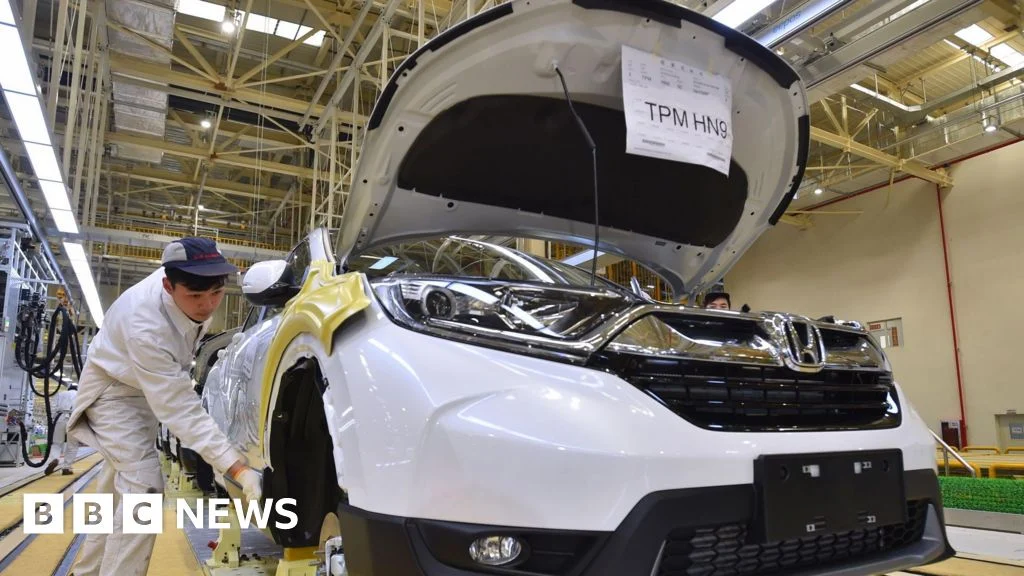
Japanese automotive giant Honda has announced its first annual operating loss in seven decades, primarily due to significant investments in the electric vehicle (EV) sector that have not met expectations. The company reported a total operating loss of ¥423 billion ($2.68 billion) for the fiscal year ending March 2026, a stark reversal for a firm that has historically demonstrated strong profitability.
This financial downturn has prompted Honda to revise its EV production targets and strategic sourcing. The company plans to scale back its ambitious EV manufacturing goals and will increasingly rely on sourcing components from China, a move aimed at reducing costs in a challenging market. The decision reflects a broader reassessment of the pace and scale of the global transition to electric mobility.
Adding to the financial pressures, Honda cited changes in United States policy as a contributing factor to its losses. Specifically, the removal of tax incentives for consumers purchasing EVs and the imposition of tariffs on imported vehicles and auto parts have negatively impacted sales and profitability. These policy shifts have altered the economic calculus for consumers considering an EV purchase.
Previously, U.S. consumers could benefit from tax credits of up to $7,500 for new EV purchases. However, these incentives were reportedly eliminated by President Donald Trump in September 2025. Furthermore, tariffs introduced in 2025 on imported cars and auto parts, even after a reduction from 25% to 15%, have continued to affect major automakers, including Honda.
Honda, which debuted on the stock market in 1957 and has since become Japan's second-largest automaker, faces challenges inherent in its large scale and established infrastructure. Analysts suggest that such legacy automakers struggle to pivot quickly in response to the volatile fluctuations in EV demand and technological advancements.
In light of these challenges, Honda is shifting its strategic focus. The company intends to bolster its highly successful motorcycle division, expand its financial services operations, and concentrate on hybrid vehicle manufacturing. These areas are seen as more stable and profitable in the current market environment.
North America, Japan, and India have been identified as priority markets for Honda's future growth initiatives. However, the company has also put on hold its plans to establish EV and battery production facilities in Canada, signaling a pause in its most aggressive expansionary moves in the EV space.
Chief Executive Toshihiro Mibe confirmed that Honda is abandoning its previous targets for EVs to constitute 20% of new car sales by 2030. Additionally, the company has scrapped its long-term goal of having all its vehicles be fully electric by 2040. These revisions represent a significant departure from its prior electrification strategy.
Honda anticipates further financial headwinds in the upcoming fiscal year ending March 2027, projecting EV-related losses of ¥512 billion. This forecast underscores the ongoing financial commitment and potential for continued losses as the company navigates the complex EV landscape.
Analysts view this development as a significant, albeit not entirely unexpected, event for Honda. Danni Hewson, head of financial analysis at AJ Bell, commented that many established automakers made a substantial bet on a rapid consumer shift to EVs, a gamble that has not paid off as anticipated. The market's response has been slower and more complex than many forecasts predicted.
Hewson further elaborated that a confluence of factors, including political shifts, economic pressures related to the cost of living, and intense competition from Chinese manufacturers, have compelled Honda to reassess and scale back its EV plans. The company is now absorbing the associated costs of these strategic adjustments.
Despite a recent uptick in EV demand, partly attributed to rising gasoline prices influenced by geopolitical events such as the U.S.-Israel conflict with Iran, companies like Honda face considerable difficulty in adapting their vast operations. Hewson noted that such large-scale adjustments are inherently challenging for businesses of Honda's magnitude.
The future of the EV market remains subject to considerable uncertainty, with potential for further unforeseen developments. Hewson suggested that additional


