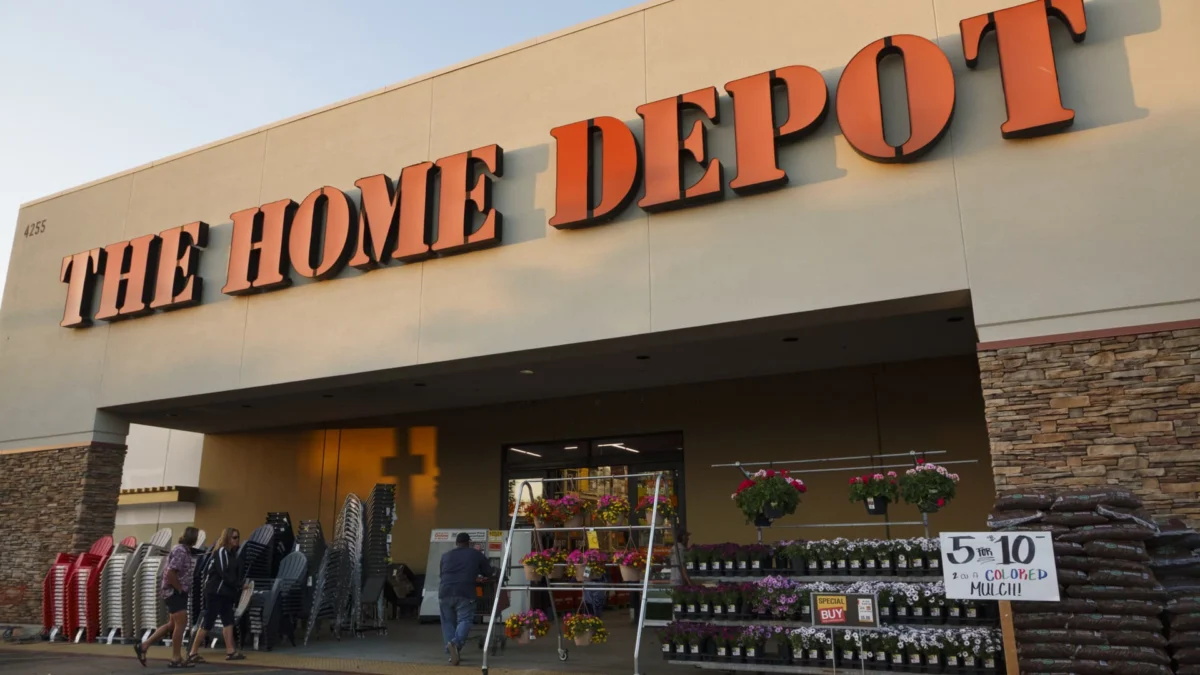
Home Depot, a titan in the home improvement retail sector, announced its first-quarter 2026 financial results, surpassing Wall Street's expectations for both revenue and earnings per share. The company also reaffirmed its full-year financial guidance, signaling confidence in its strategic direction despite a challenging economic landscape. Finance chief Richard McPhail highlighted that the company's core homeowner customer base remains actively engaged, even as consumers grapple with elevated gas prices and a general decline in consumer confidence.
Despite these broader economic pressures, McPhail noted that the financially resilient homeowner segment continues to demonstrate engagement. "The homeowner in a relevant sense is perhaps more protected financially than other customer cohorts and so we continue to see engagement," he stated in an interview with CNBC. However, he cautioned that this engagement has its limits, particularly concerning larger home improvement projects. "They continue to tell us that they are going to defer their spend on larger projects," McPhail explained, adding that this sentiment has been consistent over the past few years.
For the fiscal first quarter ending May 3, Home Depot reported net income of $3.29 billion, translating to $3.30 per share. This compares to $3.43 billion, or $3.45 per share, recorded in the same period a year prior. On an adjusted basis, excluding certain one-time items such as costs linked to intangible assets, the company posted earnings per share of $3.43, exceeding the $3.41 consensus estimate from analysts surveyed by LSEG.
Revenue for the quarter saw a notable increase, reaching $41.77 billion, a nearly 5% rise from the $39.86 billion generated in the first quarter of the previous fiscal year. This top-line growth was bolstered by the company's ongoing strategic initiatives, including significant merger and acquisition activity aimed at expanding its market reach, particularly within the professional contractor segment.
Looking ahead, Home Depot reiterated its fiscal 2026 sales growth forecast, projecting an increase between 2.5% and 4.5%. This range aligns with market expectations, which had hovered around 4%. The company also anticipates adjusted earnings per share to grow by as much as 4%, surpassing the 2.4% growth projected by analysts.
While the company's overall performance exceeded expectations, the report indicated that underlying pressures persisted through the quarter. Comparable sales, a key metric for retail performance, registered a modest increase of 0.6%. This figure fell slightly short of the 0.8% expected by StreetAccount and marked the third consecutive quarter where this metric failed to show significant movement, either positive or negative, beyond 0.5%.
Further details from the report revealed a 1.3% decrease in comparable transactions, marking the fourth consecutive quarter of decline. Additionally, the gross margin came in at 33%, slightly below the 33.2% anticipated by analysts, according to StreetAccount. These figures suggest that while overall sales are growing, the frequency of customer visits and the profitability per sale are facing challenges.
Home Depot and the broader home improvement industry have been navigating a complex environment characterized by reduced housing turnover, economic uncertainty, and a continued deferral of high-value projects. Initial optimism earlier in the year, fueled by a dip in mortgage rates, was tempered by renewed geopolitical tensions, particularly in the Middle East, which led to a resurgence in mortgage rates.
In response to these market dynamics, Home Depot has intensified its focus on attracting and retaining professional customers, such as contractors and roofers, who currently account for approximately 50% of the company's total revenue. This strategic pivot is supported by significant investments in acquisitions designed to bolster its capabilities in serving this crucial demographic.
Notable acquisitions include SRS Distribution, a supplier for roofing, landscaping, and pool professionals, acquired for $18.25 billion in 2024, and GMS, a distributor of specialty building products, acquired the previous year. Most recently, SRS Distribution completed its acquisition of Mingledorff's, a wholesale distributor of HVAC equipment and supplies, further expanding Home Depot's reach within the professional market.
These strategic moves are aimed at capturing a larger share of the substantial pro market, which McPhail estimates to be worth around $700 billion. "All of the things we're doing to build out our pro capabilities — and through the acquisitions we've made over the past several years — is to help us gain more share in the $700 billion pro market," he stated. He added, "We have a right to win that $700 billion, but we just don't quite have the ability to win yet."
The company believes these acquisitions and enhanced pro capabilities will allow it to tap into a total addressable market valued at approximately $100 billion, reinforcing its long-term growth strategy. Despite the current challenges, Home Depot's performance indicates a degree of resilience in its core customer base and a clear strategic focus on expanding its influence within the professional segment of the home improvement market.


