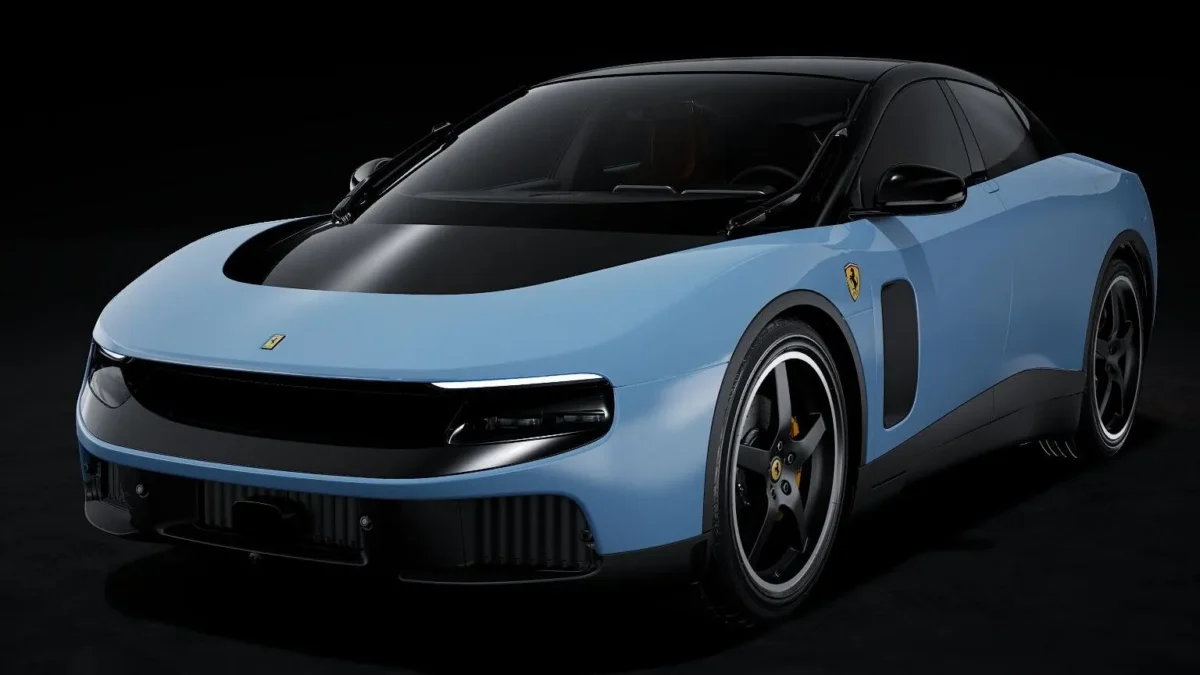
Ferrari’s Electric Debut Meets Criticism
Ferrari, a marque historically defined by its roaring combustion engines and sleek, low-slung supercars, has unveiled its first-ever electric vehicle (EV), the Luce. The launch event was significant, drawing Italian President Sergio Mattarella and Pope Leo, highlighting the importance of this strategic shift for the luxury automaker. However, the Luce, whose name translates to “light” in Italian, has been met with considerable criticism from a range of stakeholders, including internet users, investors, and politicians, raising questions about the brand’s identity and future direction in the evolving automotive landscape.
The market reaction was swift and notable. The day following the Luce’s unveiling, Ferrari’s shares experienced an 8% decline. This stock performance coincided with a wave of online commentary and memes that targeted the $640,000 (£475,625) vehicle, which also marks Ferrari’s entry into the five-seater segment. While the Luce boasts impressive performance metrics, accelerating from 0-60mph in approximately 2.5 seconds and capable of speeds exceeding 190mph, the primary source of contention has been its unconventional design. Former Ferrari chairman Luca Cordero di Montezemolo told reporters on Tuesday that the Luce is “risking the destruction of a legend” and suggested the company should remove its iconic badge from the car. Shaun Baker, an Australia-based high-end car dealer and collector, told the BBC that he refers to the Luce as the “Loser,” asserting that the car has damaged Ferrari’s image. “Ferrari was the aspirational brand to own. But with the Luce, they’ve hurt their image,” Baker said.
Heritage vs. Innovation in Luxury Automotive
The design of the Luce represents a significant departure from Ferrari’s traditional aesthetic. Lacking the signature low-slung profile and the characteristic engine roar of its gasoline-powered predecessors, the electric Luce presents a stark contrast. Italy’s deputy prime minister and transport minister, Matteo Salvini, questioned the innovation behind the vehicle, stating, “I wonder what Enzo Ferrari would say,” referring to the company’s founder. Salvini added that the Luce “looks like anything but a car from the prancing horse.” While some online commentators have praised the design, a vocal segment has condemned it. One user described it as an “abomination,” while another humorously suggested that Enzo Ferrari would “rise from his grave and take control of the company again.”
Comparisons to more affordable EVs, such as the Nissan Leaf and various Chinese electric models, have been drawn by some social media users, a notion Ferrari boss Benedetto Vigna has strongly refuted. AI-generated redesigns of the Luce, offering a sportier appearance, have also circulated online. Baker commented that these rapid creations “were made in 10 seconds and still look better than what Ferrari has come up with,” adding that he has owned more than 50 of the firm’s cars. This criticism echoes sentiments from the launch of the Purosangue, Ferrari’s first SUV in 2022. Despite critics arguing it would dilute the brand’s exclusive supercar image, the Purosangue proved to be a commercial success, enabling Ferrari to enter a new market segment. Critics had said the four-door model would tarnish Ferrari’s image as an exclusive supercar brand, but it sold well, helping the firm move into a new market.
Ferrari is not the only automotive giant to face public scrutiny for embracing electrification. In 2024, Jaguar faced significant debate over its pivot to becoming a high-end EV brand, unveiling a concept vehicle, the Type 00, that bore little resemblance to its previous models. Critics said the car, with its ultra-long bonnet and chunky wheels, was a departure from the E-Type maker’s roots. However, Jaguar’s boss, Rawdon Glover, emphasized the need for bold and disruptive strategies, telling the BBC, “Jaguar needs to be bold and disruptive in order to cut through and get our message across.”
Today, Ferrari finds itself grappling with similar claims that it has lost its identity. Singapore-based car analyst James Wong praised the design of the Luce’s interior but said as a whole the car is “unrecognisable” as a Ferrari. Furthermore, sustainable industry expert Jessica Cheam pointed out that the Luce’s “eye-popping price tag” seems particularly high, given the increasing availability of cheap and luxurious EVs already on the market. However, Vigna has said it is a fair price to pay for innovation and that the car has received strong interest from potential buyers.
Market Dynamics and Chinese Competition in the EV Sector
Ferrari’s foray into the EV market occurs as other major manufacturers re-evaluate their electric strategies. Lamborghini, a direct competitor, has reportedly shelved its EV program due to lukewarm demand and a customer preference for traditional combustion engines. Following the Luce’s launch, Lamborghini boss Stephan Winkelmann said his company’s focus on hybrid cars over all-electric models was “the right way to go.” Winkelmann told business news channel CNBC that “every brand, every company has to decide for themselves.” Other manufacturers, including Porsche, Honda, and Ford, have also scaled back their EV programs.
The global automotive industry is also contending with intense competition from China, a crucial market for luxury brands like Ferrari. Chinese consumers have come to expect competitive pricing, extensive battery ranges, and advanced features. The International Energy Agency notes that China’s extensive EV supply chains contribute to production costs being at least 30% lower than in the rest of the world. Aggressive government subsidies in China have fueled the growth of numerous domestic carmakers, compelling both local and international firms, including Tesla and Volkswagen, to implement significant price reductions in the Chinese market.
Chinese EV manufacturers are increasingly targeting the premium segment to enhance their profit margins, directly challenging high-end models from Porsche and Tesla. Companies traditionally known for SUVs and sedans are now rolling out electric supercars, such as the $250,000 all-electric BYD Yangwang U9, which can accelerate to 60mph in just over 2.3 seconds. This competitive landscape suggests that Ferrari’s Luce might be targeting a different demographic than traditional supercar buyers.
Industry experts like Cheam believe the Luce could appeal to younger consumers who are more open to EVs compared to Ferrari’s established customer base. Wong suggests that the Luce’s unfamiliar appearance might also draw new clientele to the brand. He proposed that Ferrari could have benefited from a “dipstick test” with loyal customers to gauge their reaction to such a radical design shift. “But then again, all this could have been intentional, given the huge media storm that the Luce has attracted,” Wong mused.
The BBC has asked Ferrari for its response to criticism of the Luce. The challenges faced by Ferrari highlight a broader trend in the automotive industry, where established players are navigating the complex transition to electric mobility amidst fierce competition, evolving consumer preferences, and the disruptive influence of Chinese manufacturers. The success of the Luce, and Ferrari’s broader EV strategy, will likely depend on its ability to balance its storied heritage with the demands of a rapidly changing automotive landscape.


