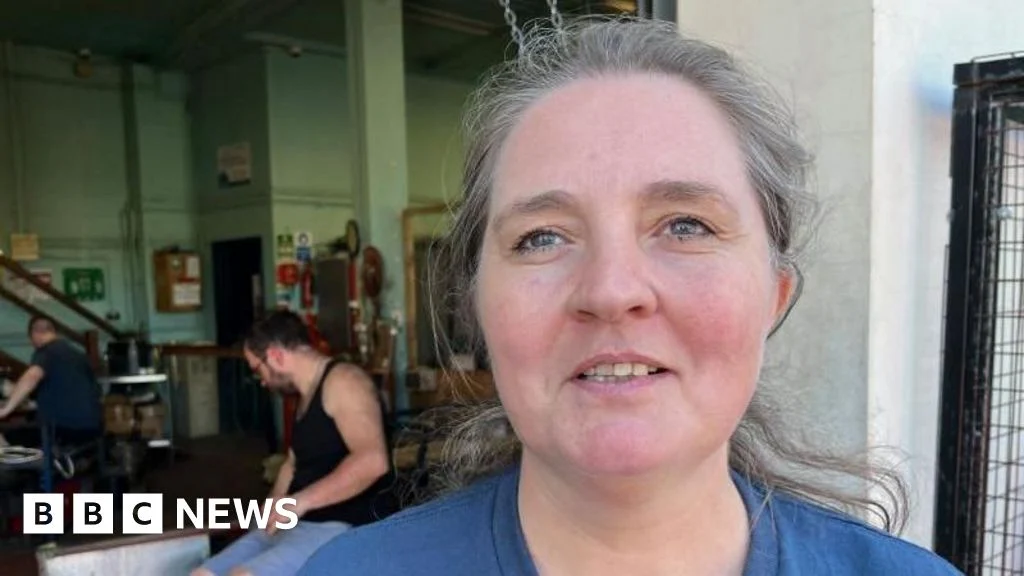
A venerable Bristol-based glassmaker, Bristol Blue Glass, has publicly voiced profound doubts about the feasibility of manufacturing within the United Kingdom. The company, which has been a fixture in the city for nearly four decades, is set to cease operations in May, a decision attributed by its leadership to escalating energy expenses and increased taxation. Suzanne Adlington, the managing director, highlighted that surges in National Insurance contributions and fuel prices have created an unsustainable operating environment for energy-intensive businesses.
Adlington expressed significant frustration when discussing the challenges that have led to the company's closure. Bristol Blue Glass had played a role in reviving a local tradition of glassmaking that dates back to the 18th century, a period when Bristol was a prominent global hub for glass and bottle production. Established in 1988, the company achieved national acclaim, with its distinctive glassware featured in popular culture, including a notable glass pillar within the TARDIS in the television series 'Doctor Who' and goblets used in the initial 'Harry Potter' films.
Concerns regarding the company's future first surfaced in November when its lease was approaching its expiration. Following a period of public support and assistance from Bristol City Council, the lease was extended until the end of May, and a new potential site at the city's Harbourside was identified. However, Adlington indicated that a series of economic shocks in recent years had exacerbated the situation, with global events contributing to sharp increases in fuel prices.
"In the stint of a few months the Iran war happened and then just all bets were off really," Adlington stated, referring to the impact of geopolitical events on market stability. She elaborated that the near doubling of fuel prices had "crucified" the market, making forward planning impossible. "We can't go forward raising money in the hope that everything's going to miraculously improve overnight." She further commented that the Value Added Tax (VAT) applied to businesses like hers "cripples creativity," leading her to question the rationale for conducting business in the UK at present, particularly within the manufacturing sector.
David Barry, the hot shop manager at Bristol Blue Glass, who has dedicated his entire adult working life of 17 years to the company, shared his dismay. Having previously been made redundant from a fishing tackle sales job, he described himself as "absolutely gutted" to be losing his current position, especially after investing so much of himself into the craft. "I've trained my entire adult life to be a glass blower and it's been one of the few things I've been good at and I've gone all over the world training, so it's a real shame to lose it," Barry remarked.
Barry expressed a hope that he might continue to utilize his skills through avenues such as teaching workshops. Nevertheless, he harbors significant doubts about securing another full-time glassmaking position in the UK, citing the industry's declining state. This sentiment is echoed by another heritage firm, Bath Aqua Glass, located approximately 18 miles away, which has implemented cost-cutting measures to ensure its survival. The company relocated its factory from Bath city centre to Corsham after its 18-year lease concluded, reduced its visitor experiences from five per week to two, and decreased its workforce by more than half.
Themis Mikellides, managing director of Bath Aqua Glass, emphasized that fuel costs represent a persistent and significant pressure, noting that the furnace alone incurs a cost of £4 per minute during glass shaping operations. He strongly refuted the notion that his business should be categorized as a luxury, instead describing it as a "national treasure" deeply rooted in centuries of regional history, with origins tracing back to Roman times. Mikellides urged central government to consider measures that could protect and nurture the industry, suggesting a substantial reduction or complete elimination of taxes.
He argued that a reduction in VAT would yield benefits for both businesses and the government, stating, "It's better to get 5% of something than 20% of nothing." In Bristol, Liberal Democrat councillor Andrew Varney observed that the difficulties faced by Bristol Blue Glass are indicative of broader concerns affecting small and medium-sized enterprises (SMEs). Varney, who supported Bristol Blue Glass when their challenges first came to light in November, pointed to economic instability, rising energy prices, and supply chain disruptions stemming from global conflicts as creating a challenging operational climate.
Varney characterized the closure as "cruel," noting that the company's products, being luxury items, are often among the first to be deprioritized by consumers facing cost pressures, who then tend to focus on essential goods. He acknowledged the unique cost structure of businesses like Bristol Blue Glass, which involve significant expenses for raw materials and fuel. "But there must be other businesses that are struggling," he added, expressing apprehension that this closure might be the precursor to many others unless the government provides more substantial support for SMEs.
A government spokesperson responded by stating that measures introduced in the recent Budget were designed to provide support for both households and businesses. "The decisions we made mean we can stabilise the economy and deliver support for families and businesses," the spokesperson said. The government highlighted its "Small Business Plan," which includes a £4 billion boost to access finance for SMEs. Regarding the Energy Profits Levy, described as a 38% windfall tax on extraordinary profits during periods of high oil and gas prices, the spokesperson noted that these profits contribute to supporting households, businesses, and public services, with the levy having already generated approximately £12 billion.
However, Adlington found the government's response to be largely unconvincing. She employed a stark analogy to convey her dissatisfaction: "That's like me saying to you, 'I'm going to get a sledgehammer, I'm going to smash your kneecaps, then I'm going to do your ankles and then I'm going to give you the website address for a portal to log onto that you might actually be able to, after several hours of sweating online, be able to get a wheelchair and maybe some antidepressants to stop the emotional pain and stress that you have to deal with.'" She questioned why the UK imposes the highest tax rates and fuel charges globally, not just within Europe.
Glassblowing activities at Bristol Blue Glass are scheduled to conclude on Friday, with the shop expected to close its doors permanently by the end of May. The company's struggles highlight the broader challenges confronting traditional manufacturing sectors in the UK, particularly those with high energy demands and susceptibility to global economic fluctuations. The situation underscores the delicate balance between maintaining heritage industries and adapting to contemporary economic pressures, with significant implications for employment and regional economies.


