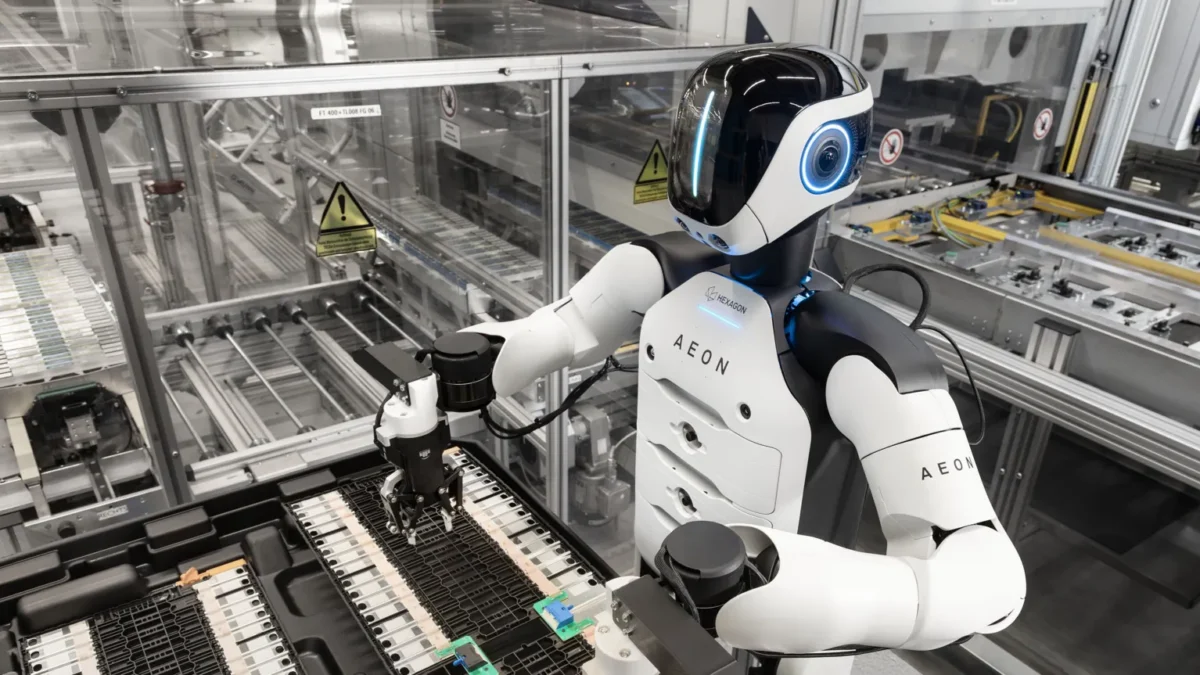
BMW’s Leap into Humanoid Robotics
BMW is set to pioneer the use of humanoid robots in its European car manufacturing operations, marking a significant shift in automotive production. Two advanced robots, developed by Hexagon Robotics, are slated to join the production line at the company’s Leipzig factory starting this summer. This move represents a strategic embrace of automation that mimics human form and capability, a departure from traditional robotic arms and fixed automation systems that have long been a staple in the industry.
Michael Nikolaides, head of process management and digitalisation at BMW, expressed strong conviction about this technological direction, stating, “This will be the future of automotive production.” He elaborated on the rationale behind adopting human-shaped robots, highlighting their inherent adaptability. “If you have a humanoid form, you can pretty much set it to any workplace where a human is working today because it has the same size and the same capabilities,” Nikolaides explained. This flexibility allows robots to integrate seamlessly into existing workflows without the need for costly and time-consuming redesigns of assembly lines.
The economic calculus has also shifted, making humanoid robots a more cost-effective solution. “When a robot costs 17 million, you’d re-organise your factory around the robot, but it doesn’t anymore,” commented Bill Ray, distinguished VP analyst at Gartner. “So now you want to fit it into your existing way of working.” This sentiment underscores a broader trend where technology is being adapted to human environments rather than the other way around.
Meet Aeon: The Humanoid Worker
The Hexagon robot, named Aeon, stands at 1.65 meters (approximately 5 feet 5 inches) tall and weighs 60 kilograms (about 9 stone 6 pounds). Its design is human-like, enabling it to navigate and operate within spaces typically occupied by human workers. Aeon boasts a top speed of 2.4 meters per second and can handle payloads of up to 15 kilograms for short durations, or 8 kilograms continuously. Its sophisticated sensor suite includes 21 components, such as cameras, radar, a microphone, and force and torque sensors, which are crucial for intricate manipulation tasks.
The training regimen for these robots at BMW involves a dual approach: teleoperation and simulation. Teleoperation utilizes sensors on human operators to guide the robot, allowing it to learn the nuances of tasks performed by humans. Simultaneously, a digital twin of the factory, powered by Nvidia software, is used for reinforcement learning. In this simulated environment, the robot repeatedly attempts tasks to identify optimal solutions. This combination of real-world guidance and virtual practice aims to accelerate the robot’s learning curve and enhance its efficiency.
Arnaud Robert, president of robotics at Hexagon, highlighted the significance of imitation learning in this domain. “One of the most exciting aspects of the application of AI to the physical world (physical AI) is imitation learning,” he stated. This method allows robots to learn tasks by observing human actions, either through video analysis or by using movement sensors on human operators. Robert estimates that imitation learning can drastically reduce training times, from months down to mere days, emphasizing that “the best translation [from the human to the robot] is when the teacher and the student have the same form factor.” He envisions a future, perhaps a year or two away, where robots could learn by simply observing tasks, such as packing boxes.
Gartner’s Bill Ray further predicts that within three to five years, humanoid robots will be capable of executing simple voice commands to perform tasks effectively. Addressing the practical challenge of operational duration, Aeon is equipped with a battery life of three hours. To overcome this limitation during an eight-hour shift, the robot is designed to autonomously swap its own battery in approximately three minutes, including the time taken to travel to and from the charging station.
Tasks and Future Implications
At BMW’s Leipzig facility, Aeon’s primary responsibilities will include feeding parts to manufacturing tools and performing pick-and-place operations for battery assembly. While these robots are designed to be multi-functional, they are not expected to frequently change their assigned tasks, much like human factory workers. Nikolaides pointed out that these robots can alleviate the burden of repetitive or physically demanding work for human employees and also help address an anticipated labor shortage.
Drawing a parallel to historical technological shifts, Nikolaides recalled the introduction of automation in car production during the 1970s. “When we automised the production of cars in the ’70s, everybody said this will lead to a lot of job losses, but the opposite was the case,” he said. “There were new jobs created by this new technology, and that’s the way we look at [humanoid robots].” This perspective suggests that while automation may displace certain tasks, it ultimately fosters the creation of new roles and opportunities.
Industry-Wide Adoption and Robot Capabilities
BMW is not alone in exploring advanced robotics. Other major automakers are also investing in similar technologies. Toyota plans to deploy Digit humanoid robots from Agility Robotics, following successful trials. Chinese company Xiaomi has tested its own humanoid robots in electric vehicle production. Hyundai is utilizing Boston Dynamics’ Spot robots for industrial inspections and has plans for their Atlas humanoid robots.
BMW’s prior experience with humanoid robots in its Spartanburg, US, plant, where a Figure O2 robot assisted in building 30,000 Model X3 cars, has provided valuable insights. The Figure O2 robot operated at a pace comparable to human workers. A key observation from this deployment was the superior ability of AI-driven robots to handle variability in production processes. Nikolaides noted, “If you changed the position of the sheet metal a little bit or you shift it, or you tilt it, with a standardised industry robot, you would have a failure. These humanoid robots can analyse that and they will just keep on working.”
A notable difference between the Figure and Aeon robots is their locomotion. While Figure walks, Aeon utilizes wheels. Nikolaides explained the practical advantage of wheels on a factory floor: “It makes more sense on a shop floor [to have wheels] because Aeon can roll around from one place to the other.” BMW has also deployed a Boston Dynamics Spot robot, resembling a dog, for maintenance tasks, demonstrating its capability to navigate challenging environments like basements with extensive machinery.
Nikolaides reported a positive reception from staff regarding the introduction of these robots. He anticipates that employees will likely give them names, a practice common with older, non-humanoid robots. “If it doesn’t have a name, it’s a machine,” observed Gartner’s Ray. “If it gets it wrong, it’s broken. If it has a name, then people expect it to make mistakes. People forgive it. One of the things we say to companies is to give your robots names.” This humanization of robots can foster better integration and acceptance within the workforce.
Aeon features a display area on its head that communicates its status through symbols, such as a line when performing a task and a circle when listening. Robert acknowledged that this visual language is still under development but stressed its importance: “We feel very strongly that Aeon needs to be signalling in a way that’s natural to humans.”
Despite the advancements, Bill Ray cautioned against overestimating the current capabilities of humanoid robots, particularly following high-profile demonstrations. “The primary use case for a humanoid robot today is to walk on stage and artificially inflate your share price,” he remarked. “Robots dancing or whatever: That’s not that difficult to do.” Ray warned of a tendency for the public to project advanced abilities, such as running, climbing, or jumping, onto robots simply because they can walk. “There’s a risk of people overestimating a robot’s capabilities,” he stated. “When you see a humanoid robot walking, you assume it can run, it can climb, it can jump. It can’t do any of those things, but your brain fills in those gaps. We’re having unrealistic expectations when people deploy these robots.”


