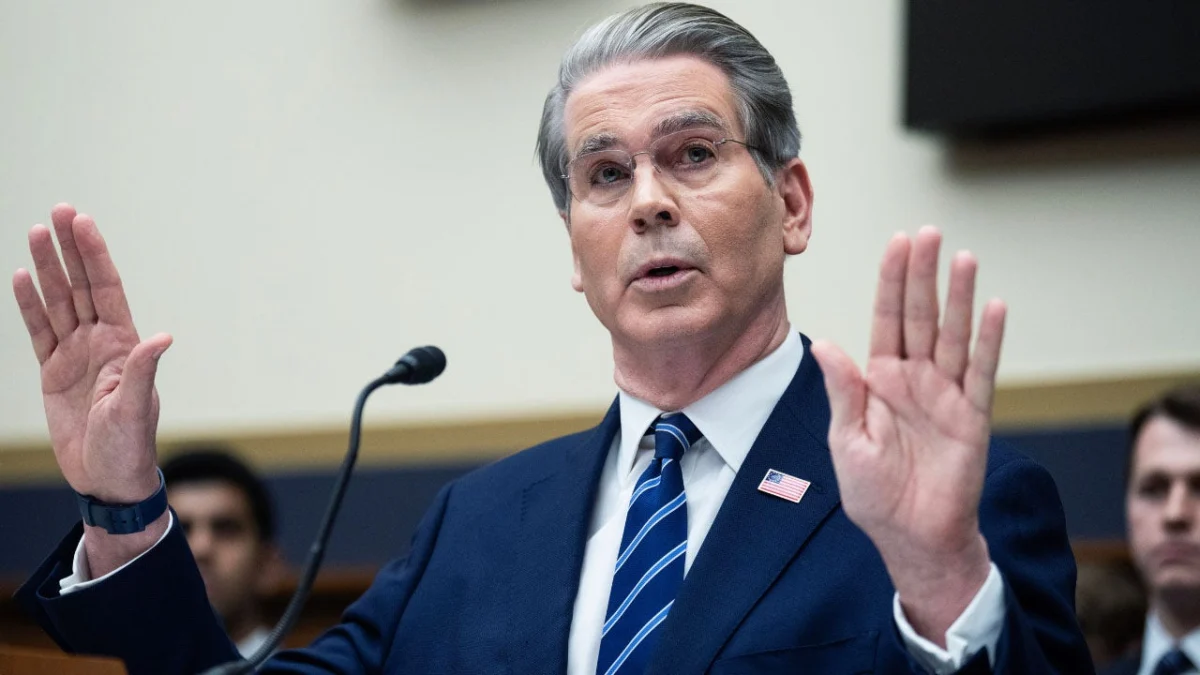
Treasury Secretary Scott Bessent pushed back Wednesday after Sen. Chris Coons, D-Del., suggested temporary sanctions relief for Iran has granted the country $14 billion during the war.
During a fiery exchange at Wednesday's Senate Appropriations Committee subcommittee hearing on the 2027 fiscal budget, Coons levied the charge at Bessent, noting that "estimates are" that Iran has gained $14 billion since the U.S. granted the Islamic Republic temporary oil waivers in March.
Citing President Donald Trump's previous criticisms of former President Barack Obama for giving $1.7 billion to Iran, Coons said, "I don't know how you described 14 billion, but you don't have to read ‘The Art of War’ to know that helping your adversaries gain money while you're at war is a terrible idea, and it's shocking to me that the country's currently profiting from the release of sanctions."
Bessent disputed the characterization as a "myth" and "a DNC talking point."
"If anyone would like to show me where that 14 billion comes from," Bessent added. "I look forward to an exchange of details on that."
"Mr. Secretary," Coons shot back. "Can exchange it in a very public forum."
Bessent continued, "Can exchange it in a very public forum."
Coons then asked Bessent point-blank, "Do you disagree that Iran has received significant additional revenue from their sales of oil because of sanctions relief?"
"Couldn't disagree more," Bessent replied.
"OK. But do you disagree that Russia has received significant additional revenue from the sanctions relief?" Coons asked.
Again, Bessent responded, "I couldn't disagree more."
Bessent proceeded to explain why the Treasury Department elected to provide temporary sanctions relief to Iran and Russia.
"Just as you are concerned about gasoline prices for the American consumer and for our Asian allies, as are we," Bessent said.
"Treasury was able to create more than 250 million barrels on the water. And the way to think about this is as they came in today, the oil prices are at $100. If we had not done that sanctions relief, they might have been at $150 because the world became very well supplied."
"So, if Russia was selling their oil at a 20% discount, I can tell you that 100% of 100 is less than 80% of 150. And the American consumer has been better off."
Treasury issued the relief to Iran through temporary 30-day oil waivers in March, then extended them another 30 days on Wednesday.
Bessent, again pushed by Coons, added that many U.S. allies in the Gulf and in Asia have requested foreign exchange swap lines.
"Swap lines, whether it's from the Federal Reserve or the Treasury, are to maintain order and the dollar funding markets and to prevent the sale of U.S. assets in a disorderly way. So, the swap line would both benefit the UAE [United Arab Emirates] and the U.S. And, as I said, numerous other countries, including some of our Asian allies, have also requested them," he said.
Fox News Digital contacted the Treasury Department and Coons' office for further comment but did not immediately receive a response.
The exchange highlights ongoing debates within the U.S. government regarding the effectiveness and unintended consequences of economic sanctions on international relations and market dynamics.
This discussion also touches upon broader economic concerns, such as the price of gasoline for consumers and the stability of international financial markets. The Treasury's approach, as explained by Bessent, suggests a focus on pragmatic measures to ensure market liquidity and prevent price shocks, even if those measures involve temporary adjustments to sanctions regimes.
The differing perspectives presented by Secretary Bessent and Senator Coons reflect the inherent challenges in balancing national security objectives with economic considerations in a volatile global environment. The effectiveness of sanctions as a foreign policy tool remains a subject of continuous evaluation and debate among policymakers and international observers.
Bessent's defense of the sanctions relief strategy centers on the principle of market stabilization and the prevention of more severe economic outcomes. He argued that the Treasury's intervention, by increasing oil supply, effectively capped potential price increases, thereby benefiting both American consumers and international allies facing energy cost pressures.
The debate also points to the transparency and accountability concerns surrounding financial flows related to sanctioned entities. While Bessent challenged the specific figures presented by Coons, the underlying concern about adversaries potentially benefiting from U.S. policy remains a significant point of contention in foreign policy discussions.
The Treasury's use of swap lines, as described by Bessent, illustrates a proactive approach to managing financial system risks. These agreements are designed to ensure that key trading partners have access to U.S. dollar liquidity, which is vital for global trade and financial stability, particularly during times of economic uncertainty or stress.
This policy debate shows how economic statecraft and national security interests can overlap. The Treasury's actions, according to Bessent, are intended to serve U.S. interests by stabilizing global energy markets and preventing price spikes that could harm consumers and allies. The assertion by Senator Coons, however, points to a persistent concern that such policies might inadvertently provide financial windfalls to adversaries, particularly during periods of geopolitical tension.
The Treasury's justification for the waivers is rooted in the concept of managing global oil supply to prevent extreme price volatility. Bessent's explanation suggests that by ensuring sufficient oil is available on the market, the Treasury can prevent prices from reaching levels that would be detrimental to the U.S. economy and its allies. This approach prioritizes immediate economic stability over the potential for more severe, albeit less certain, financial repercussions for sanctioned nations.
The specific figure of $14 billion, as presented by Senator Coons, remains a point of contention. Bessent's challenge for evidence indicates a desire for a more data-driven discussion on the actual financial impact of the sanctions relief. The "DNC talking point" label suggests that Bessent views the figure as politically motivated rather than factually substantiated.
The effects of sanctions relief, even temporary measures, remain under close scrutiny. While the Treasury aims to mitigate economic shocks, critics often focus on the potential for sanctioned entities to exploit any available economic channels. This tension between pragmatic economic management and the punitive intent of sanctions is a recurring theme in international economic policy.
The discussion around foreign exchange swap lines further illustrates the Treasury's role in maintaining global financial stability. These mechanisms are crucial for ensuring that countries have access to dollar liquidity, which is essential for international trade and financial transactions. Bessent's emphasis on the mutual benefit of these swap lines highlights a strategy of fostering stability that extends to U.S. allies and, by extension, the broader global economy.
The Treasury's actions, as defended by Bessent, represent a calculated effort to balance competing economic and geopolitical objectives. The department's strategy appears to be one of managing immediate market conditions to prevent adverse outcomes for the U.S. and its allies, while simultaneously navigating the political and ethical considerations associated with engaging with sanctioned nations. The debate with Senator Coons encapsulates the challenges inherent in this balancing act.


