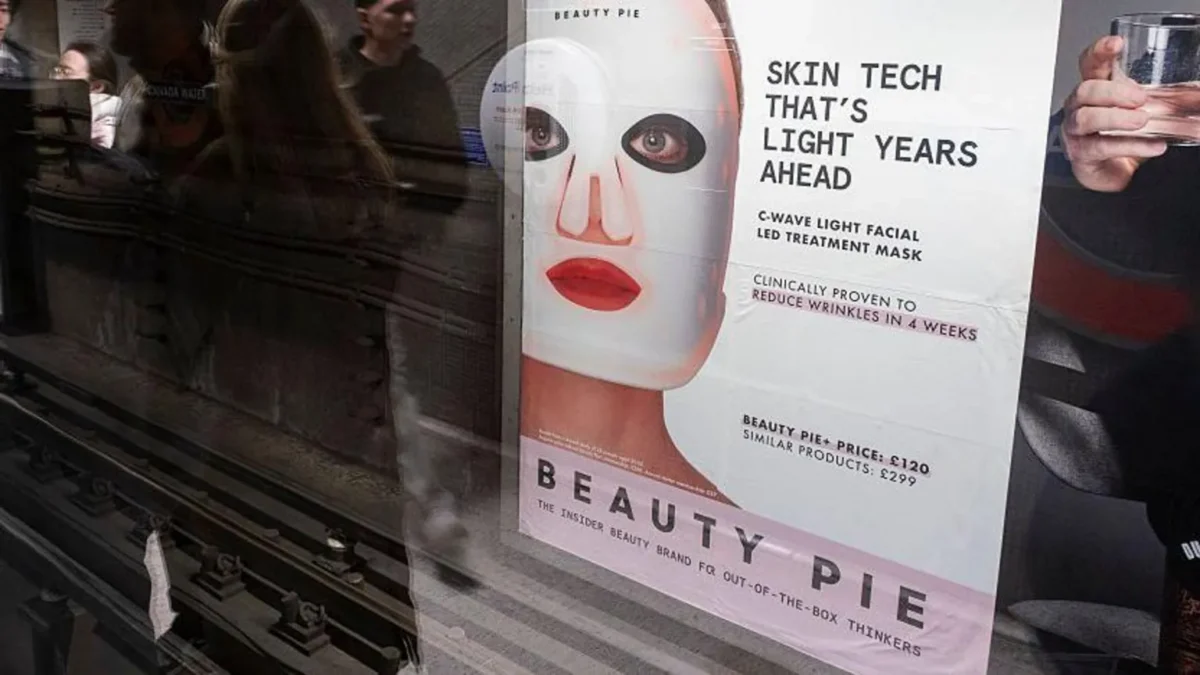
Beauty Pie’s LED face mask advertisement has been banned for making anti-wrinkle claims that the watchdog said lacked adequate evidence. The ad stated the mask was “clinically proven to reduce wrinkles in four weeks,” but the Advertising Standards Authority (ASA) concluded the guarantee was not sufficiently substantiated. Beauty Pie argued the product was tested by 28 people aged 30 to 65 over four weeks, yet the ASA described this sample as “relatively small.”
LED technology is widely used in medical settings to treat conditions such as eczema, acne and psoriasis, and sun damage, though at-home devices have grown in popularity. The global LED market is projected to reach about £600 million by 2032, according to Skyquest analysis. Dermatologists have told the BBC that there have not been large enough or long enough trials to confirm benefits of at-home LED masks.
Beauty Pie markets itself as a direct-to-consumer, membership-based cosmetics firm offering luxury formulas at affordable prices. Its C-Wave Light Facial LED mask is priced at £199 for Beauty Pie members and £299 for non-members, positions the product as cheaper than many rivals. The ASA noted an advertisement seen on the London Underground described the mask as “skin tech that’s light years ahead” and demanded “robust, product-specific evidence” to support such a claim.
In its ruling, the ASA described the trial results as having a “significant limitation,” noting there was no placebo group and the sample size was small. It also highlighted that testers used an exfoliating product and a hydrogel, which are not sold with the mask. The ASA stated that improvements could not be attributed to the mask alone and concluded the ad was misleading unless backed by evidence. Beauty Pie responded that regulator practices vary and that sample sizes of 20 to 25 are often accepted elsewhere. The ASA also found that other studies Beauty Pie cited were insufficient to prove the claim that the mask was clinically proven to reduce wrinkles in four weeks. BBC News has requested comment from Beauty Pie.
The ruling underscores ongoing scrutiny over marketing of at-home LED devices and the pace of evidence gathering in beauty tech. Health professionals caution that more rigorous, large-scale trials are needed to determine the true effectiveness of such products.


