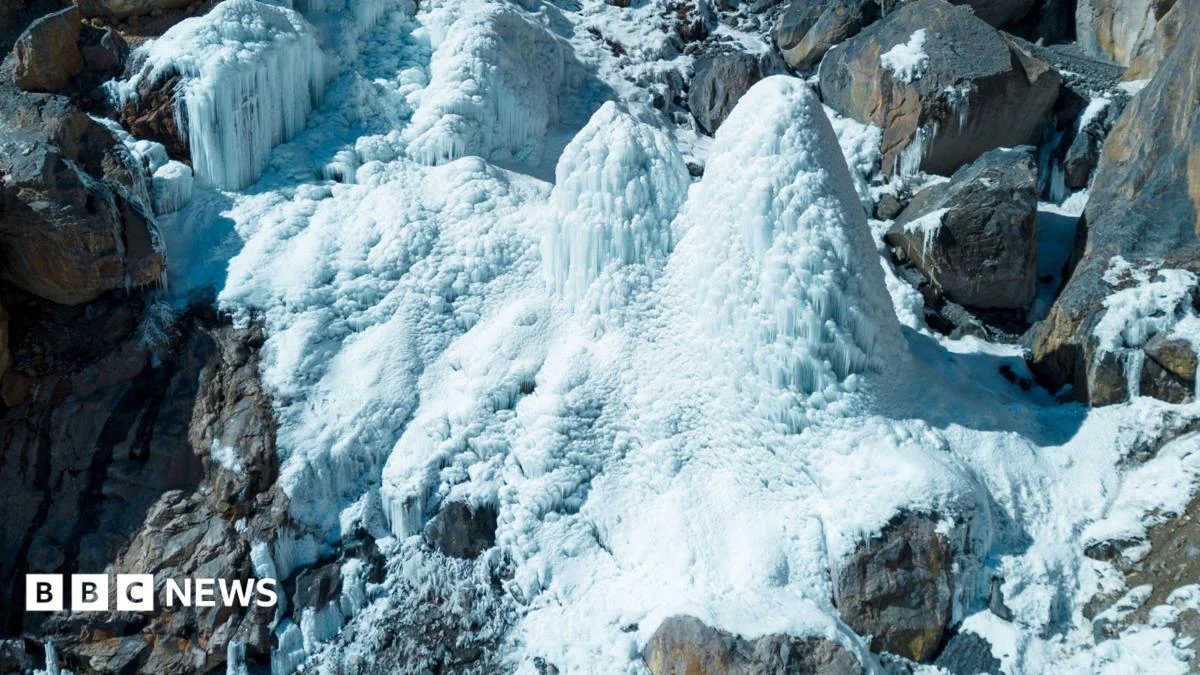
At an altitude of almost 4,000m (13,000ft) and with scant rainfall, the Himalayan village of Sakti embodies the harsh climate facing Ladakh’s farmers. The region’s summer is brief, and the window to plant crops like wheat, peas and potatoes closes quickly as winter returns. As one farmer, Gelak Gutme, notes, Ladakh has a brutal, single-cultivation season, and a desert-like climate makes life precarious for those who rely on fragile water sources. In recent years, warming temperatures have driven the loss of smaller, low-altitude glaciers that historically fed crops in early spring, intensifying water scarcity across the high-altitude valleys.
To secure a vital spring water supply, Ladakh’s villages began experimenting in the early 2010s with ice reservoirs, or ice stupas. The idea was to pipe water from higher elevations during winter and spray it into the air so that it would freeze and accumulate into towering structures of ice. These natural-like towers could release meltwater as spring arrived, helping farmers get water when the growing season finally began. Yet the method carried notable risks: if temperatures plummeted below minus 20C, sometimes minus 30C, water in the pipes could freeze, crack the pipes, and wreck the entire system. Farmers would then endure freezing nights in the mountains to monitor and repair blockages, a painstaking ritual to keep the glacier-like ice supply functioning.
Leh, the capital of Ladakh, sits in Indian-administered Kashmir, a region contested with neighbors to the north and west. The ice-stupa approach, while innovative, was far from perfect: continuous water flow could melt earlier ice, undermining the stored supply. The pressure to deliver water in the spring remained acute for communities, and the attempt to create a more reliable source became urgent as climate pressures intensified. A turning point arrived with a tech upgrade led by a private partner, Acres of Ice, and local authorities. The Automated Ice Reservoir, or AIR, adds precision to ice production. Water is channeled down from higher elevations and released into the valley floor through a vertical nozzle, a process described as a massive fountain. A solar-powered control box, connected to a weather station, governs the operation by monitoring air and water temperatures and other environmental conditions.
The AIR system does not spray water indiscriminately. It uses bursts of mist to coat existing ice, then pauses, allowing the coating to freeze before the next spray. According to Dr. Suryanarayanan Balasubramanian, founder of Acres of Ice, AIR converts nearly all diverted water into ice. The entire system runs automatically over a wireless network, with a manual override available if needed. This automation addresses the core vulnerability of the previous approach: delayed freezing, cracking pipes, and the inefficiency of continuous spraying under fluctuating winter conditions.
The impact has begun to show in the villages. Local officials and villagers report groundwater recharge and revived spring sources, with water arriving in time for planting and irrigation. A scientific study is planned to quantify the AIR system’s effects more precisely, but early testimonies suggest improved reliability of water supply for farming. In 2025, the project ecosystem expanded with ten AIR installations across Ladakh, a sign of the program’s scalability and the potential for broader adoption.
Sakti’s farmers remain hopeful. Gutme, who has farmed the land for decades, says that the single AIR installation has delivered a more dependable water source, and he envisions adding two more artificial glaciers to secure future harvests. The narrative from Ladakh points to a broader lesson: in a region where climate risks are intensifying, community-driven, technology-enabled water management can ease scarcity and sustain livelihoods while possibly attracting investment and attention to the region’s innovative hydraulic engineering efforts.


